Nuance Labs is a Seattle research lab that builds AI you talk to face to face, on a video call. Its model, Nuplex, listens, watches, thinks, speaks and moves its face at the same time, the way people do in a conversation. The first persona built on it is Emma, launched on 9th November 2026, and developers can build their own through the Nuplex Beta API.

What it does
Most AI avatars are a pipeline: speech-to-text, then a language model, then text-to-speech, then a face animated over the audio. Each step waits for the one before, and the avatar takes turns like a walkie-talkie.
Nuance builds 1 model instead. Nuplex stands for Nuance Full-duplex: it takes in your voice, your face, your tone and your timing as a live stream, and streams back voice and face in the same moment. That lets it do what pipelines can't:
- Active listening: nods, "mm-hm", small reactions while you speak.
- Turn-taking from visual cues: it uses gaze, not only silence, to know when you've finished.
- Interruptions both ways. It can be cut off, and it can jump in.
- Seeing you: with your camera on, it can talk about what it sees.
The pitch is a "human foundation model". Language models learnt language by predicting the next word. Nuance trains the same kind of transformer to predict the next audio and video token, so it learns behaviour, not only words.
Emma
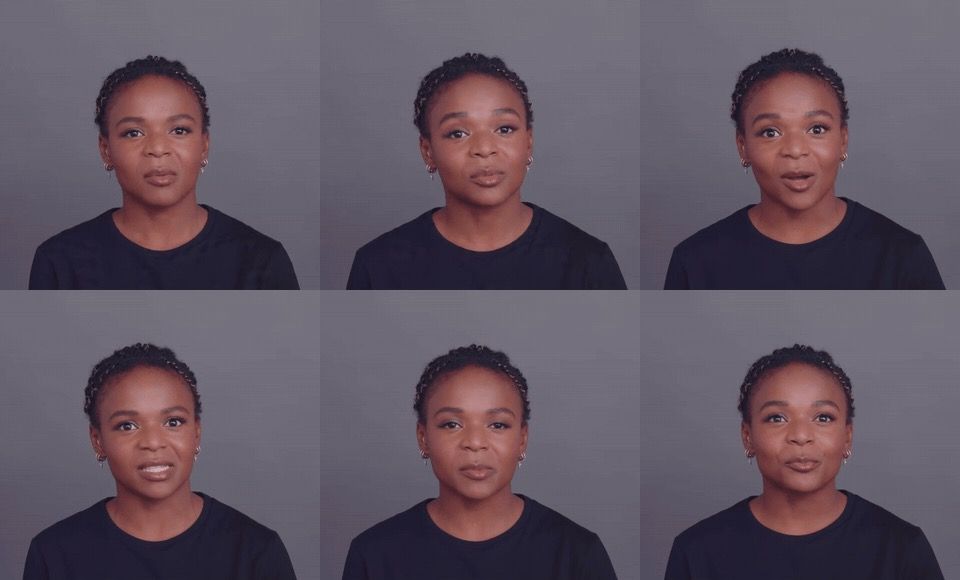
Emma took 18 months of research. Her face and voice are licensed from a real actress, who recorded how she actually listens and reacts. Nuance's argument: AI-generated faces show a prototypical, cartoon version of each emotion, and an average of many people looks like no one. A single real person gives a consistent character.
Her personality is designed too. She's curious, quick, has opinions and will disagree with you, and she always says she's an AI. Most assistants agree with whatever you say. Emma is built not to.
Try her at emma.nuancelabs.ai, no account needed.
Reply timing
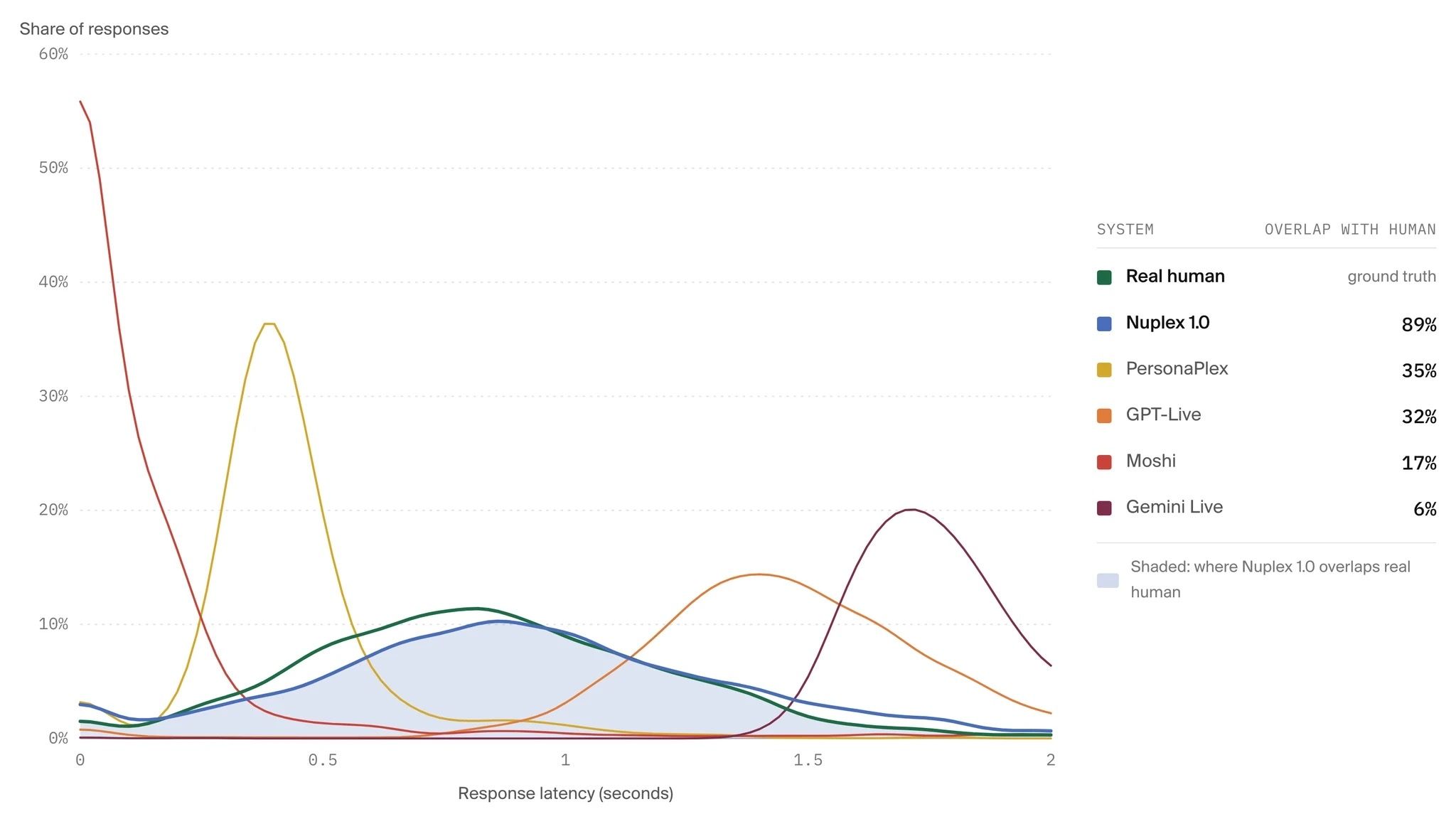
Nuance doesn't claim the fastest replies. It measures when a reply starts compared with when a real person answered the same question. On 1,785 questions from its own recordings of real conversations, Nuplex's timing overlaps the human's 89% of the time:
| System | Overlap with human timing |
|---|---|
| Nuplex 1.0 | 89% |
| PersonaPlex | 35% |
| GPT-Live | 32% |
| Moshi | 17% |
| Gemini Live | 6% |
PersonaPlex is NVIDIA's open full-duplex speech model, see PersonaPlex
It's their benchmark on their data, and Nuance says itself that benchmarks for face-to-face AI don't match the experience yet. On the chart, Moshi and PersonaPlex answer before people do, GPT-Live and Gemini Live after.
The Nuplex Beta API
The API at platform.nuancelabs.ai (sign-in with GitHub or Google) gives developers a few stock personas:
- Brief a persona with your own prompt.
- Follow the conversation live.
- Let the persona hand longer tasks to your own tools in the background while it keeps talking.
The beta limits, by design:
- No cloning. You can't upload a face or a voice. Custom faces exist only by arrangement, with the person's explicit consent, for 1 organisation.
- Always an AI. Personas never claim to be human or to be a real company, and API video carries a visible watermark.
- Closed areas: healthcare, anything for under-18s (education included), sexual content and AI companions.
- 1 language model. Nuplex works with any LLM, but in the beta Nuance serves its own. Your tools can call any model.
- English only. Adults only.
- Regions: the EU, the UK, the US (except Colorado, Connecticut, Illinois and Texas) and Canada (except Quebec).
Automated checks screen every prompt and end a call on violence, hate speech, sexual content, or a persona asking for money, card details or remote access.
Pricing isn't public. It sits behind the platform sign-in.
Known weaknesses
Nuance lists them itself: confident reasoning mistakes from the LLM, jumping in too early or too late (long pauses mid-sentence are the hardest case), poor turn-taking with background noise, early-stage visual understanding, and glitches in lip sync, gaze and expression on a bad connection.
The Emma controversy
Emma went viral on TikTok in November 2026, and drew criticism. Ebony, Black Enterprise and others called Emma "digital blackface": a Black woman persona designed and owned by a tech company. Nuance's answer is the licensed likeness of a real actress who worked with the team. The debate is about who controls a likeness and who profits from it, more than about the technology.
Team and funding
Founded in spring 2025 by 3 former Apple researchers:
- Fangchang Ma, CEO: PhD in robotics and machine learning from MIT, previously an engineering manager at Apple.
- Edward Zhang, CTO: PhD in computer graphics from the University of Washington, previously a senior research scientist at Apple.
- Karren Yang, Chief Scientist: PhD in audiovisual synthesis from MIT, previously a senior research scientist at Apple.
The wider team includes PhDs from Oxford, CMU and Johns Hopkins, and people from Meta and Amazon AGI. 27 people in September 2026.
| Round | Date | Amount | New investors |
|---|---|---|---|
| Seed | September 2025 | $10M | Lightspeed, Accel, South Park Commons |
| Series A | September 2026 | $50M | NVIDIA, Define Ventures |
Total raised: $60M. Lightspeed led the Series A, with Accel and South Park Commons back in, and NVIDIA and Define Ventures new.
Target uses: sales, customer service, coaching and, later, education.
No named customers yet (26th November 2026). The NVIDIA logo on the Nuance homepage sits with Lightspeed, Accel and South Park Commons: NVIDIA is an investor, not a client. The Series A release, the GeekWire coverage and the Emma launch name no customer, pilot or partner. Enterprises can order custom personas by arrangement, but none is public.

Where it fits
The direct competitors are the real-time video agents: Tavus, LemonSlice and Keyframe Labs. Nuance compares Emma's expressions against all 3 in its launch post. More of them in my list of video agents, see Video Agents
The research on why face-to-face AI works: see Research: Conversational Interfaces and AI Video Agents (Digital Humans)
How Nuance describes its difference:
- 1 model, not a pipeline, where others animate a face over a voice pipeline.
- 1 crafted character per persona, not a face generated from 1 photo.
- No self-serve cloning: custom faces only by arrangement, with consent.
Further reading