
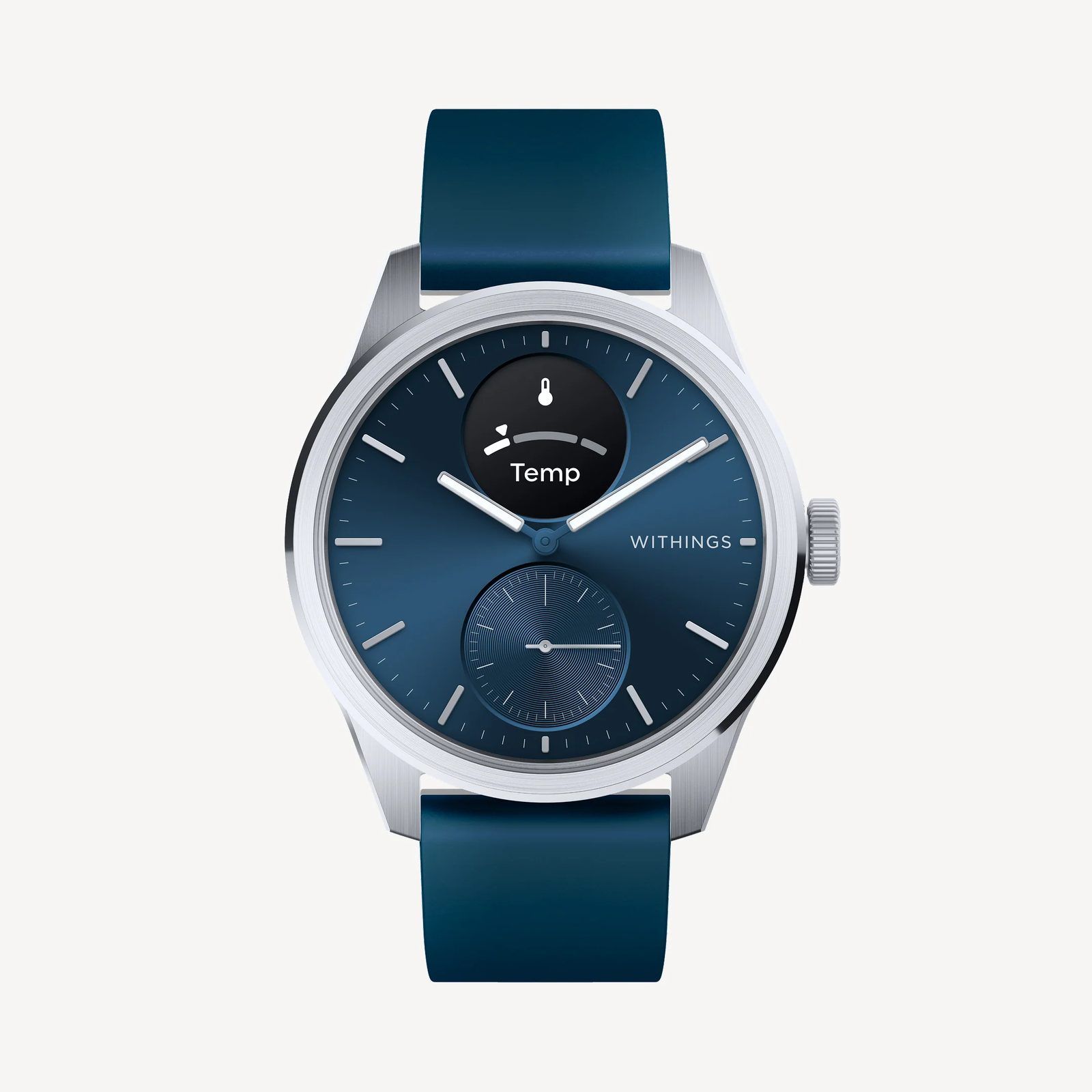
The Withings ScanWatch 2 is a hybrid smartwatch: an analogue watch with real steel hands, a sapphire crystal and a small monochrome PMOLED window punched into the dial. No touchscreen, no app store, no daily charging. It tracks heart rhythm, blood oxygen, skin temperature, sleep and activity, records a medical-grade ECG, and runs about a month between charges. I bought the 42mm blue on the steel case to replace my Apple Watch SE 3.
Overview
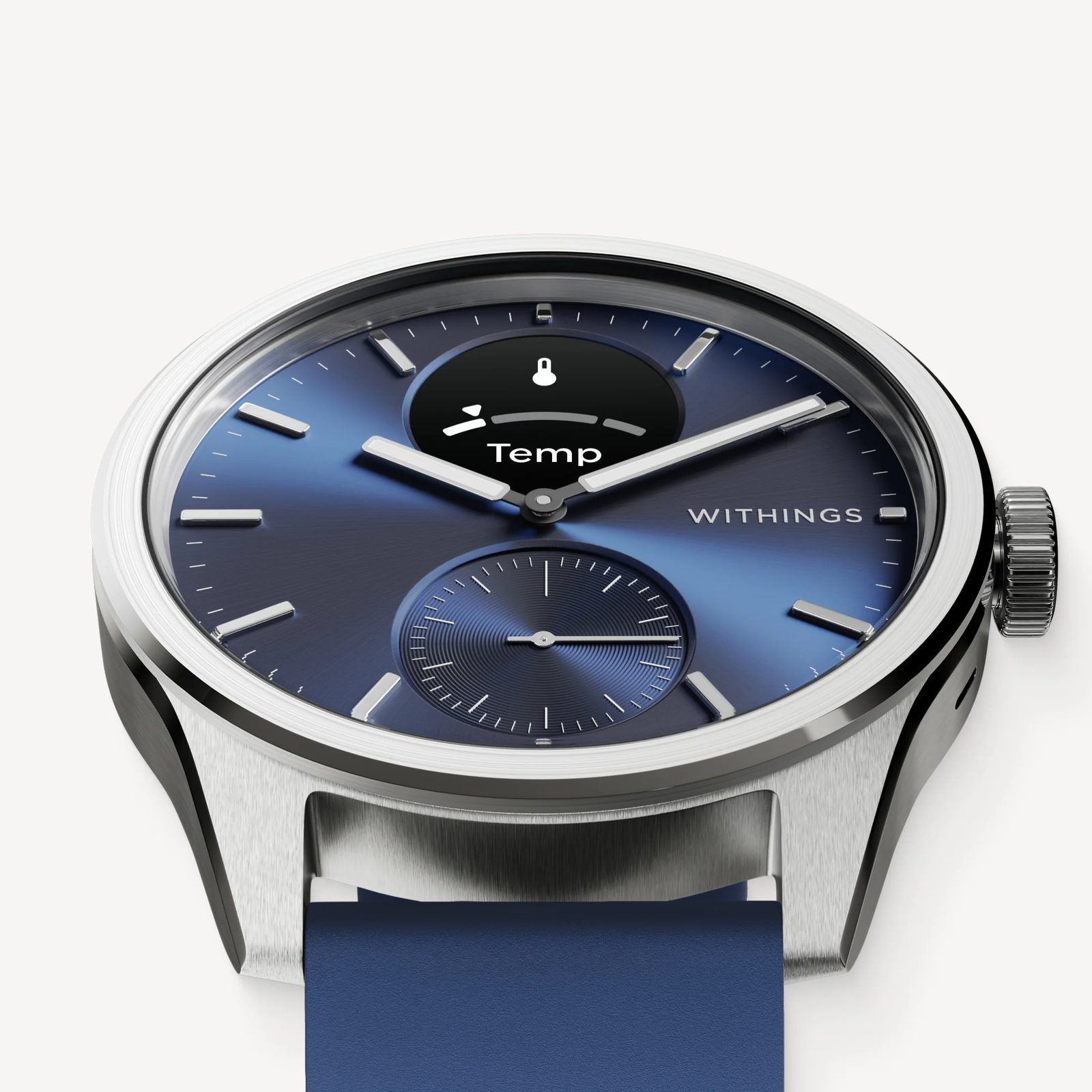
€349.95 for a stainless steel case, sapphire glass and 5 ATM water resistance puts this in mechanical-watch territory on materials alone. What you pay the premium for is the sensor stack hidden behind a watch that reads as a watch: hands, indices, a small seconds subdial, brushed and polished steel contrasts. The PMOLED window sits at 12 o'clock and stays dark until you turn the crown.
The trade is explicit. You give up a bright touchscreen, an app ecosystem, onboard GPS and rich notifications. You get 30 days of battery, a device you never think about charging, and something you can wear with a suit without it looking like a fitness tracker.
Detailed Specifications
| Spec | Detail |
|---|---|
| Price | €349.95 (EU, direct) |
| Case | 42mm stainless steel, brushed and polished; also sold in 38mm |
| Glass | Sapphire crystal, domed |
| Dial | Blue sunburst, hybrid, with embedded PMOLED window and small seconds subdial |
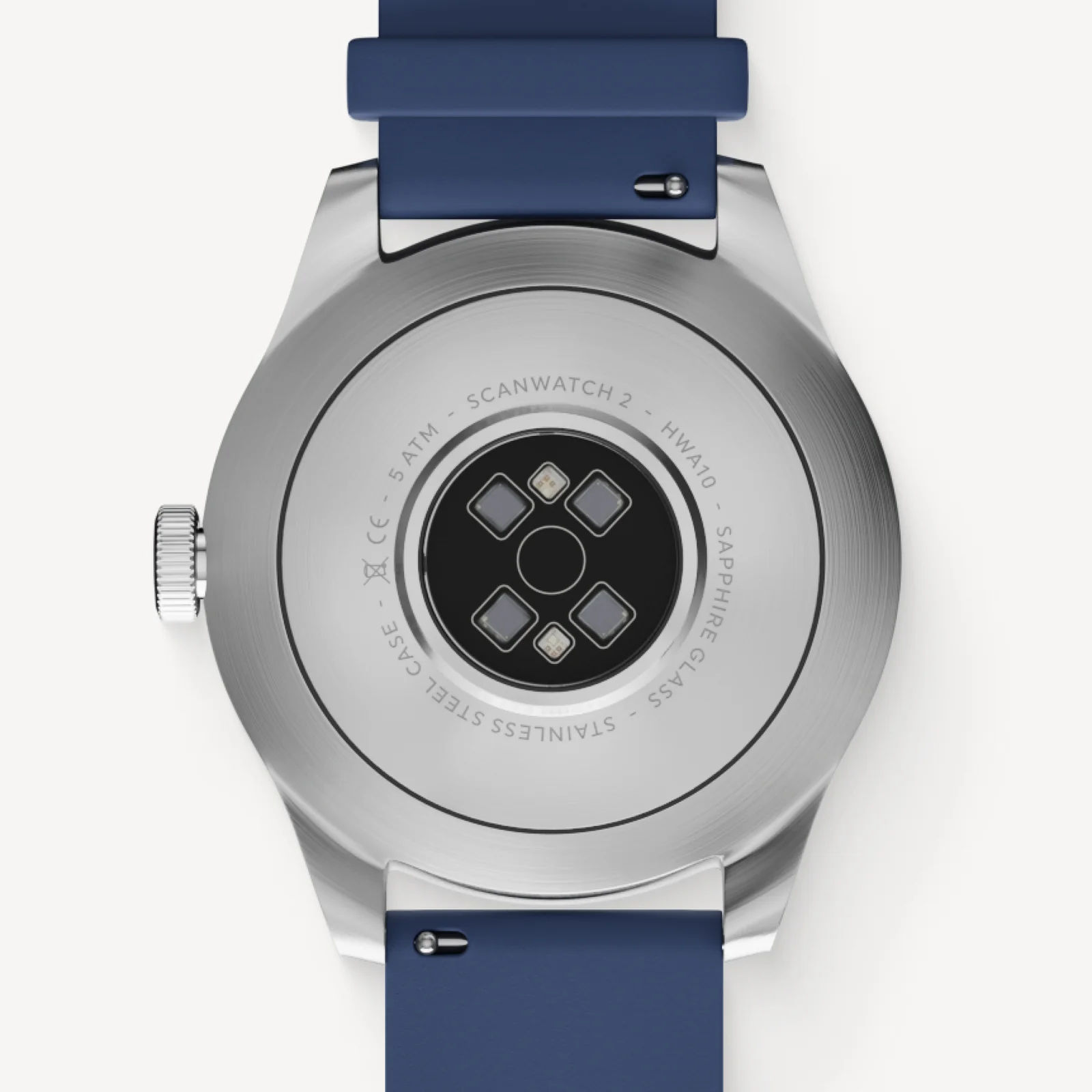
| Model code | HWA10 (engraved on the caseback) |
| Water resistance | 5 ATM (50m) |
| Strap | Fluoroelastomer (FKM) included, 20mm lug width |
| Battery | Up to 35 days claimed, around 26 to 30 days in reviewer testing |
| Sensors | ECG (Class IIa medical device), SpO2, multi-wavelength PPG, skin temperature, accelerometer |
| Metrics | Heart rate, HRV overnight, blood oxygen on demand, 24/7 temperature variation, sleep cycles and score, respiratory rhythm, 40+ workout modes, cycle tracking, readiness |
| GPS | None onboard, uses the phone's GPS |
| App | Withings HealthMate, iOS and Android; syncs to Apple Health |
| Subscription | Withings+ optional (first month free, roughly €100/year) for cardiologist ECG review and Readiness |
| Variants | 38mm and 42mm, black / blue / white |
| Warranty | 2 years |
The 20mm lug width matters more than it sounds. It is a standard size, so the watch takes any strap I already own rather than locking me into a proprietary connector. Withings sells 13 alternatives from €35.95 to €109.95 in leather, steel link and sport rubber, but the open standard is the point.
What it measures
The caseback carries a four-photodiode sensor array with two LED clusters, plus the electrode ring used for the ECG. You place a finger on the bezel to close the circuit and get a 30-second lead-I recording, cleared as a Class IIa medical device in the EU, screening for atrial fibrillation.
Temperature is the addition over the original ScanWatch: a continuous variation signal rather than an absolute body temperature, useful for spotting the overnight rise that precedes illness. Sleep tracking splits light and deep phases, and the readiness score blends HRV, resting heart rate and sleep debt into a single morning number.
Two honest caveats. SpO2 is on demand, not continuous overnight, so it will not catch apnea patterns the way a dedicated device does. And every number here is a trend instrument, not a diagnosis.
Replacing the Apple Watch SE 3
This is the swap I actually made, so the comparison is the useful part of this note.
| ScanWatch 2 | Apple Watch SE 3 | |
|---|---|---|
| Battery | ~30 days | 18 hours (32h low power) |
| Display | Analogue hands + small PMOLED | Always-On 368x448 LTPO OLED |
| ECG | Yes, Class IIa | No |
| Blood oxygen | Yes, on demand | No |
| Skin temperature | Yes, 24/7 | Yes |
| Onboard GPS | No, uses phone | Yes |
| Apps and notifications | Minimal, text only | Full watchOS |
| Case / glass | Steel / sapphire | Aluminium / Ion-X |
| Water resistance | 5 ATM | 5 ATM (50m) |
| Price | €349.95 | from ~€269 |
The surprise is that the cheaper Apple watch is the one missing the medical sensors. Apple reserves ECG and SpO2 for the Series and Ultra lines, so moving from an SE 3 to the ScanWatch 2 is a straight gain on health hardware, not a compromise. What I give up is the wrist computer: no onboard GPS, no Apple Pay, no proper notification triage, no third-party apps.
Nightly charging was the real reason to switch. A watch that dies every evening cannot track sleep without a charging ritual built around it, and the SE 3's 18 hours means exactly that.
Pros & Cons
Pros
- Materials you would expect at this price: steel case, sapphire crystal, 5 ATM.
- 30 days per charge removes the charging habit entirely, which is what makes overnight tracking realistic.
- Class IIa ECG and SpO2, neither of which the Apple Watch SE 3 has.
- Standard 20mm lugs, so any strap fits.
- Looks like a watch. Nobody reads it as a fitness tracker.
- Works with both iOS and Android, and pushes cleanly into Apple Health.
Cons
- No onboard GPS. Runs need the phone in a pocket to map properly.
- The PMOLED window is small and monochrome. Notifications are a name and a truncated line, not a usable inbox.
- SpO2 is spot-check only, not continuous overnight.
- The best analysis (cardiologist ECG review, Readiness) sits behind Withings+.
- No payments, no music control worth using, no third-party apps.
- Setting the hands back after a battery change or reset takes a calibration step.
Who It's For
Someone who wants a watch first and a health tracker second. It fits if you already carry a phone everywhere (so onboard GPS is redundant), if you care about sleep and cardiac trends more than split times, and if a charging cable every night is the thing that made you stop wearing your last smartwatch. The 42mm wears smaller than the number suggests thanks to short lugs and a thin case.
It is the wrong watch if you run or cycle without a phone, if you want Apple Pay and notifications on the wrist, or if you want a bright screen to interact with. Buy a Garmin Forerunner or stay on Apple for those.
Buying Considerations
- Where to buy (EU): direct from the Withings store, or Amazon.de and MediaMarkt for local returns. Two-year warranty either way.
- Size: 42mm for most male wrists, 38mm if you prefer something dressier. The 42 is the one with the fuller dial layout.
- Skip the subscription at first. The core tracking, ECG recording and sleep analysis all work without Withings+. Try the free month, then decide whether the cardiologist review is worth roughly €100 a year.
- Alternatives: the Withings ScanWatch Light if you do not need ECG or SpO2, the original ScanWatch second-hand, or a Garmin Vivomove for a similar hybrid concept with onboard GPS.
Verdict / My Take
The ScanWatch 2 is the right shape of compromise for me. I was not using the Apple Watch SE 3 as a computer, only as a sensor with a screen attached, and paying for that screen with a nightly charge and an aluminium case that scratched. Swapping to steel and sapphire, adding ECG and SpO2 that the SE 3 never had, and dropping from daily charging to monthly is a clear net gain in my case.
It is not a smartwatch replacement in the general sense. If you live off wrist notifications and pay for coffee with your watch, this will feel like a downgrade. The pitch here is narrower and, I think, more honest: a proper watch that quietly collects medical-grade data and stays out of the way. See also Withings Body Scan 2 for the scale that feeds the same app.
Further Reading / Sources


User Manual
Transcribed from the printed Product Guide shipped in the box, so I can throw the booklet away. Covers all HWA10 variants, including ScanWatch NOVA.
Getting started
Box content:
- ScanWatch 2
- Charger and cable
- Quick Start Guide
- Product Guide
To recharge the battery, use the provided power cord.
The watch is used with a software accessory, the ScanWatch 2 companion app, which is part of the Withings App. It installs the watch, activates its medical features and displays the results of performed measurements.
Set-up
- Follow the Quick Start Guide and the Withings App to set up the device.
- To wake the device for the first time, press the crown. If it does not start, charge it for at least two hours and try again.
- Once installed and configured, it appears in the devices list in settings.
- Some measurements need tutorials in the app before they work. ECG and Irregular Heart Rhythm Notification both require onboarding tutorials.
Irregular Heart Rhythm Notification
Activate it through the onboarding tutorial in the Withings App. Once active, the watch runs an irregular heartbeat scan every 10 minutes in the background, with no input from you, looking for patterns suggestive of atrial fibrillation. When one is detected you are notified on the watch and on the phone, and the watch suggests taking an ECG recording. The text "Signs of AFib" scrolls across the watch screen.
How to take an ECG recording
- Wear the watch snug on the wrist you selected during the tutorial. To check which one: Withings App > Devices > All settings > ECG.
- Rest your arms on a table and hold the top electrode (the bezel) with your other hand, thumb and index finger for example. You do not need to press the bezel during the session.
- Follow the gesture shown in the "best practice" article in the app to get good signal quality.
- Recording starts after the first vibration.
- Recording lasts 30 seconds.
- The second vibration confirms the end of the measurement.
ECG outputs
After a recording, one of these classifications appears on the watch screen and in the Withings App, along with your average heart rate and the ECG tracing.
| Result | Heart rate | Meaning |
|---|---|---|
| Sinus Rhythm | 50-99 bpm | Beating regularly, the normal result |
| Low Heart Rate | Below 50 bpm | Beating slowly, cannot be classified by the device |
| High Heart Rate | Above 150 bpm | Too fast to be classified by the device |
| High Heart Rate (No signs of AFib) | 100-150 bpm | Fast, no signs of atrial fibrillation |
| Atrial Fibrillation | 50-99 bpm | Beating irregularly |
| Atrial Fibrillation - High HR | 100-150 bpm | Fast and irregular |
| Inconclusive | Any | Good signal, but not classifiable as sinus rhythm or AFib |
| Poor Recording | Any | Recording quality too low to classify |
A low heart rate can happen if electrical signals are not properly conducted through the heart. Some medicines cause it too. A high heart rate can come from exercise, stress, dehydration, infection, an arrhythmia, AFib or another cause. If you have not been diagnosed with AFib before and get an Atrial Fibrillation result, talk to your doctor.
An Inconclusive result means the recording quality is good but the signal fits neither sinus rhythm nor AFib. It may be caused by other arrhythmias or heart conditions.
A Poor Recording comes from excessive movement, proximity to a device generating strong electromagnetic fields, or not following the recommended gesture. A small percentage of people have physiological conditions that prevent them from creating enough signal for a quality recording. You can re-record from Take a Recording in the ECG section of the app. If you think you may be having a heart attack or facing a medical emergency, call the emergency services.
The classification is for information only. It supplements traditional methods of diagnosis, it does not replace them.
Sharing ECG results
All ECGs sync to the Withings App on iOS or Android. Once the ECG feature is activated, results can be shared with a physician as a PDF generated by the app, containing:
- The ECG strip for lead I
- The average heart rate
- The classification according to the detection algorithm
Troubleshooting ECG measurements
I cannot get the watch to take an ECG reading
- Make sure your wrist and the watch are clean and dry. Water and sweat cause poor recordings.
- Keep the watch, arms and hands still during the recording.
- Check that you completed every onboarding step in the Withings App.
The recording shows artifacts, noise or interference
- Rest your arms on a table, relax and do not move.
- Tighten the band so the back of the watch touches the skin. Moving the watch slightly should move the skin with it.
- Move away from anything plugged into an outlet to avoid electrical interference.
The ECG waveforms appear upside down
- The device orientation is set to the wrong wrist. In the app, tap Devices > More Settings > Device Orientation.
For anything else, see withings.com/support.
Technical specifications
| Spec | Detail |
|---|---|
| Product name | Withings ScanWatch 2 |
| Model | HWA10 |
| PPG sensor | Red 660nm, infrared 850nm and 940nm, green 530nm |
| Accelerometer | Sensitivity +/- 4g |
| Battery | Up to 30 days on a single charge |
| Power source | 3.87 Vdc lithium-ion, dock and USB-C cable included, 5 V DC adapter 3 W to 5 W (not included) |
| HR range (ECG) | 30 bpm to 220 bpm |
| HR accuracy | Bias -0.97 bpm, standard deviation 3.3 bpm |
| Display | OLED screen on the watch |
| Weight | 34.6 g (38mm), 52.6 g (42mm); NOVA 63 g (42mm), NOVA Brilliant 42 g (39mm) |
| Operation time | 30 days typical use on a single charge |
| Storage conditions | -25°C to 70°C, humidity 20 to 90%, pressure 700-1060 hPa |
| Operating conditions | 5°C to 35°C, humidity 15 to 90%, pressure 700-1060 hPa |
| Wireless | Bluetooth Low Energy (BLE) |
| IP protection | IP22 |
| Mode of operation | Continuous operation |
| Expected life | 3 years |
| Type BF applied part | Back case |
If the watch has been stored outside the operating conditions, wait 30 minutes before using it.
Parts in contact with the skin: fluoroelastomer (wristband), mineral glass (lens), stainless steel (case), stainless steel coated with TiCN/Au (case), titanium (case), sapphire glass (front glass), thermoplastic polyester elastomer (compression rings on the back case).
ECG sensor by variant: 38mm, 42mm and NOVA 39mm Silver use one stainless steel electrode (back case) and one titanium electrode (bezel). Rosegold uses two stainless steel electrodes coated with TiCN/Au. NOVA 42mm uses two stainless steel electrodes. The 39mm gold-silver uses one stainless steel electrode (back case) and one stainless steel electrode coated with TiCN/Au (bezel).
Wireless information
| Item | Value |
|---|---|
| Wireless technology | Bluetooth BLE |
| Version | Supported BT5.1 |
| Operation frequency | 2402 MHz - 2480 MHz |
| Transmission power | +8 dBm (max) |
| Modulation | GFSK |
| Receiver sensitivity | -96 dBm |
The watch talks to the Withings App over BLE, encrypted by default through an exchange of a paired key. Latency stays under 10 seconds at an operating distance of up to 5 metres, and interference sources within 5 metres do not modify the link. Measurements are stored on the watch itself. The app must come from the App Store or Google Play, and requires iOS 15 or later, or Android 9 or later.
Wireless coexistence tested to ANSI C63.27:2021 and AAMI TIR69:2017 (R2020). Electromagnetic disturbances tested to IEC 60601-1-2:2014/A1:2020.
Cleaning and disposal
- Use a lint-free cloth moistened with warm water to clean the glass and casing.
- Run the wristband under warm water and rub it with hypoallergenic soap.
- Dry the wristband with a soft cloth.
Notes:
- Avoid solvents, detergents, perfumes and cosmetics. They damage the wristband and the casing.
- If the side button feels stuck, rinse the casing with warm water and dry it with a lint-free cloth.
- If the altimeter opening gets dirty or clogged with debris or sweat, elevation readings suffer. Clean the case with warm soapy water and let it dry. Clean the watch after every workout you wear it for.
- Withings does not recommend ultrasonic cleaners.
- Do not wear the watch on a wrist with poor skin integrity. If skin irritation appears, see a dermatologist before resuming use. Reactions may come from an allergic reaction to the materials in the back casing, or from a photosensitizing medication.
- The device complies with IEC 62471 on the photobiological safety of lamps and lamp systems.
Product references covered
| Reference | Case size |
|---|---|
| hwa10-38-black-silver | 38 mm |
| hwa10-38-blue-rosegold | 38 mm |
| hwa10-38-white-rosegold | 38 mm |
| hwa10-38-white-silver | 38 mm |
| hwa10-39-gold-silver | 39 mm |
| hwa10-39-silver | 39 mm |
| hwa10-42-black-div2 | 42 mm |
| hwa10-42-black-silver | 42 mm |
| hwa10-42-blue-div2 | 42 mm |
| hwa10-42-blue-silver | 42 mm |
| hwa10-42-green-div2 | 42 mm |
| hwa10-42-white-silver | 42 mm |