
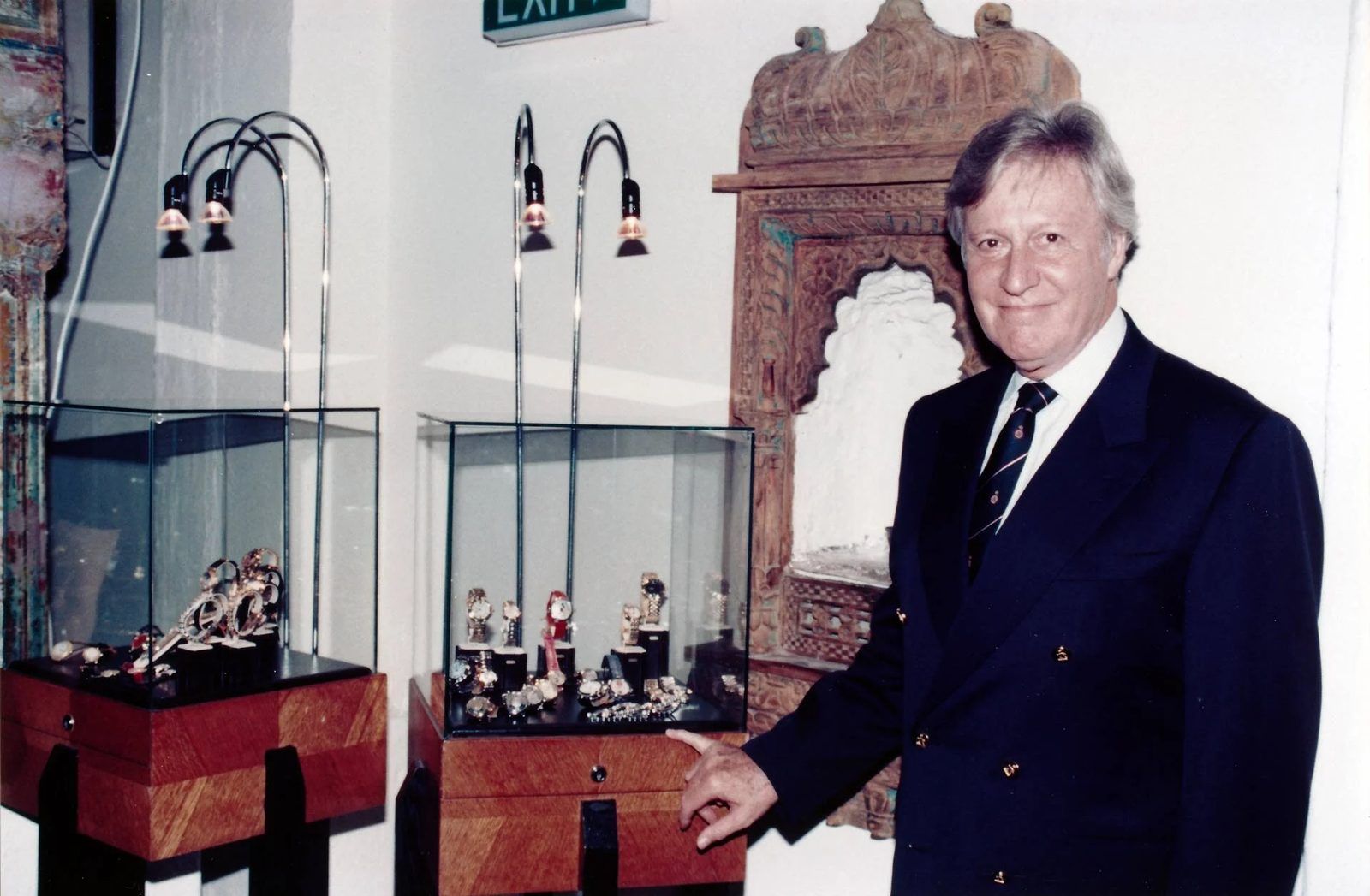
Gérald Genta (1931 to 2011) was a Swiss watch designer from Geneva. He drew the Audemars Piguet Royal Oak in 1972 and the Patek Philippe Nautilus in 1976, and with them he invented the luxury steel sports watch: a case that flows into its bracelet, finished like a jewel, at the price of gold. Most integrated-bracelet watches made today, from the IWC Ingenieur to the Christopher Ward Twelve, follow his template.
He was a freelancer for most of his career, so his name rarely appeared on the watches he drew. Christopher Ward's Loupe magazine calls him the "Picasso" of watchmaking. He saw himself first as a painter.
Key facts
| Born | 1st May 1931, Geneva. Swiss mother, father of Piedmontese (northern Italian) origin |
| Died | 17th August 2011, aged 80 |
| Training | Jewellery apprenticeship in Geneva, 1946 to 1950. Swiss federal diploma in 1951 |
| Work | Freelance designer for Universal Genève, Omega, Audemars Piguet, Patek Philippe, IWC, Bulgari, Cartier and others |
| Own brands | Gérald Genta (1969, sold to Bulgari in 2000), then Gérald Charles |
| Output | About 100,000 designs, by his widow's estimate |
| Best known for | Royal Oak (1972), Nautilus (1976), Ingenieur SL (1976), Bulgari Bulgari (1977) |
Life in 4 phases
1. The freelancer (1950s and 1960s)
Genta trained as a jeweller, not a watchmaker. After his diploma he went from brand to brand in Geneva to sell drawings. His widow, Evelyne Genta, told Loupe that he started "selling his designs at just 10 Swiss francs per design".
His first big success came at 23: the Universal Genève Polerouter of 1954, named for the SAS polar flights from Europe to North America. More work followed for Universal Genève (the Golden Shadow and White Shadow), for Omega on the Constellation, for Rolex on the gold King Midas, and, by most accounts, for Patek Philippe on the Golden Ellipse of 1968.
2. The steel icons (1970s)
In 1970 quartz was eating the Swiss industry, and Audemars Piguet needed something new. One afternoon its managing director, Georges Golay, called Genta. In Genta's own account, kept by his Heritage Association, Golay said: "Mr. Genta, I need a steel sports watch that has never been done before, I want it to be something totally new and waterproof." Then: "I want the design by tomorrow morning."
Genta remembered the divers on Lake Geneva from his childhood, their helmets bolted to the suit: "I designed it overnight and my idea was to replicate the system of the scaphander's helmet on the watch case. With the eight screws and with the joint visible on the case's exterior."
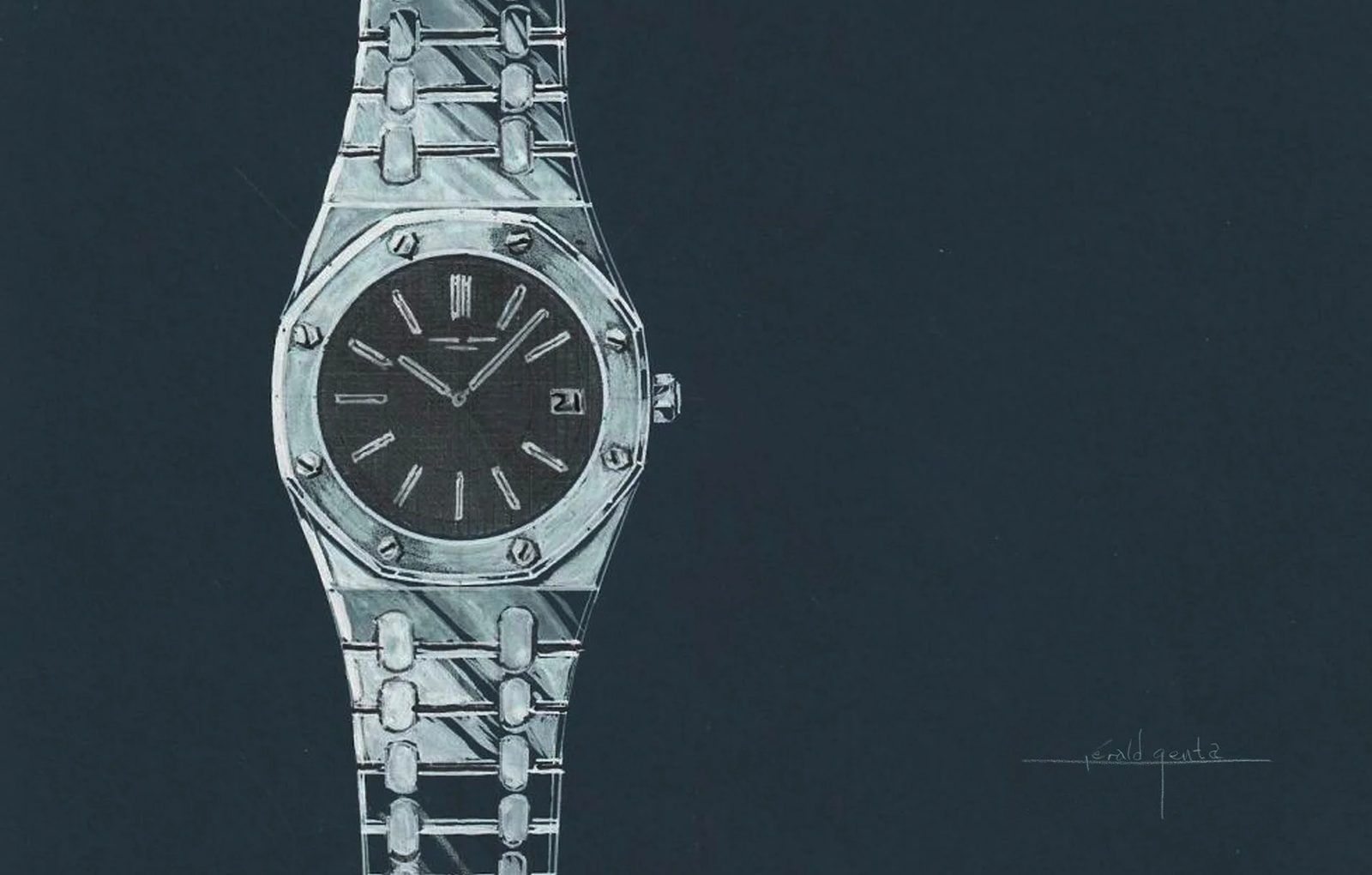
The Audemars Piguet Royal Oak, reference 5402, launched at the Basel fair in 1972. Sources put its price between 3,300 and 3,750 Swiss francs, more than many gold watches. It took about 3 years to sell. Only the Italians, Mme Genta says, "got it" straight away.
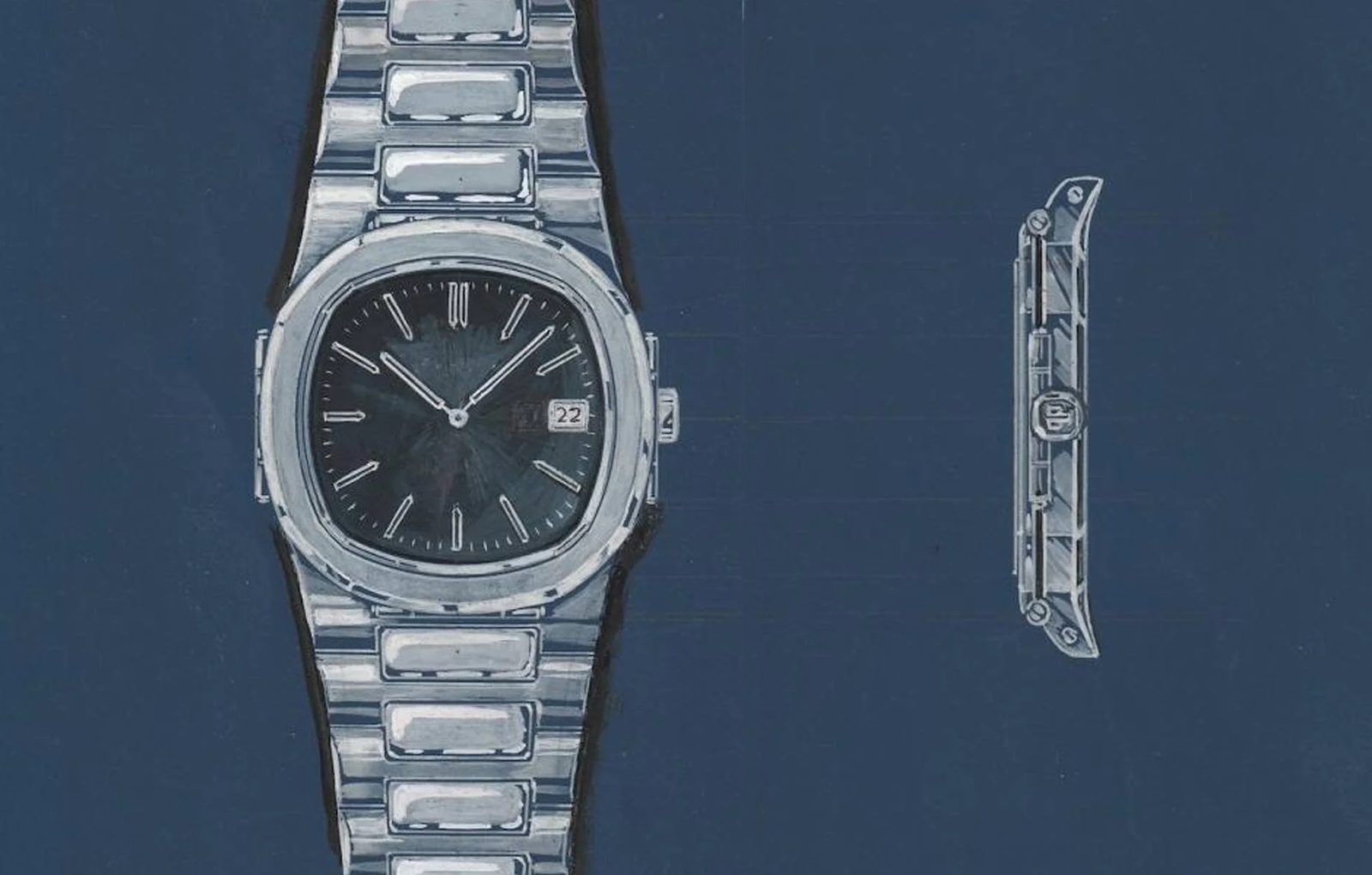
The Nautilus for Patek Philippe came in 1976, and it took even less time. Genta sat in a hotel restaurant during the Basel fair, with the Patek team at another table. He told GQ:
"It is a watch that I designed during the Basel Trade Fair. [...] I told the head waiter, 'Bring me a piece of paper and a pencil. I want to design something.' I designed the Nautilus while observing the people from Patek eating... It was a sketch that I completed in five minutes."
The shape came from a ship's porthole: the Stern family, who owned Patek, were keen sailors.
The same year, IWC launched Genta's Ingenieur SL (reference 1832), with 5 holes in the bezel in place of the 8 screws. In 1977 came the Bulgari Bulgari for Bulgari, its bezel engraved with the brand name like an ancient Roman coin.
3. His own brand (1969 to 2000)
Genta founded his own company in 1969. It made custom pieces first, and became known as a brand in the 1980s. It did 2 things no one expected from the same house:
- Grand complications. A minute repeater of 1981, only 2.72 mm thick by Christie's measure. In 1994, after about 5 years of work, the Grande Sonnerie: a Westminster chime on 4 gongs, a tourbillon, a perpetual calendar and over 1,000 parts. It was called the most complicated wristwatch of its time.
- Mickey Mouse. Under a Disney licence, the Fantasy collection put Mickey, Minnie, Donald, Scrooge and Goofy on serious mechanical watches, often with retrograde hands.
Retrograde displays and jumping hours became the house signature. The Gefica, a bronze watch for big-game hunters with a compass in the clasp, dates from the mid-1980s (sources give 1984 or 1988).
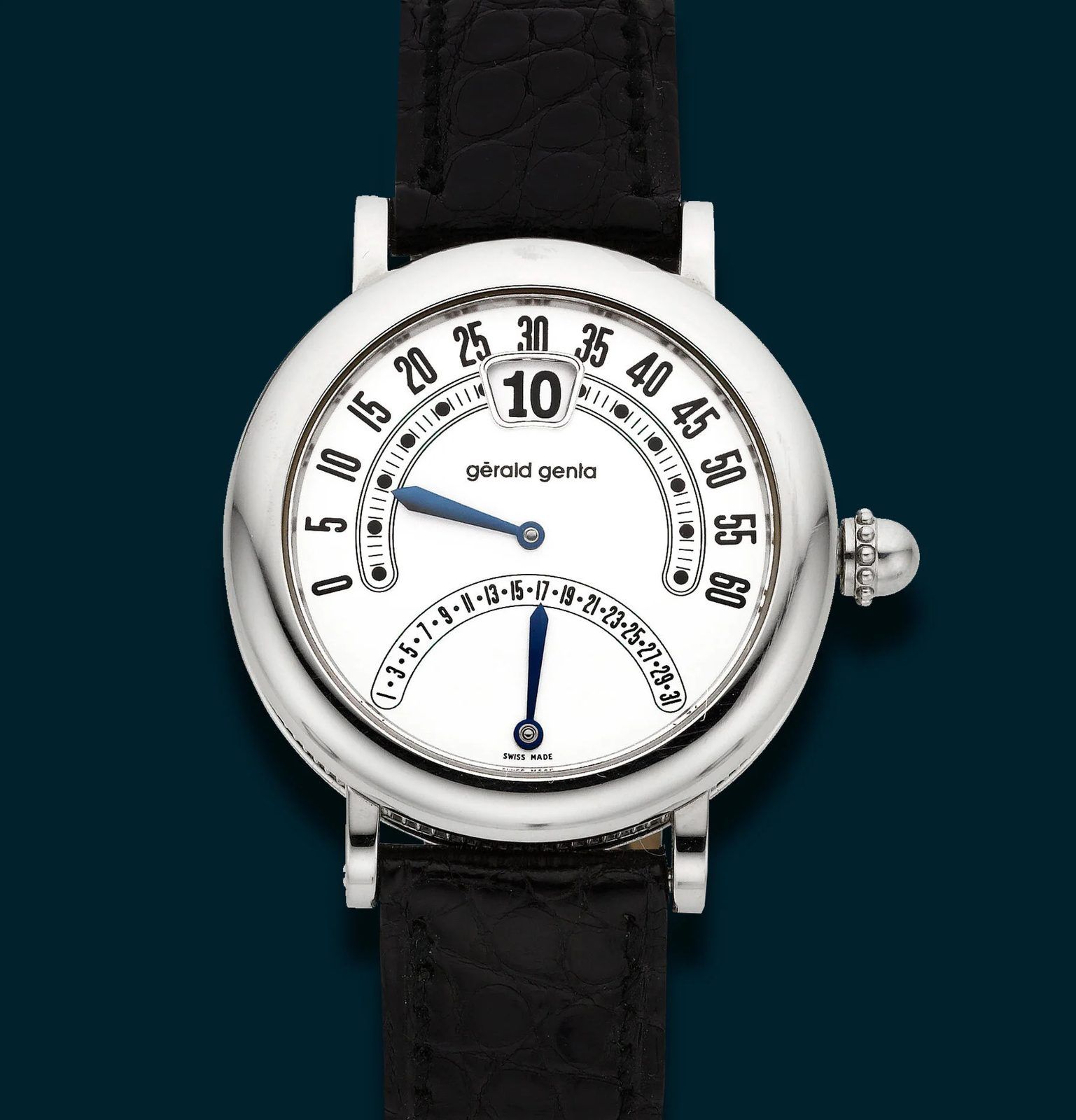
The Singapore retailer The Hour Glass bought a majority stake in the late 1990s (sources give 1996 or 1998). In 2000 Bulgari bought the brand, its trademarks and its designs, and Genta left. He started again under a new name, Gérald Charles.
4. Late work and death (1985 to 2011)
As a freelancer he kept drawing for others. The Cartier Pasha of 1985 is usually credited to him: his modern take on a name Cartier first used for the Pasha of Marrakesh. Loupe calls it his last classic.
Genta died in 2011. His family created the Gérald Genta Heritage Association to keep his archive and back young designers. Loupe reports about 4,000 unused designs in that archive.
His icons by year
| Year | Watch | Brand | Note |
|---|---|---|---|
| 1954 | Polerouter | Universal Genève | His first hit, at 23, for the SAS polar route |
| 1960s | Golden Shadow, White Shadow | Universal Genève | Ultra-thin dress watches |
| 1960s | Constellation | Omega | Credited with work on the line, not a single reference |
| 1964 | King Midas | Rolex | Asymmetric gold case, listed by his Heritage Association |
| 1968 | Golden Ellipse | Patek Philippe | Often attributed to him, not confirmed by Patek |
| 1972 | Royal Oak 5402 | Audemars Piguet | The diver's helmet with 8 screws |
| 1976 | Nautilus 3700 | Patek Philippe | Sketched in 5 minutes in a restaurant |
| 1976 | Ingenieur SL 1832 | IWC | 5 holes in the bezel instead of screws |
| 1977 | Bulgari Bulgari | Bulgari | Inspired by an ancient Roman coin |
| 1985 | Pasha | Cartier | Usually credited to him |
| 1994 | Grande Sonnerie | Gérald Genta | Over 1,000 parts, 5 years of work |
Genta designed cases and dials, not movements. And he often drew a first version that the brand then developed, so "designed by Genta" can mean anything from the whole watch to the first sketch.
How he worked
- A compass, then a brush. "His design process was always to start with a compass," Mme Genta told Loupe. "He'd make a circle with the compass and draw a line to represent 12 to 6 and another line for 9 to 3. Then he'd paint every sketch using his collection of fine brushes." The drawings in this note are paintings, not technical plans.
- Never other watches. "He got his ideas from architecture and nature, from artists like Dalí, Miró, Picasso, Anish Kapoor - but never from other watches," Mme Genta said. The Royal Oak came from a diving helmet, the Nautilus from a porthole, the Bulgari from a coin. A design she says he made for her came from sea urchins.
- Speed. A night for the Royal Oak, 5 minutes for the Nautilus. Both came after about 20 years of drawing watches for other brands.
- Steel as a luxury. Christopher Ward's design director, Adrian Buchmann, sums up his lesson: Genta "showed high-end watches didn't need to be made of precious metal - that the value comes from the quality, finishing and movement".
He had a complicated relationship with time itself. In a 2009 interview he said:
"For me, watches are the antithesis of liberty. I am an artist, a painter. I hate having to adhere to the constraints of time. It irritates me."
Legacy
The Genta formula
The integrated-bracelet sports watch is now a genre of its own, and the Royal Oak and the Nautilus are among the most copied designs in watchmaking. The formula has 4 parts:
- A bracelet that flows into the case, so the watch reads as one object.
- A strong bezel shape: an octagon, a porthole, a tonneau.
- A textured dial, such as the Tapisserie grid of the Royal Oak or the horizontal grooves of the Nautilus.
- Steel finished like gold, with brushed and polished surfaces side by side.
Brands at every price level now make their own version: the Tissot PRX, the Christopher Ward Twelve, the Vacheron Constantin Overseas and many more.
The brand comes back
LVMH bought Bulgari, and with it the Gérald Genta name, in 2011. In April 2023 it announced the return of Gérald Genta as a separate brand, developed with La Fabrique du Temps Louis Vuitton. The first watch, in June 2024, was the Gentissima Oursin, a titanium watch shaped like a sea urchin, from one of his drawings. The Gentissima Oursin Fire Opal won the Ladies' Watch Prize at the 2025 GPHG.
On this site
- Audemars Piguet Royal Oak Automatik: the Royal Oak Automatik, his 1972 design as it is made today.
- IWC Ingenieur Automatic 40 Blue (IW328907): the 2023 Ingenieur, which goes back to his 1976 SL.
- Omega Constellation Steel: the Constellation, a line he worked on in the 1960s.
- Christopher Ward The Twelve 40: Christopher Ward's homage to his work, and the 40 mm Nic pre-ordered in October 2026.
Further Reading




- Gérald Genta and the watch that kickstarted his career, Universal Genève magazine, on the Polerouter
- Gérald Genta: legendary watch designer with a renegade spirit, Quill & Pad
- Gérald Genta's watches, GQ, with his account of the Nautilus sketch
- The Gentissima Oursin and the return of the brand, Monochrome, 2024
- Gérald Genta, Wikipedia