
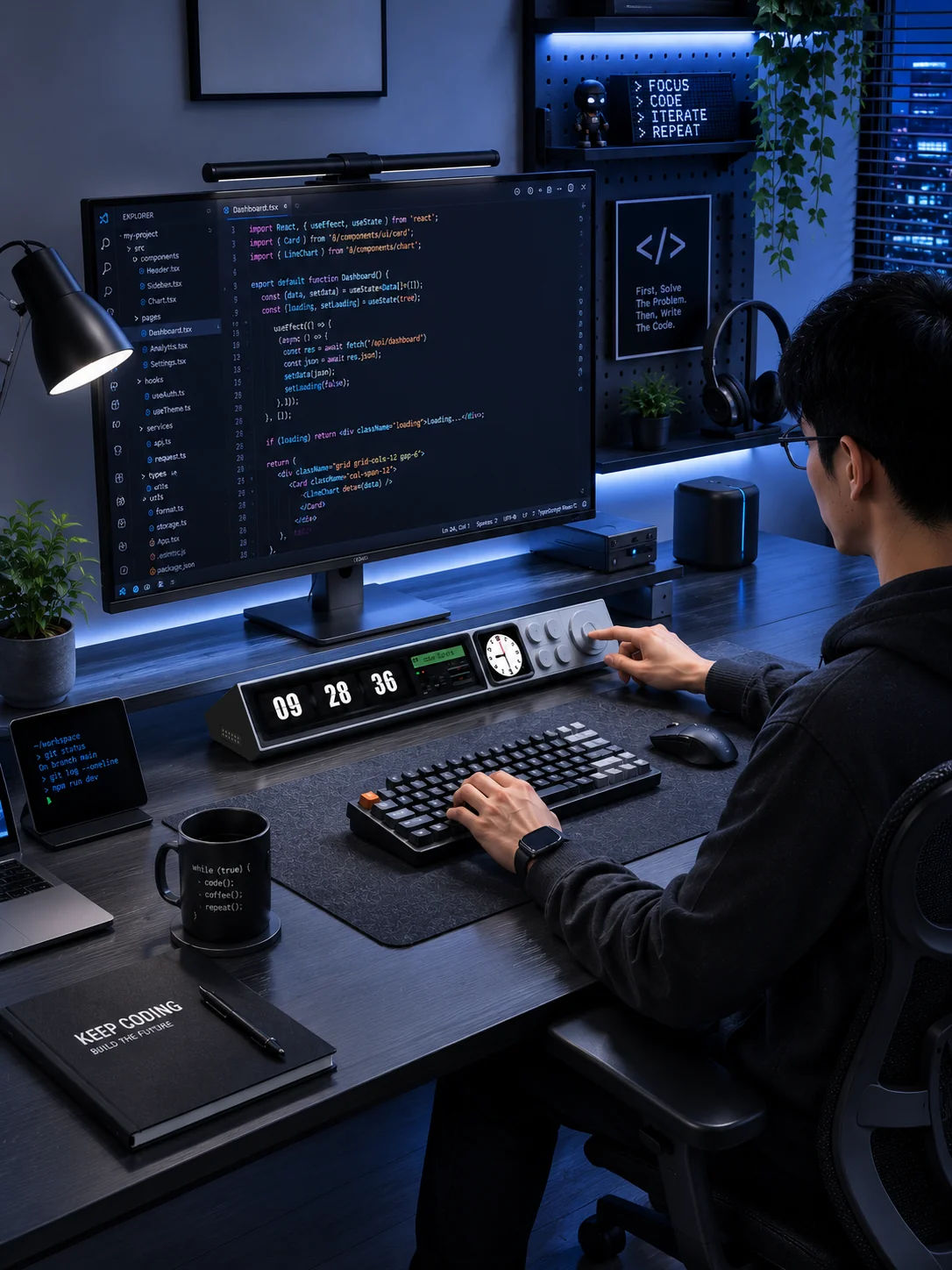
The UltraBar X is a wedge-shaped bar that sits between your monitor and your keyboard, carrying a 7" ultra-wide touch strip plus magnetic modules you snap on and off: knobs, mechanical keys, a small AMOLED screen, an environmental sensor. It runs its own operating system, so it keeps working when the computer is off.

It raised 2,708,734 USD from 803 backers on Kickstarter, around 26,700% of a roughly 10,000 USD goal. The campaign closed on 10th January 2026 with shipping targeted for April. It now sells direct at 599 USD.

The modules
The CoreBar is the spine. Everything else clips onto it through a magnetic pogo-pin connector Sanytron calls QuantumLink, using N52 magnets. Up to 15 modules, hot-swappable, quoted at 0.3 seconds to reconfigure.
| Module | Price | What it is |
|---|---|---|
| CoreBar | in bundle | 7" ultra-wide LCD touch strip, USB-C hub, 250g |
| SenseCube | 129 | mmWave presence radar plus temperature, light and humidity |
| VivoCube | 99 | 2" AMOLED touch module with gesture control |
| KnobKey | 59 | Metal rotary encoder with tactile detents |
| DotKey | 49 | 3 Cherry MX mechanical shortcut keys |

Every module is currently sold out individually on the store. Only the bundles are purchasable, which tells you something about supply.
Specs
| Display | 7" ultra-narrow LCD, 1424 x 280, touch. 5:1 ratio |
| OS | LineOS, a proprietary Android-based system |
| Connectivity | Wi-Fi 5, Bluetooth 5.0, USB-C with PD 3.0 |
| CoreBar size | 199 x 50.4 x 59.6mm, 250g |
| Module weight | About 100g each |
| Mount | QuantumLink magnetic pogo interface, up to 15 modules |
| Angle | Fixed 45 degree wedge |
| Colours | Grey, White. Green and Gold also listed |
| Host support | Windows, macOS, Linux |
| Smart home | Home Assistant and Mi Home native, plus Philips Hue and Sonos |
| Config | UltraMate software, drag and drop |
| Warranty | 12 months, 30-day returns, free worldwide shipping |
What makes it different
Most desk controllers are dumb surfaces driven by software on the host. The UltraBar X is not. LineOS runs on the bar itself, over its own Wi-Fi connection, so the clock, the sensors and the smart-home controls keep working with the PC shut down. That is a genuine architectural difference from a Stream Deck, and it is the reason the sensor module makes sense: presence detection that only works while your Mac is awake would be useless.
Sanytron claims 90+ platform integrations and 300+ templates. There is also an optional PCIe module for wireless PC boot at BIOS level, which is a nice touch for a headless machine.
What it is competing with
Sanytron's own marketing answers this. Their "before" image is a desk buried in cables with 3 Elgato Stream Decks on it.

That is a fair shot at a real problem, and also a revealing one. It tells you the target buyer already owns a Stream Deck.
The honest comparison:
| Stream Deck XL | UltraBar X | |
|---|---|---|
| Price | ~250 USD | 599 USD |
| Runs without the PC | No | Yes |
| Ecosystem age | 8+ years, 100s of plugins | New, closed beta of an SDK |
| Runs local shell scripts | Yes, any .sh |
Not documented |
| Sensors | None | mmWave presence, temp, light, humidity |
| Physical knob | Only on the Stream Deck + | Yes, metal encoder |
| Remapping | Full, per key, per profile | UltraMate drag and drop |
The Home Assistant angle
Native Home Assistant support is the most interesting thing here, and it is not marketing fluff: a standalone Android device with a presence radar and a touch strip is a reasonable HA dashboard and trigger source in a way a host-dependent keypad is not.
Sanytron also sells Astrion at 180 USD, a dedicated Home Assistant remote with physical buttons. If HA control is what you want rather than desk automation, that is the cheaper and more focused product.
The risks
This is crowdfunded hardware from a young Chinese company, and the usual caveats apply with a few specific ones.
- LineOS will not be fully open source. APIs and an SDK are promised, not shipped. The entire value of the device depends on Sanytron staying alive and keeping the integrations current. Elgato has had 8 years to build a plugin ecosystem; this has months.
- No published MQTT, webhook or scripting documentation as of now. The reviewer guide lists no SDK details.
- 2.7M raised against a 10,000 USD goal. That ratio is a scaling problem, not a triumph. Fulfilment at 270x your plan is where crowdfunded hardware usually breaks.
- Modules are sold out individually. If you want to expand later, you are waiting.
- The site copy is rough. The support address on the product page reads
suppprt@sanytron.com, and the Astrion description has broken English. Normal for a direct-from-China hardware startup, and still a signal about what support will feel like. - The product page carries the line "this item is a deferred, subscription, or recurring purchase", which is worth clarifying with them before you pay 599 USD.
Independent coverage exists and is broadly positive on the concept: CNX Software, New Atlas and Hackster all ran pieces. New Atlas's comment section is where the scepticism lives: readers questioning whether it solves a real problem, and what the always-on sensors mean for privacy.
Buying
| Product | Price (USD) |
|---|---|
| UltraBar X (CoreBar plus modules) | 599 |
| UltraBar (the non-X bundle) | 429 |
| CoreBar Content Creator | 599 |
| Astrion HA remote | 180 |
Free worldwide shipping, 24-hour processing, 5 to 10 business days quoted. Shipping from China means German buyers should expect 19% import VAT plus a handling fee on top, so 599 USD lands closer to 650 to 700 EUR. There is no EU warehouse.
My take
The idea is good and the standalone OS is the right call. A desk controller that keeps working when the machine is off is genuinely more useful than one that does not, and putting a presence sensor on it is a smarter move than adding more keys.
But I would not buy it, and the reason is specific. My Stream Deck XL works because every key points at a .sh file in ~/sh/, which opens a Terminal and runs a Python job on the Mac. That is the whole automation layer: backups, transcription, site deploys, the daily routine. Nothing in the UltraBar X documentation says LineOS can trigger a local shell script on a macOS host. It is an Android device on its own Wi-Fi connection, which is architecturally the opposite of what makes my setup work. That is the single question to answer before spending 599 USD, and right now the answer is not published.
599 USD also buys roughly 2 Stream Deck XLs, with 8 years of plugins behind them and no dependency on a company that has shipped one product.
Where it makes sense: someone starting from nothing who wants a physical Home Assistant surface, a knob and a clock on their desk, and who does not need host-side scripting. For that person it is more interesting than a Stream Deck.
Worth watching rather than buying. Revisit when the SDK ships and when backers have had units for 6 months. If the HA integration is the draw, the 180 USD Astrion answers that question for a third of the money.
Further reading


- Reviewer guide on the Sanytron forum, the best source for actual specs
- New Atlas coverage, plus a sceptical comment section
- UltraBar, the 429 USD bundle