
Freewrite makes computers that only write. No browser, no notifications, no apps, and deliberately almost no editing. You type, it saves, it syncs to Dropbox or Google Drive when it finds Wi-Fi. That is the entire product, and the price of that restraint is 349 to 1,099 USD depending on the model.
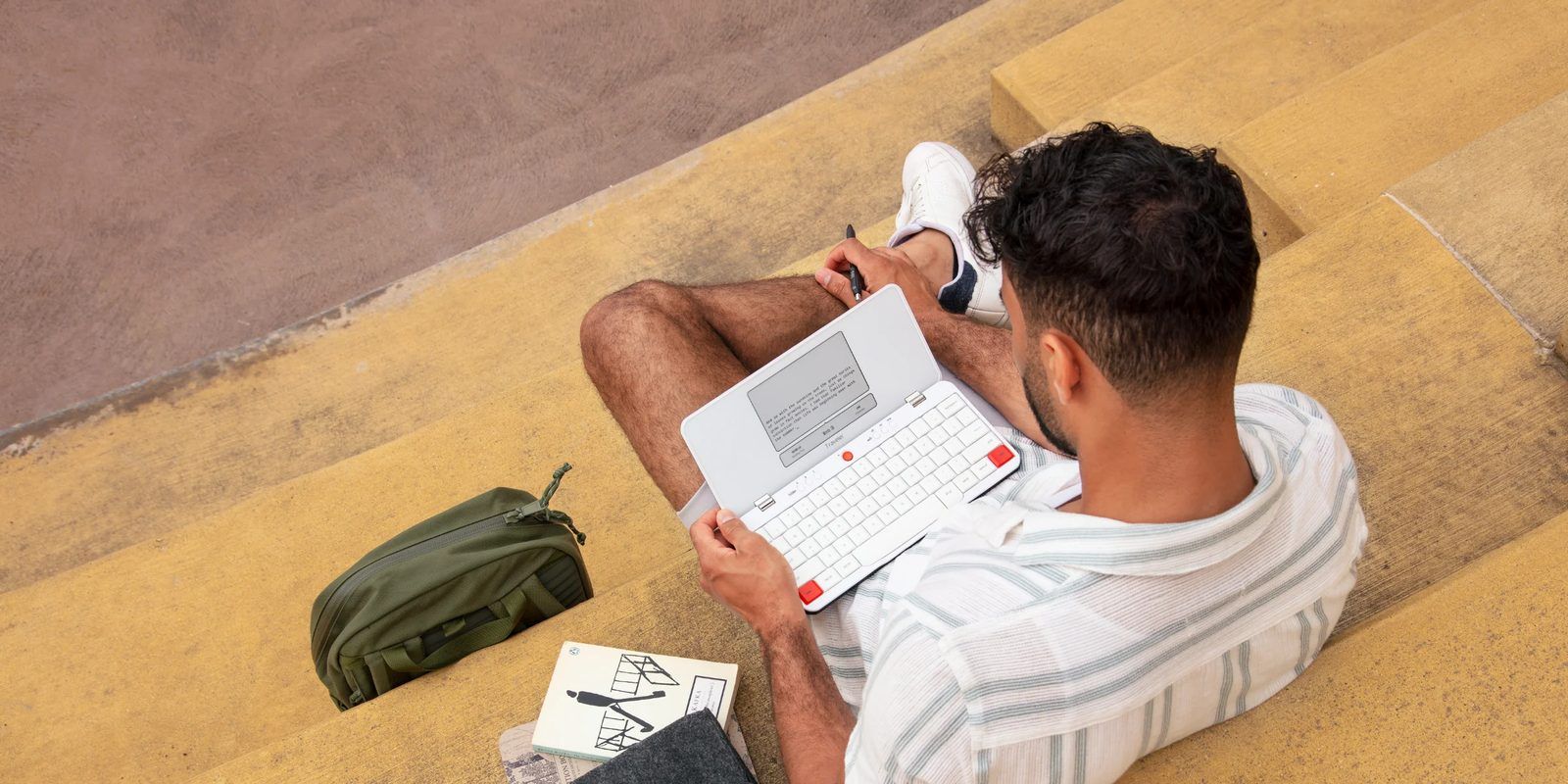
The company is Astrohaus, based near Detroit. The argument they sell is not features, it is subtraction: the machine cannot do anything except take words, so you cannot do anything except put words in it.

The lineup at a glance
Prices are USD, direct from the Freewrite store. Every device stores roughly 1 million words internally and syncs over 2.4 GHz Wi-Fi to Postbox, Dropbox, Google Drive, OneDrive and Evernote.
| Model | Price | Screen | Keyboard | Weight |
|---|---|---|---|---|
| Alpha | 349 | Backlit LCD, 2 to 4 lines | Kailh Choc V2 low profile | 0.7 kg |
| Alpha Cosmic Edition | 499 | Backlit LCD, terrazzo hull | Kailh Choc V2 low profile | 0.7 kg |
| Traveler | 549 | E Ink, no frontlight | Scissor switch | 0.7 kg |
| Smart Typewriter Gen3 | 699 | 6" E Ink, frontlit | Kailh Box Brown mechanical | 1.8 kg |
| Valentine Special Edition | 999 | 6" E Ink, frontlit | Kailh Box Brown mechanical | 1.8 kg |
| Hemingwrite Signature | 1,099 | 6" E Ink, frontlit | Kailh Box Brown mechanical | 1.8 kg |
| Wordrunner | 349 to 379 | None, it is a keyboard | Tactile, hot-swap PCB | n/a |
Every product
Alpha, 349 USD
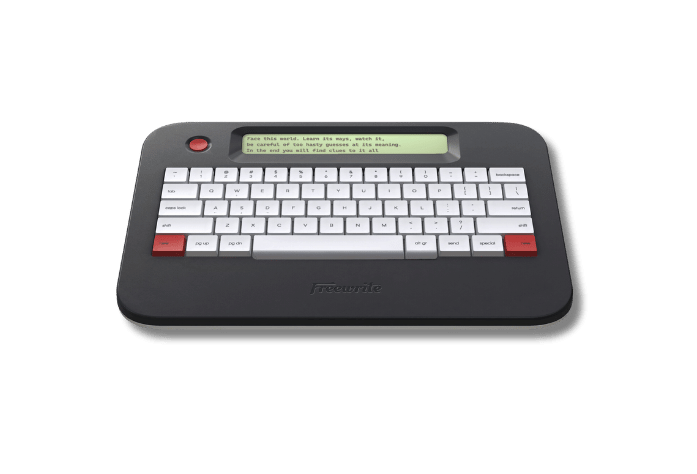
The entry point and the one most people should look at first.
| Screen | Anti-glare FSTN LCD, 164 x 25mm canvas, 2 to 4 lines of text |
| Backlight | Warm-toned, 5 brightness levels |
| Keyboard | Full-size mechanical, Kailh Choc V2 low profile tactile, WASD arrow keys |
| Battery | ~100 hours of writing |
| Size | 0.7 kg, 320 x 215 x 22mm |
| Storage | ~1 million words on internal flash |
| Sync | Wi-Fi to Dropbox, Google Drive, OneDrive, Evernote. USB-C for offline transfer |
The backlight matters. Early Alphas shipped without one and every review said so; the current Raven Black model has it. Best value in the range by a distance.
Alpha Cosmic Edition, 499 USD
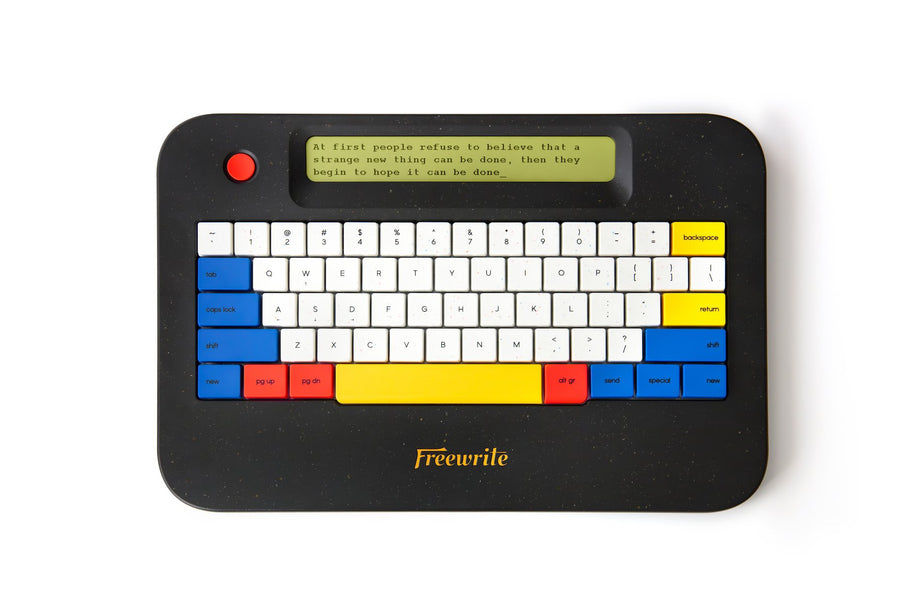
The same machine in a limited-run finish.
| Differences | Terrazzo-speckled black hull with red, blue and yellow flecks and matching keycaps |
| Included | Charcoal felt sleeve with leather trim and coloured stitching |
| Screen, keyboard, battery | Identical to the standard Alpha |
| Availability | Limited batch, no committed reruns |
150 USD for a paint job and a sleeve. Buy it if you want the object, not if you want the tool.
Traveler, 549 USD
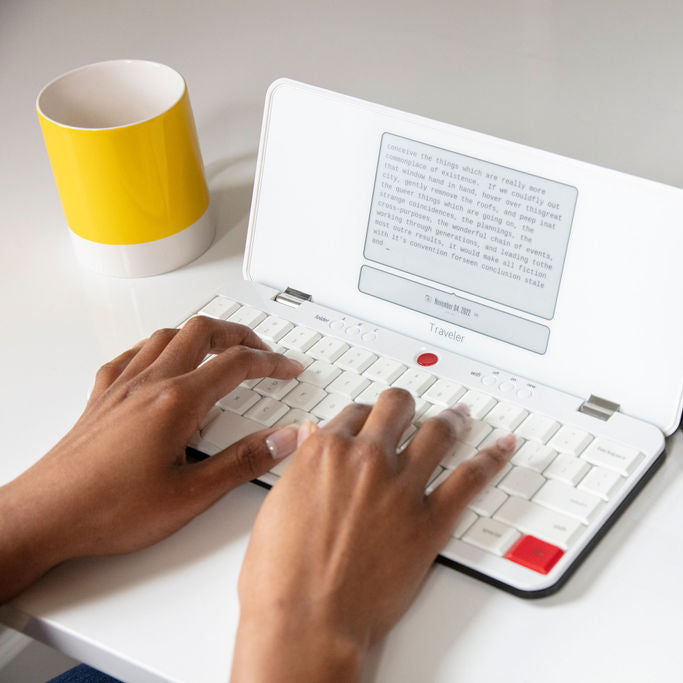
The portable one. Folds flat, goes in a bag.
| Screen | E Ink, 121 x 70mm canvas plus a 121 x 15mm status strip. No frontlight |
| Keyboard | Full-size scissor switch, over 2mm travel, WASD arrow keys |
| Battery | ~4 weeks at 30 minutes of writing a day |
| Size | 0.7 kg, 288 x 128 x 24.7mm, polycarbonate body |
| Hinge | Adjustable to 135 degrees |
| Sync | Postbox, Google Drive, Dropbox, Evernote, OneDrive |
Sunlight-readable, which the Alpha is not. Unusable in a dim room, which the Alpha is not either. Pick your compromise. No hardware refresh in years, and the price shows it.
Smart Typewriter Gen3, 699 USD
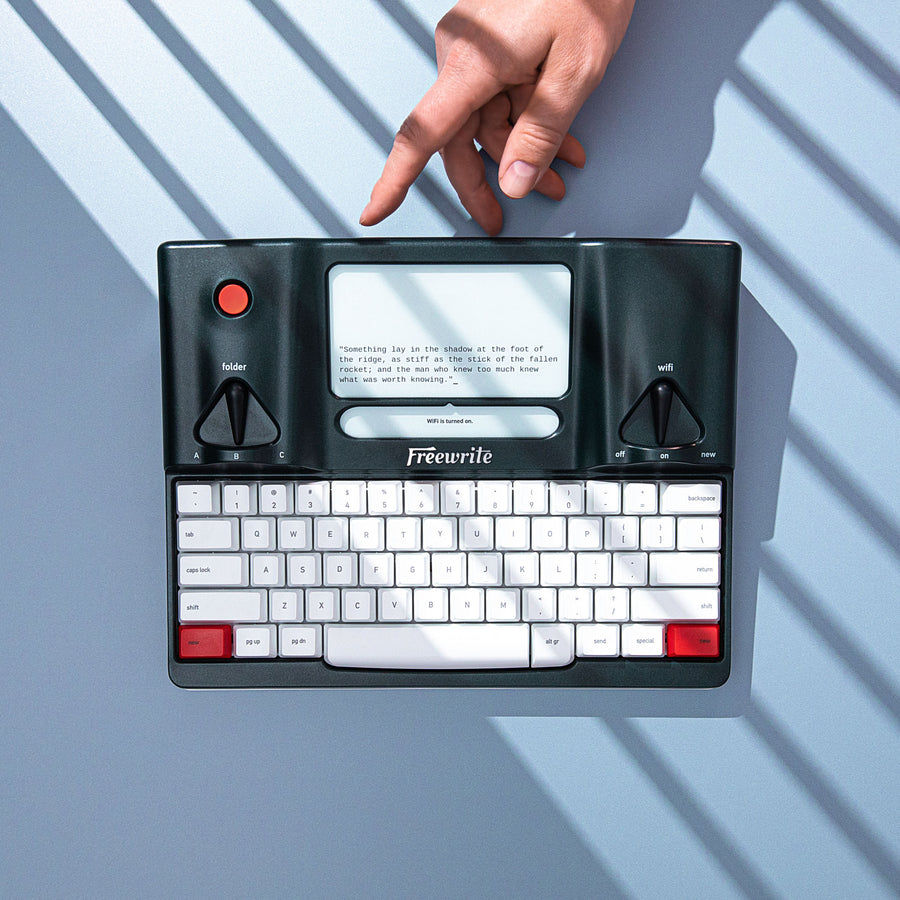
The original shape, and the one that looks like a typewriter.
| Screen | 6" E Ink with integrated frontlight, adjustable. 121 x 68mm canvas, 113 x 18mm status window |
| Keyboard | Full-size mechanical, Kailh Box Brown, thick PBT keycaps, rated 50M presses |
| Battery | ~4 weeks at 30 minutes a day |
| Size | 1.8 kg, 298 x 237 x 70mm |
| Body | Die-cast aluminium with an all-metal retractable handle |
| Controls | Physical folder dial (A/B/C) and a Wi-Fi dial (off / on / new) |
| Languages | 60+ languages, 85+ keyboard layouts |
Desk furniture more than a portable. The 2 mechanical dials are the best interface idea in the range: your document set is a physical switch position, not a menu.
Valentine Special Edition, 999 USD
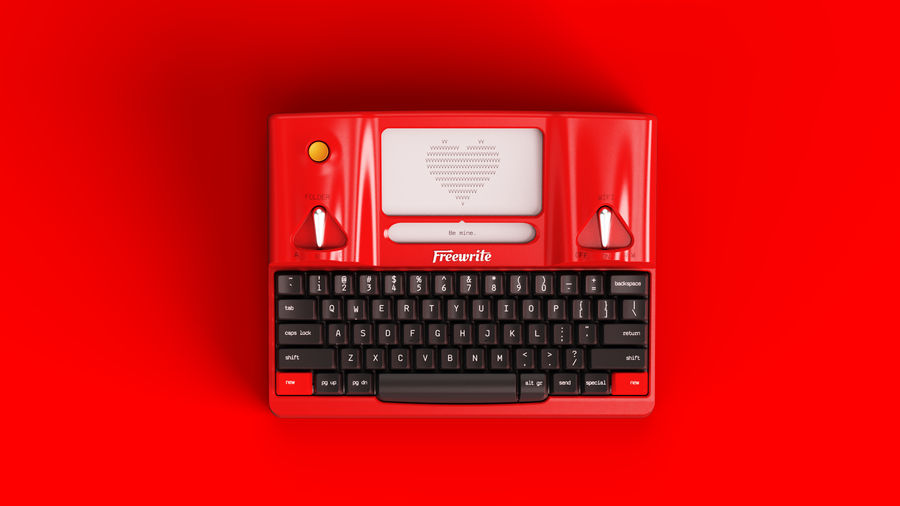
A Smart Typewriter in glossy red with black keycaps, sold with a carrying case.
| Differences | Red finish, black keycaps, carrying case |
| Everything else | Same Gen3 hardware |
300 USD over the standard Gen3 for the colour. A collector item.
Hemingwrite Signature Edition, 1,099 USD
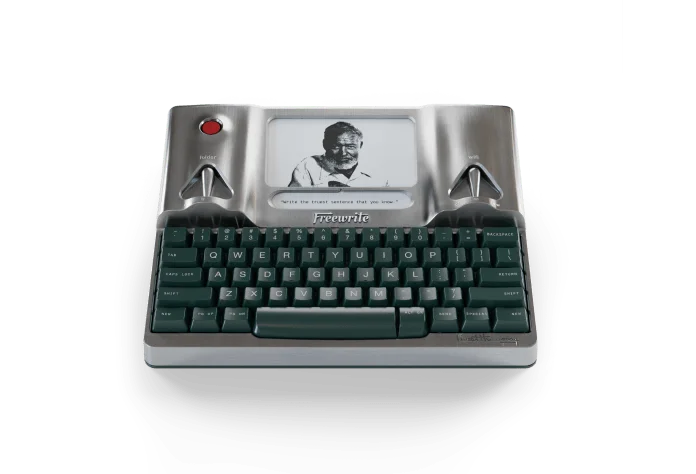
The top of the range, and an official collaboration with the Ernest Hemingway estate.
| Body | Raw aluminium chassis, polished and finished by hand, develops a patina |
| Keycaps | Dark green |
| Engraving | Laser-engraved Hemingway signature |
| Included | Cognac leather attaché case, monogrammed microfibre cloth, booklet |
| Everything else | Same Gen3 internals |
400 USD over the Gen3 buys you the finish, the case and the licensing. No edition size is published.
Wordrunner, 349 to 379 USD
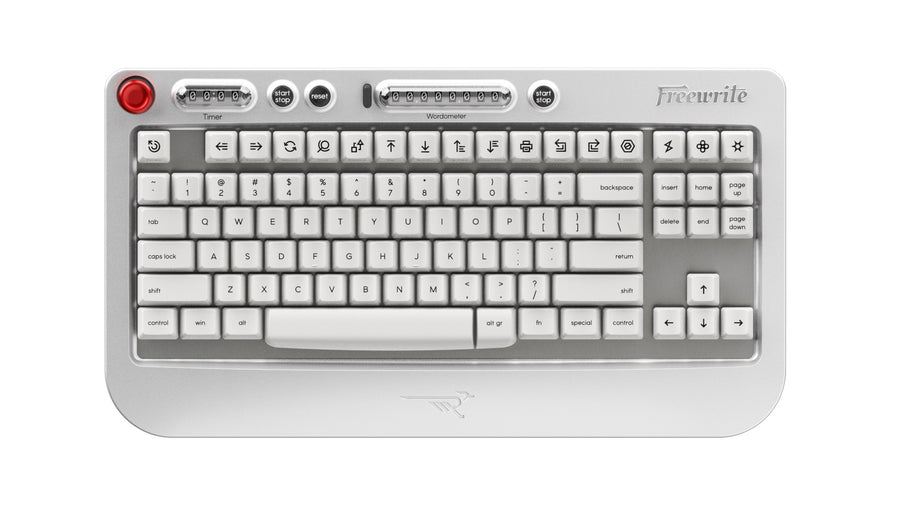
The odd one out: a standalone keyboard with no screen, for people who want the feel without the machine.
| Body | Solid die-cast aluminium |
| Switches | Tactile, rated 80M presses, hot-swap PCB |
| Counters | An 8-digit electromechanical Wordometer driven by a coreless motor, counting words in real time and holding its count with the power off. Plus a mechanical timer. Both reset by hand |
| Connectivity | USB-C wired, Bluetooth to 3 devices, switching across 4 |
| Battery | ~1 month of regular use |
| Works with | Windows, macOS, iPad, Android, anything that takes a standard USB or Bluetooth keyboard |
| Variants | 349 barebones (no keycaps or switches), 379 with white keycaps and tactile switches |
Currently on preorder, down from a 459 list price. The physical word counter is either the best or the silliest thing Freewrite has made, and I cannot decide which.
The constraint is the product
Every Freewrite refuses to do 3 things, on purpose:
- No cursor navigation. You can backspace, but you cannot click into a paragraph 3 pages up and rework it.
- No spell-check, no grammar suggestions, no copy and paste.
- No apps, no browser, no notifications. There is nowhere to go.
That is the whole thesis: drafting and editing are different jobs, and the machine only does the first one. You dump the draft, it lands in Dropbox, you edit it somewhere else.
Whether that works depends entirely on how you write. If you are the kind of writer who fixes the previous sentence 6 times before starting the next, this device breaks that loop by force. If you compose by rearranging, it will drive you up the wall.
The software side
The devices are half the product. The rest is a small stack:
- Postbox, the web interface where your drafts land and can be organised.
- Sprinter, a browser-based drafting environment that applies the same constraints without hardware. Free to try, which is the cheapest way to find out whether the idea suits you.
- Freewrite Plus, a paid tier adding document import, emailing drafts out and other extras.
- Sailfish firmware, the current generation, which the company claims is 40 to 100% faster to respond and uses 30 to 50% less power.
Everything syncs as plain text to Dropbox, Google Drive, OneDrive or Evernote, so nothing is trapped on the device.
Background
It started as the Hemingwrite in 2014, built by Adam Leeb and Patrick Paul in Detroit. The prototype lost its hardware competition, got picked up by the press anyway, and the Kickstarter raised over 200,000 USD in the first 20 hours, finishing at 342,471 USD from 1,096 backers. The name changed to Freewrite for legal reasons and Astrohaus was formed around it.
The Hemingway estate came back into the picture later, licensing the Signature Edition.
The store has since grown well past hardware into stationery: Circa discbound notebooks, Levenger True Writer pens, journals, even a studio gong. Levenger's own site carries a Freewrite collection in return.
Pros and cons
Pros
- The constraint works. Reviewers who dislike the price still report writing more.
- Real keyboards. The Alpha's Kailh Choc V2 switches and the Smart Typewriter's mechanicals are not laptop compromises.
- Battery measured in weeks, not hours.
- Files sync out as plain text. No lock-in.
- Built to last, and the company still ships firmware for hardware from 2016.
Cons
- Expensive for the silicon. 549 USD for the Traveler buys specs a Kindle would be embarrassed by. You are paying for the restriction, not the components.
- No editing is a feature until it is not. Long-form restructuring has to happen elsewhere.
- The Traveler has no frontlight, so it is unusable in a dim room.
- 1-year warranty only.
- The Traveler has not had a hardware refresh in years.
Buying from Germany
There is no EU store. You order in USD from getfreewrite.com and the parcel imports.
- Add 19% German import VAT on the declared value plus shipping, and customs duty on top.
- Duties and taxes on international orders are not refundable by Freewrite if you return the device. That is stated in their policy and it makes a return genuinely expensive.
- Warranty is 1 year from shipment, and applies only to purchases made on getfreewrite.com or Amazon USA. Third-party sellers are excluded.
So an Alpha at 349 USD lands closer to 450 to 500 EUR by the time it reaches a German doormat. Budget for that before deciding it is the cheap one.
Alternatives
- Sprinter, Freewrite's own browser version. Zero cost, same discipline, no hardware.
- An old laptop with the Wi-Fi turned off. Unfashionable, free, and works.
- A reMarkable or Boox with a keyboard folio, if you want e-ink plus the option to read and annotate.
- A plain mechanical keyboard and a full-screen editor. The Wordrunner at 369 USD is Freewrite selling you exactly this.
My take
The idea is right and the execution is honest. A machine that physically cannot open a browser removes a decision you otherwise make 40 times an hour, and no amount of willpower software replicates that.
The price is where it falls down for me. I write in Markdown that has to end up in a pipeline: a note file with frontmatter, a deck, a proposal, an email. A device that produces plain text into Dropbox does fit that, and Dropbox is already where my notes live. But 500 EUR landed for a second keyboard I would carry alongside a Mac is a lot to pay for discipline I can also get by closing tabs.
The honest test is free: run Sprinter for a week. If the no-editing constraint makes you write more rather than making you furious, the hardware is worth considering, and the Alpha is the model to buy. If it annoys you in the first hour, you have saved 500 EUR.
The version I would actually want does not exist yet: a Traveler with a frontlight, at the Alpha's price.
Further reading

- Sprinter, the free browser version
- Postbox, where drafts land
- Return policy and warranty terms
- The original Hemingwrite Kickstarter, 2014