
A physical timer solves one problem your phone cannot: it does not contain everything else. Open the clock app to start a 25-minute block and you have already been shown three notifications. A timer on the desk has no feed, no lock screen, and no reason to be picked up. That is the entire value proposition, and it holds for a 25-minute writing block and for a 40-second work interval in the gym.
This note covers the whole field: visual disk timers, flip cubes, rotary magnetic LED pucks, keypad digital timers, and gym interval clocks. They are not competing products. They solve different problems, and the right answer is usually two of them.
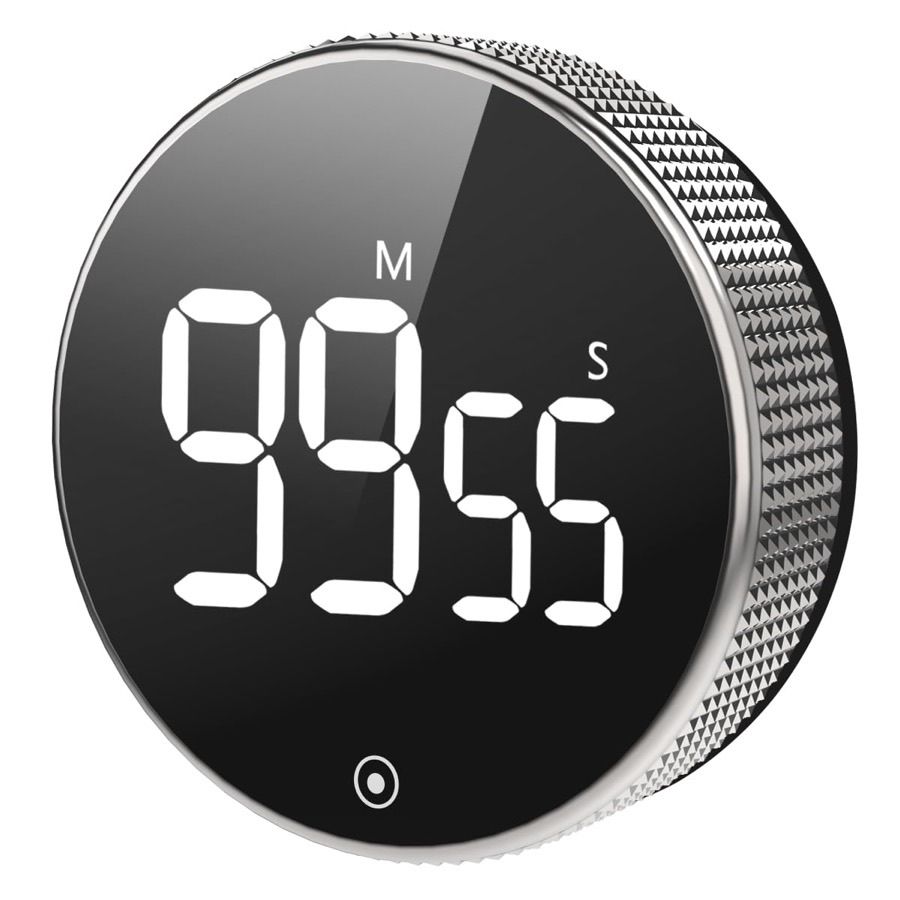
This is the one I already own three of: a Vabaso rotary puck, the knurled silver ring you spin to set the time. It is a clone of the Baseus Heyo, and it is the format I reach for most.
The five types at a glance
| Type | How you set it | Best for | Price band |
|---|---|---|---|
| Visual disk | Turn the red disk to the time | Deep work, meetings, time blindness | 25 to 120 EUR |
| Flip cube | Tip the cube onto a labelled face | Pomodoro, fixed-length blocks | 15 to 60 EUR |
| Rotary magnetic LED | Spin the outer ring | Kitchen, quick ad-hoc timing | 10 to 20 EUR |
| Keypad digital | Type the digits | Exact times, several at once | 10 to 35 EUR |
| Gym interval clock | Program work/rest rounds | HIIT, EMOM, Tabata, boxing | 30 to 200 EUR |
Visual disk timers: Time Timer
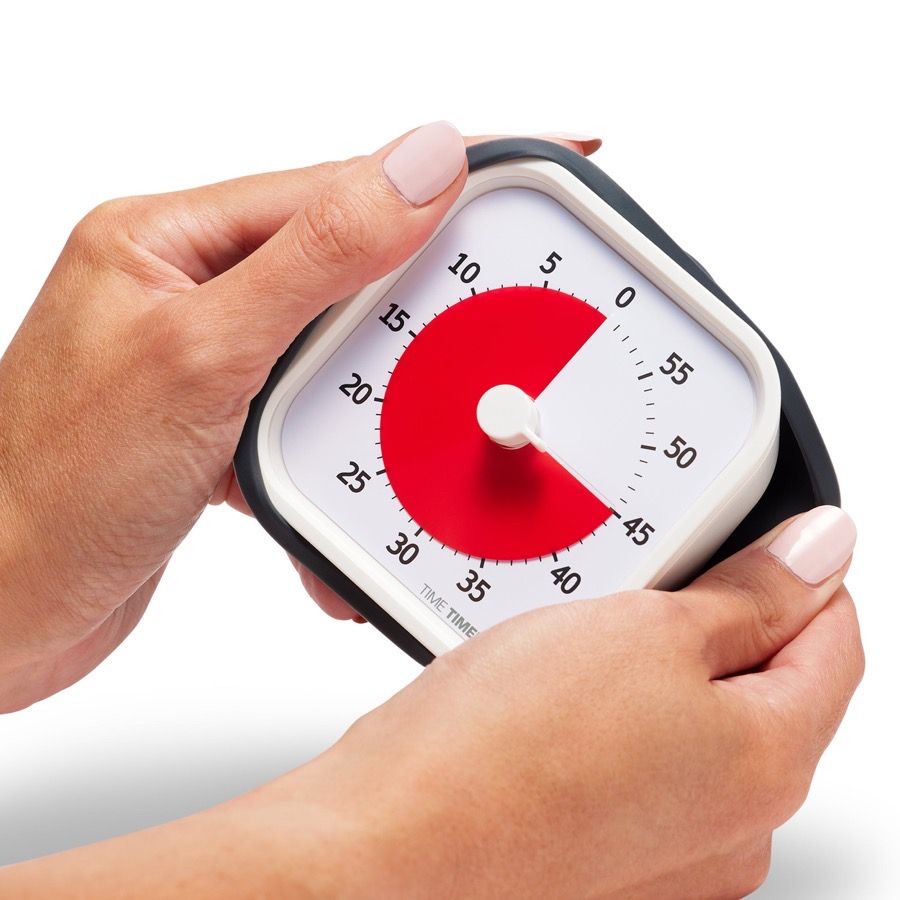
Time Timer invented this category in 1994 and still owns it. A red disk covers the remaining time and shrinks as it elapses. You read it the way you read a fuel gauge, with no numbers to parse and no mental subtraction. That is the point: it makes time visible to people who cannot feel it passing, which is why it has become standard equipment in classrooms, therapy practices and ADHD toolkits.
The engineering is unremarkable and the design is the product. Silent operation, an optional beep at zero, no lit display to distract you at night.
| Model | Size and duration | Price (official) | What it is for |
|---|---|---|---|
| MOD | 9 cm, 60 min | 36.95 USD | The desk default. Silicone case, quiet |
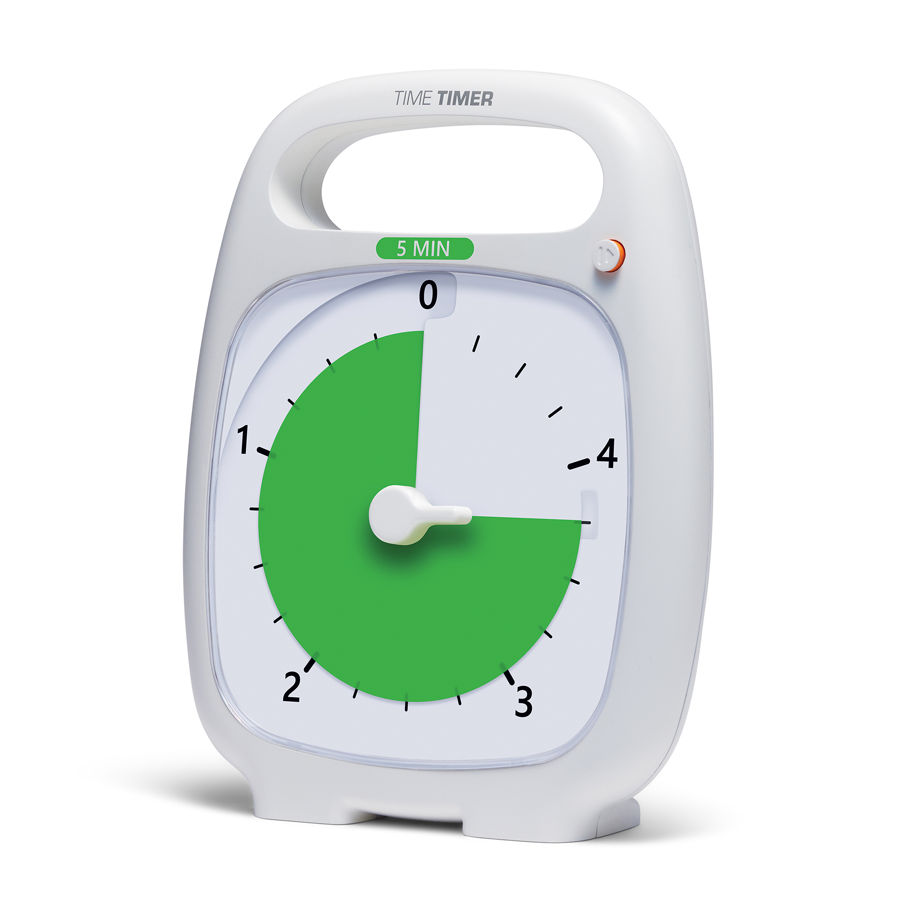
| PLUS | 18 cm, 5 or 60 min | 40.95 USD | Carry handle, sturdier, louder alert |
| MAX | 30 cm, 60 min | 119.95 USD | Wall or room scale, dry-erase face |
| Original 8" | 20 cm, 60 min | 38.95 USD | The classic, magnetic back |
| TWIST | Pocket, 90 min | 22.95 USD | Cheapest way in, kickstand |
| ELEMENT | Desk, 60 min | 38.95 USD | Water resistant version |
The MOD is the one to buy first. The PLUS 5 Minute is the interesting outlier: a whole face dedicated to five minutes, which turns a vague "give me a minute" into something visible to everyone in the room.
The MAX is Calm Tech Certified, an actual third-party standard for technology that stays out of your attention. At 119.95 USD it is a room fixture, not a desk object, and it earns that price only if a group of people needs to see it.
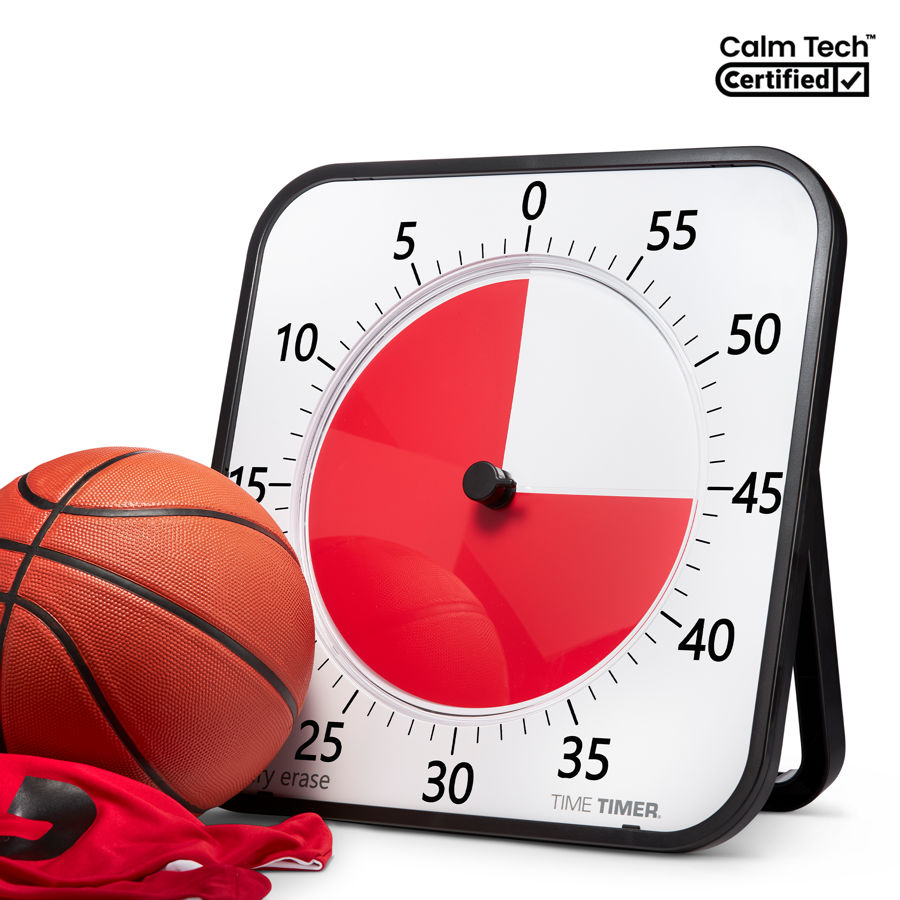
Buying in Germany: timetimer.eu is the European distributor, Robo Educational Toys in the Netherlands, and it is an information site rather than a shop. In practice you buy on Amazon.de or a school-supplies retailer, and German prices run above the US list. Check before ordering.
Flip cubes
Tip the cube so the face you want is up and it starts. No buttons, no confirmation step. The friction of starting a timer is the reason most people do not start one, and this removes it almost completely.
I already have a full note on the best of them: TickTime TK3 Pomodoro Timer Cube, a rechargeable cube with a colour LED ring, automatic 25/5 Pomodoro cycling, a stopwatch and a desk clock, at around 60 EUR. It is the one I would pick for actual work.
The cheaper, more honest alternative is the German one:
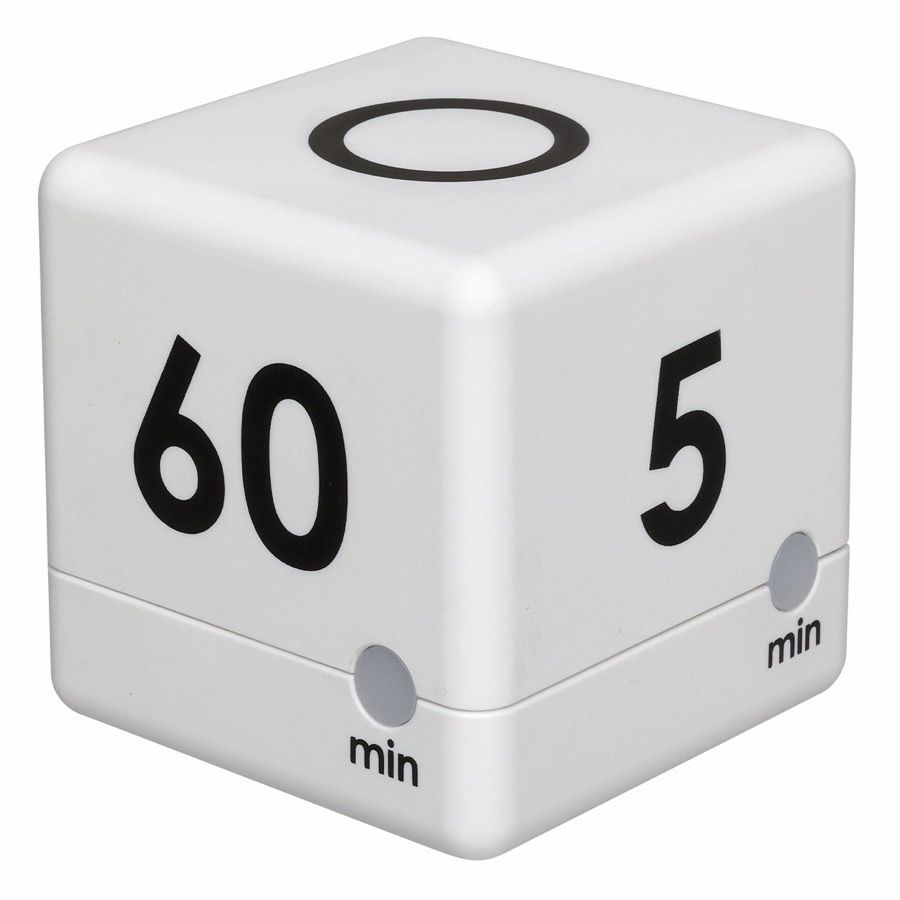

Four fixed times, a small digital display that rotates with the cube, and a pulsing red LED that flashes when time is up. Turn it to the neutral face to silence it. No rechargeable battery, no custom durations, no app. It does one thing and costs a fraction of a TickTime. TFA Dostmann is a German measuring-instrument maker that sells through retail, so the site lists no prices; expect somewhere in the mid-teens in euros.
Rotary magnetic LED pucks
The round puck with a ring you spin to set the time. Fast, satisfying, and the format most people actually own, including me.
The original: Baseus Heyo
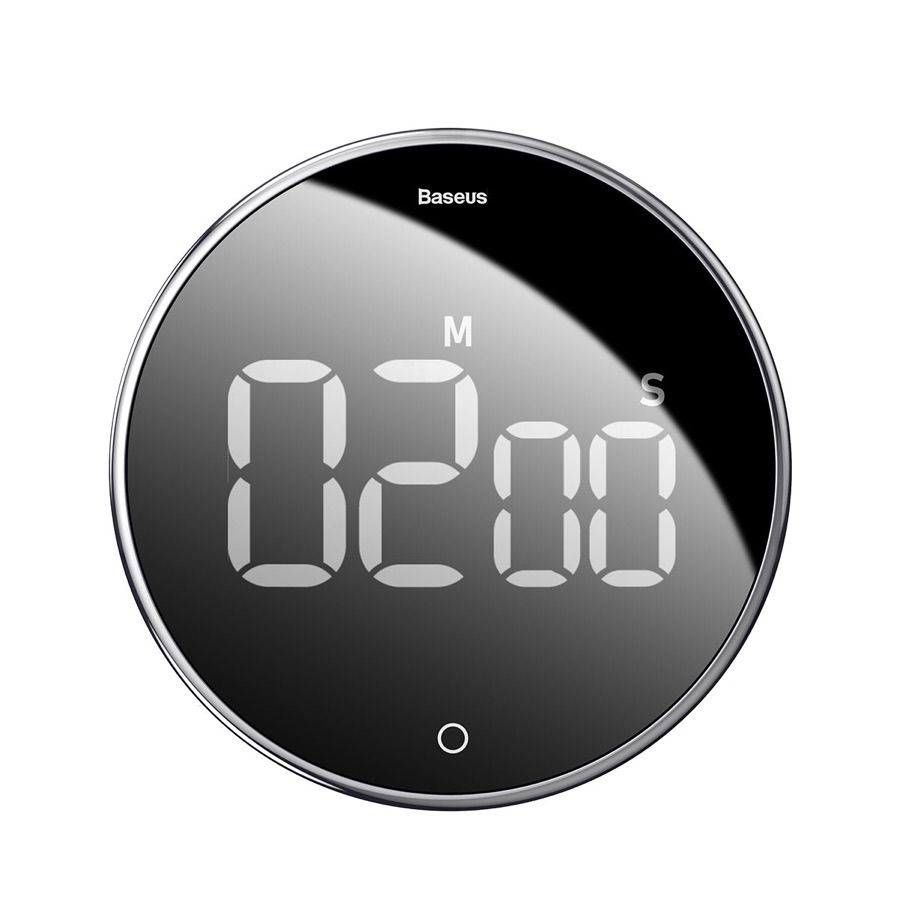

Everything in this category is a copy of this. Baseus launched the Heyo around 2019 and won a Taiwan Golden Pin Design Award for it. Spin the ring to set the time, slowly for five-second steps and faster for minutes, press the face to start or pause. Countdown or count up to 99 minutes 55 seconds, three volume levels including a mute mode that flashes the display instead, auto-dimming, a magnetic back with non-slip pads, three AAA cells, about 78 mm across.
The catch: Baseus no longer lists it on its own stores, including the German one. It survives on Amazon, marketplace sellers and regional Baseus distributors, alongside a swarm of near-identical clones from Vabaso, LIORQUE, Hommini, AVINIA, Ultralent and others.
What I own: Vabaso
Mine is one of those clones, and it is the knurled-ring version, which is the detail that matters. The diamond-pattern silver bezel gives you something to grip, so you can set a time one-handed while it stays stuck to the fridge.
B083GH3RL9, 4.3 stars from 2,662 ratings, three volume modes up to 90 dB, magnetic. The one real annoyance: the alarm beeps for a full minute. Charming in a kitchen, unbearable in an office. Learn where the mute mode is.
What I am buying next: LIORQUE aluminium
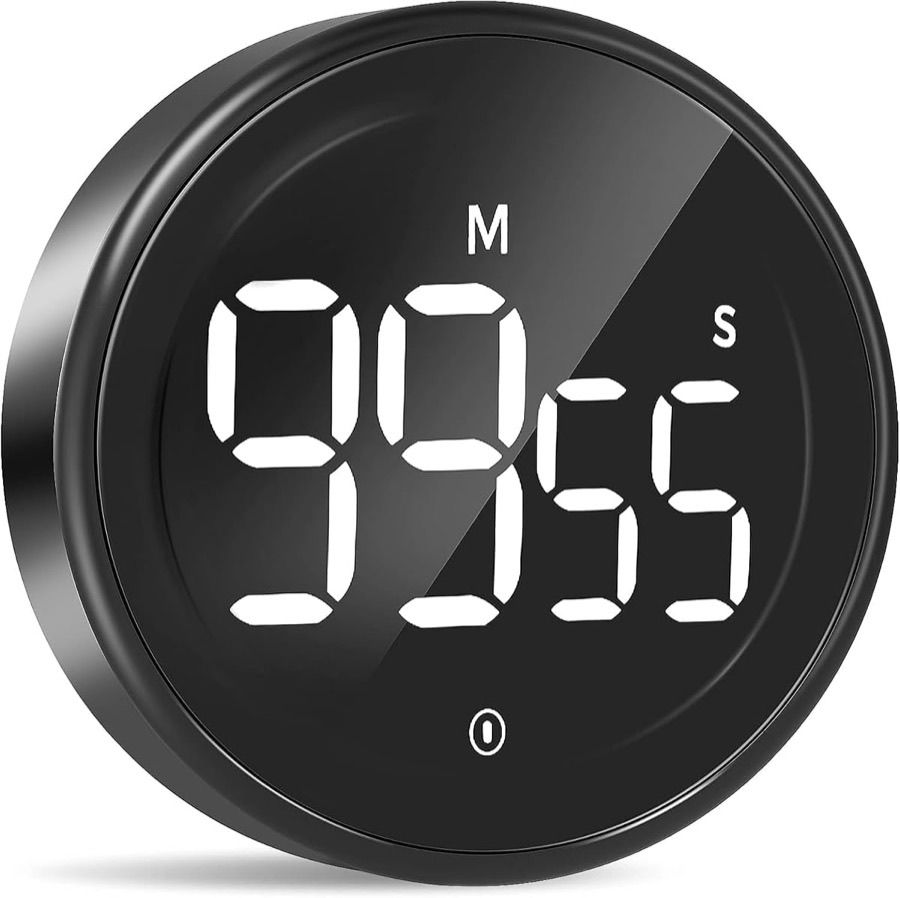
B08DJ3XJ5X, 4.5 stars from 3,079 ratings, an aluminium alloy frame rather than plastic, three volume levels from 0 to 90 dB, two brightness modes (constant or an eco dim), 99-minute countdown and count-up, magnetic with anti-slip pads, 140 g, battery included.
Look closely at the photo before ordering: the LIORQUE ring is smooth anodised aluminium, not knurled. You gain a metal ring and a cleaner look, and you lose the grip texture. Whether that is an upgrade depends entirely on whether you set it on the desk or on a vertical fridge door. German reviews are consistent on the two things that matter here: the dial action is good and the magnet holds, though a couple of buyers on stainless steel added their own magnets. One reviewer using it for Pomodoro docks a star for having no vibration alert.
| Baseus Heyo | Vabaso (mine) | LIORQUE alloy | |
|---|---|---|---|
| Ring | Knurled metal | Knurled metal | Smooth aluminium |
| Rating | Design award | 4.3 from 2,662 | 4.5 from 3,079 |
| Volume | 3 levels, mute | 3 levels, 90 dB | 3 levels, 0 to 90 dB |
| Brightness | Auto-dim | Auto-dim | 2 modes |
| Availability | Marketplace only | Amazon.de | Amazon.de |
Buy on feel, since the internals are the same everywhere: a metal ring rather than plastic, magnets strong enough to hold while you turn the ring, and a mute mode. Ten to twenty euros. Do not overthink it.
Keypad and LCD digital timers
The unglamorous category, and the one that wins when you need an exact time or several at once.
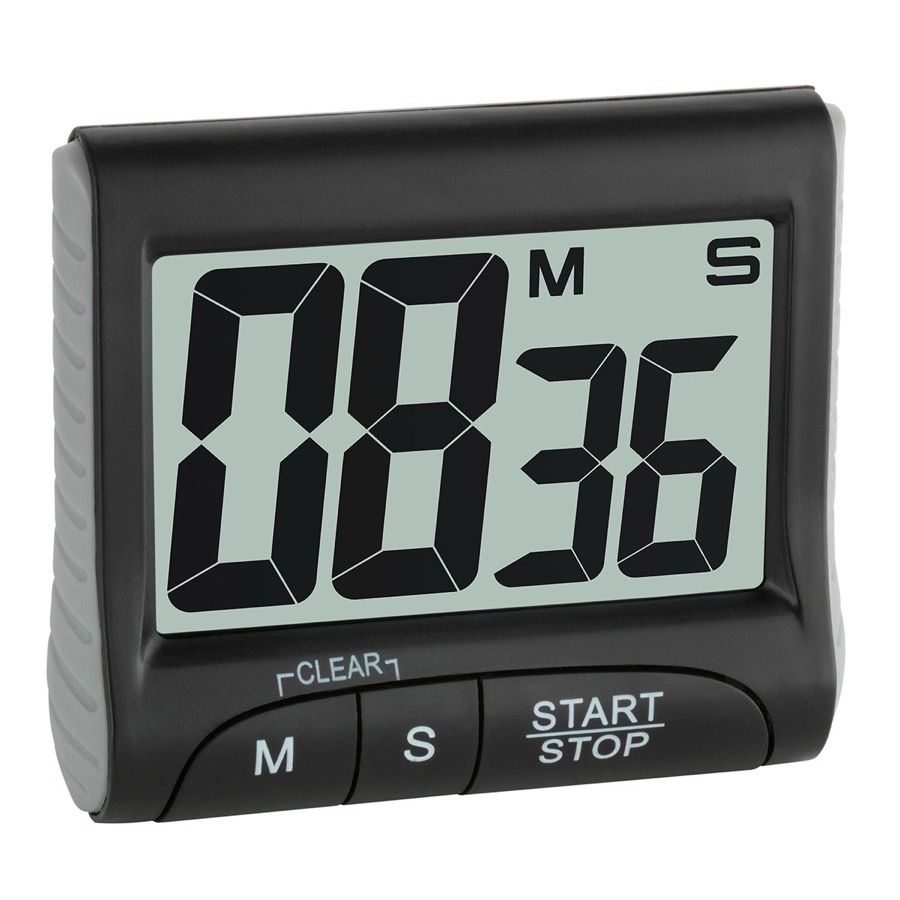
The TFA 38.2021 is the archetype: 83 x 70 mm, a display you can read across a room, counts to 99:59 up or down, one AAA cell, and four mounting options in the box (magnet, stand, clip, hanger). The memory function matters more than it sounds, because it saves re-entering the same time every session.
This is the shape almost every cheap rectangular Amazon timer copies, the way the Baseus Heyo is the shape every round one copies. They work. Buy the TFA and skip the clones here: at this price the difference is a few euros, and the German one has the memory function and the four mounts.
When you need three timers at once, there is one obvious answer:
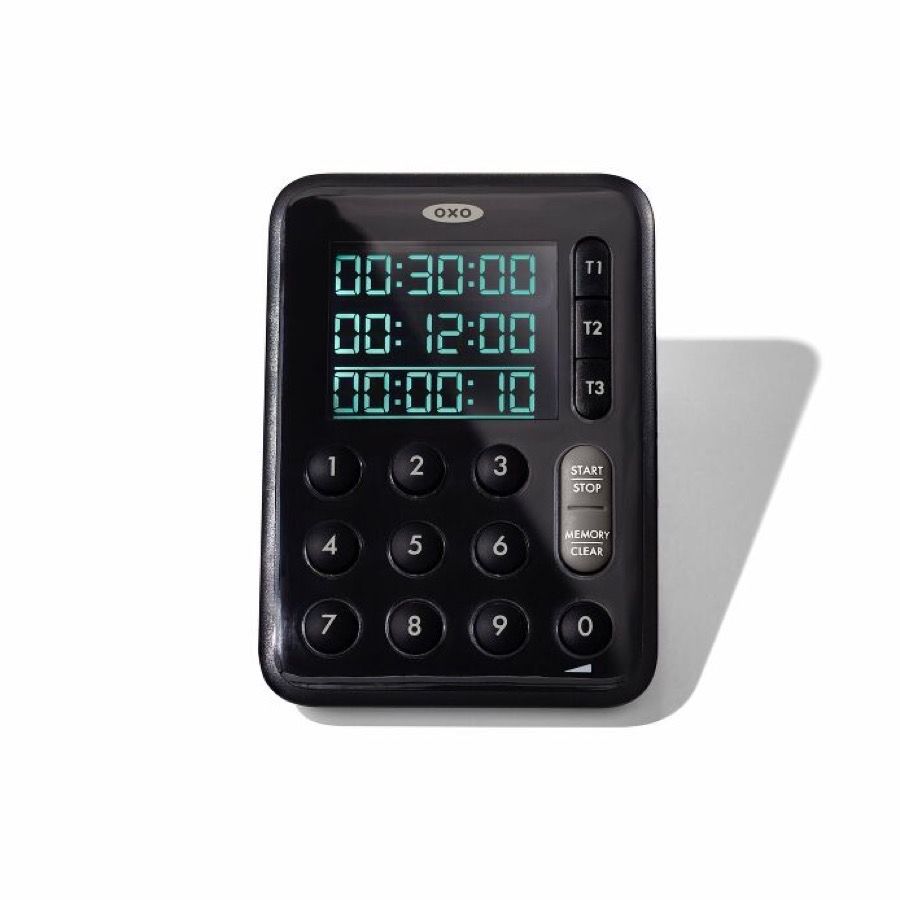

Three channels, each up to 100 hours, a full numeric keypad so you type 45 rather than holding a button 45 times, an angled base for reading from above, and three distinct beep patterns so you know which one fired without looking. Built for a kitchen on Christmas Day, equally good for anyone juggling parallel processes.
Interval timers for training
Different requirement. Here you are not timing one block, you are programming a work/rest pattern and then never touching the device again while sweating.
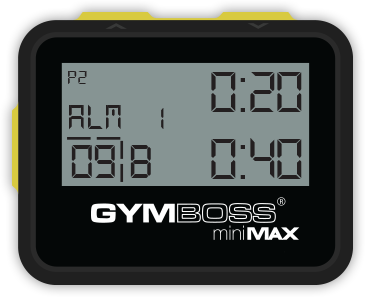
The Gymboss miniMAX is the standard for a reason. Up to 25 different intervals in a sequence, 20 saved programmes, and repeats at three levels (an interval up to 99 times, a group up to 99 times, the whole sequence up to 99 times). Alert by beep, vibration or both, with 1, 2, 5 or 9-second durations. Roughly 4.5 x 5.5 x 1.3 cm, one AAA cell, shock resistant, removable belt clip, one-year warranty. The vibration alert is the feature that justifies it: it works with headphones in, in a loud gym, and without waking the house at 06:00.
For a wall, the app-driven option:
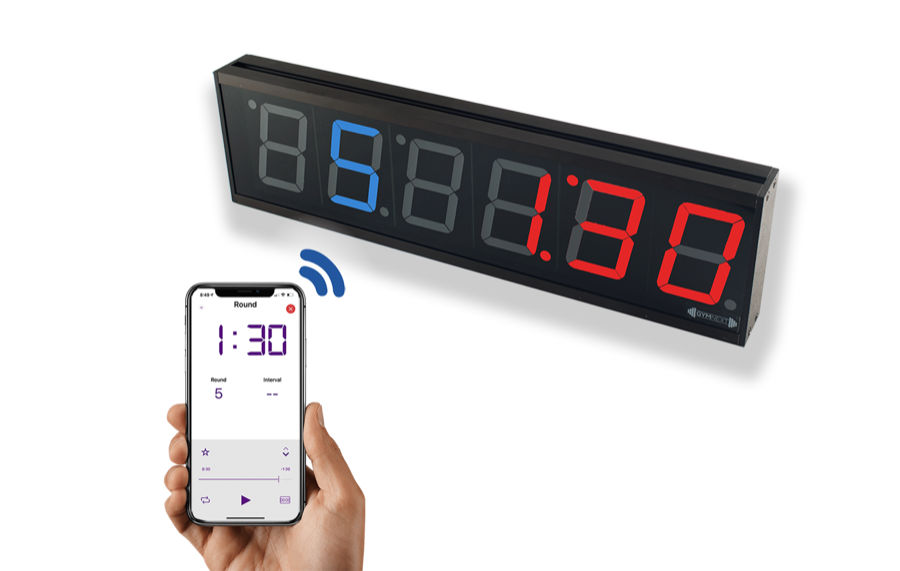

Count up, count down, Tabata, EMOM, rounds and intervals, all programmed from the phone and stored on the clock, with unlimited saved workouts. The app dependency is the trade: brilliant for varied programming, needless if you only ever run 40/20.
Cheaper wall option: the Synergee 7-inch magnetic interval timer, around 40 USD, 30-hour battery, no app, magnetic mount.
Apps still win on flexibility. Seconds by Runloop remains the best interval timer on iOS: complex sequences, spoken interval names, and music that ducks for the announcement. The argument for hardware is the same as everywhere in this note. The phone is the distraction you are trying to leave alone.
What I would actually buy
| Use case | Buy | Why |
|---|---|---|
| Deep work blocks | Time Timer MOD | Silent, visible, no numbers to read |
| Pomodoro discipline | TickTime TK3 Pomodoro Timer Cube | Flip to start, auto 25/5 cycling |
| Cheap fixed blocks | TFA CUBE-TIMER | Four faces, no thinking required |
| Kitchen and ad-hoc | LIORQUE alloy puck | Fastest to set, metal ring, magnetic |
| Several timers at once | OXO Triple Timer | Keypad entry, three channels |
| Home gym intervals | Gymboss miniMAX | Vibration alert, saved programmes |
| Garage gym wall clock | GymNext Flex Timer | Programmed once, readable across the room |
My take
Two devices cover almost everyone: a Time Timer MOD on the desk and a Gymboss miniMAX in the gym bag. Around 65 EUR for the pair, and neither has ever needed a firmware update.
The rotary pucks earn their place by being the fastest thing here to set, which is why I have three and why they get used daily. They are still a kitchen tool that happens to work on a desk: no vibration, no programmes, no silent countdown you can glance at. The 60 EUR flip cubes are a genuine upgrade only if the automatic Pomodoro cycling is something you will actually use, and the honest test is whether you already run 25/5 without being told to. See Resources for Deep Work for why the block length matters more than the device.
The one thing I would avoid is buying the cheapest of anything here. The failure modes are all the same and all irritating: a weak magnet that slides down the fridge, a ring that feels gritty, an alarm you cannot mute, and a beep that runs a full minute.
Further Reading
- Time Timer, official store, and timetimer.eu for Europe
- TFA Dostmann timers, the German range including cube and analogue models
- Gymboss and GymNext for interval training
- OXO Good Grips Triple Timer
- Baseus, origin of the rotary puck design
- My note on the TickTime TK3 Pomodoro Timer Cube flip cube