
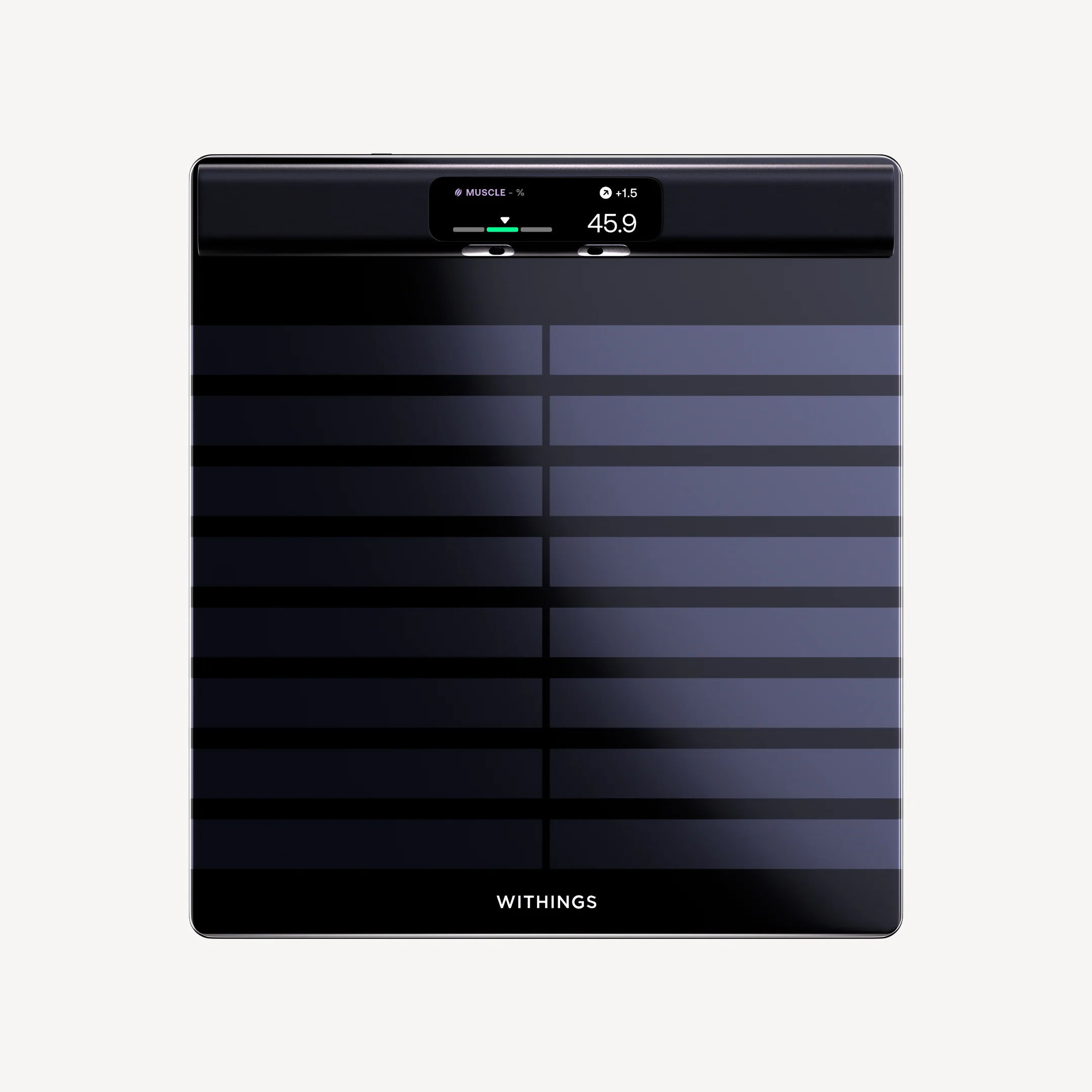
The Withings Body Scan 2 is a smart scale that behaves more like a home health station. Step on it, pull up the retractable handle, and in about 90 seconds it reads over 60 biomarkers: weight and segmental body composition, a 6-lead ECG, vascular age, blood oxygen, and new-for-this-model hypertension and cellular-health signals. It won a CES 2026 Innovation Award and is the clearest example yet of the scale becoming a longevity dashboard.
Overview
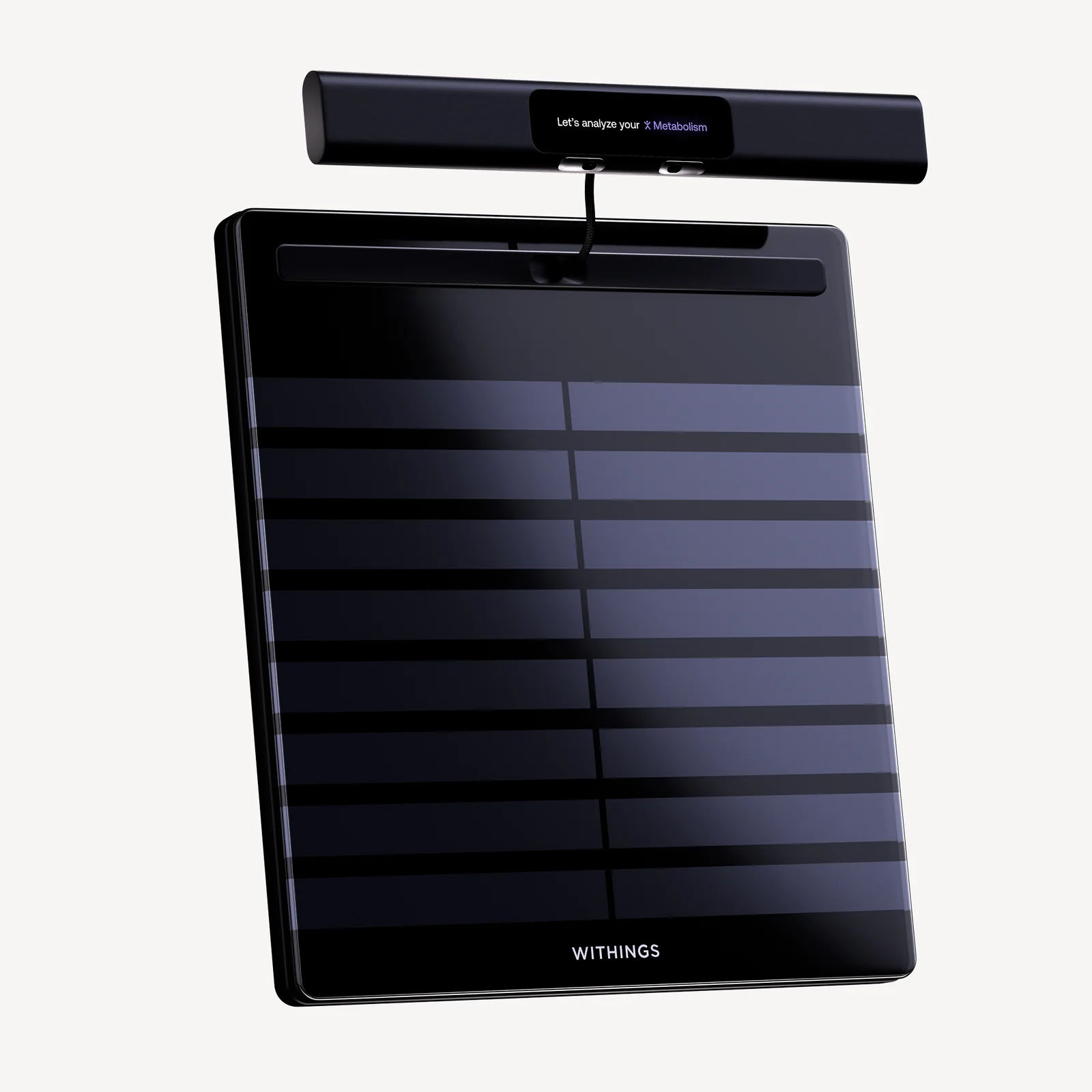
A premium connected scale that measures far more than weight. It stands out for its retractable handle with grip electrodes, which closes a full-body electrical circuit for ECG and segmental analysis, and for the sheer breadth of metrics (60+ biomarkers in ~90 seconds). At €437.95 in Europe (about $599.95 in the US), it is priced like a medical device, not a bathroom scale. The value proposition: one device that tracks cardiovascular, metabolic, and cellular health over time and flags problems (arrhythmia, high blood pressure) early.
Detailed Specifications
| Spec | Detail |
|---|---|
| Price | €437.95 (EU); ~$599.95 (US) |
| Colour | Black |
| Measures | Weight, 6-zone segmental body composition (fat %, muscle, bone, water), visceral fat, BMR, heart rate, 6-lead ECG, AFib detection, SpO2, vascular age, pulse wave velocity, nerve reaction score (hands/feet) |
| New vs Body Scan 1 | Impedance Cardiography (ICG, heart-pump efficiency), Bioimpedance Spectroscopy (BIS, cellular health), hypertension notifications, pre-diabetes signals |
| Electrodes | 12 total: 8 ITO-glass + 4 stainless-steel grip electrodes |
| Bioimpedance | Multi-frequency spectroscopy, up to 13 frequencies to 800 kHz |
| Handle | Retractable, auto-locking, haptic guidance; houses 3.2" LCD colour display (640x172) and multi-wave PPG for SpO2 |
| Weight range | 5-200 kg, 50 g precision |
| Users | Auto-recognises up to 8; athlete and baby modes |
| Connectivity | Wi-Fi 802.11 b/g/n; Bluetooth "coming soon"; unlimited cloud, 16 measurements stored offline |
| App | Withings app (iOS 18+, Android 12+); syncs to Apple Health and Google Health Connect |
| Battery | Rechargeable Li-ion, up to ~15 months per charge, USB-C |
| Dimensions | 325 x 357 x 18.5 mm, 3.4 kg; foldable ITO glass platform, reinforced aluminium frame |
| Certification | CE-certified medical device (EU, from 14 Apr 2026); US FDA clearance for heart metrics still pending |
The markers, explained
The Body Scan 2 reports 60+ values across four systems. Below is what each one is, what a good versus concerning reading looks like, and why it matters. Two caveats before the numbers: bioimpedance readings are estimates best used as trends (weigh at the same time of day, similar hydration), and the ranges here are general clinical references (ACC/AHA for blood pressure, ADA for glucose, published bioimpedance norms), not Withings' exact proprietary cut-offs. None of it replaces a doctor; it flags what to ask about.
Body composition
Weight. Total body mass, to 50 g precision, 5-200 kg range. On its own it is the least useful number here (it cannot tell fat from muscle from water); its value is as the denominator for every percentage below and as a daily trend line. Track the 7-day average, not the daily jitter.
Body fat percentage. The share of body weight that is fat tissue.
| Category | Men | Women |
|---|---|---|
| Essential (too low) | 2-5% | 10-13% |
| Athletic | 6-13% | 14-20% |
| Fitness (good) | 14-17% | 21-24% |
| Average / acceptable | 18-24% | 25-31% |
| High risk | 25%+ | 32%+ |
A good reading sits in the fitness-to-average band for your sex and age. Concerning is the high-risk band, or dropping below essential fat. It matters because excess fat, especially with high visceral fat, drives cardiometabolic risk, while too little disrupts hormones, immunity, and bone health.
Segmental distribution (6 zones). Fat and muscle broken out per limb (both arms, both legs) plus trunk and abdomen. This is what the handle unlocks over a normal scale. Good is roughly symmetric left-to-right; a persistent imbalance can flag an under-recovered injury or uneven training, and a high trunk/abdomen share points to the visceral fat that carries the most risk.
Muscle (skeletal muscle mass). The proportion of weight that is skeletal muscle. Healthy is roughly 50-65% for men, 45-60% for women; higher, paired with real strength, is better. Low muscle (below ~50% men / ~45% women, or a falling trend) signals sarcopenia risk. It matters for strength, mobility, metabolic reserve, and glucose control, and it is the single metric most worth defending as you age.
Bone mass. An estimate of bone mineral content, typically 3-5% of body weight. Treat it as a stability check, not a diagnosis: a smart scale is not a DEXA bone-density scan. A stable value in range is fine; a low or steadily falling estimate is a prompt to ask about bone density, since low bone mass raises fracture risk.
Body water percentage. Share of weight that is water, usually 50-65% (men), 45-60% (women). Muscle holds more water than fat, so a higher figure often just tracks more muscle. Persistently low can mean dehydration or a high fat proportion; unusually high can reflect fluid retention. Best read as a hydration-consistency signal alongside the composition numbers.
Visceral fat. Fat stored around the abdominal organs, reported as an index. A common interpretation: 1-12 is healthy, 13+ is high (Withings uses its own visceral fat scale, so watch the direction more than the absolute). This is the most important fat number on the scale: visceral fat is metabolically active and independently raises the risk of type 2 diabetes, fatty liver, and cardiovascular disease, even at a normal total body fat.
Basal metabolic rate (BMR). Calories burned at rest to keep you alive, estimated from your composition, so roughly 1,200-1,500 kcal/day (women) and 1,500-1,900 (men), scaling with lean mass. There is no universal "good" value; a BMR consistent with your size and lean mass is the point. A rising BMR usually means you added muscle. It matters as the base for estimating daily calorie needs.
Cellular health / phase angle (BIS). New on the 2: bioimpedance spectroscopy sweeps many frequencies to derive phase angle, a marker of cell-membrane integrity and cell mass. Typical healthy is about 6-8 degrees (younger men), 5-7 (younger women), declining with age; below ~4-4.5 degrees is concerning. Higher means more, healthier cells and muscle; low phase angle tracks with malnutrition, inflammation, sarcopenia, and frailty, and predicts worse outcomes in chronic illness. BIS also splits extracellular vs intracellular water, where a rising extracellular share can signal inflammation or fluid overload.
Heart and vascular
Resting heart rate. Beats per minute at rest. Normal is 60-100 bpm; for most healthy adults the mid-50s to low-70s is a good, fit range, and trained athletes run 40-60. Persistently above ~90, or a sustained jump of 10-15 bpm over your baseline, is worth attention; below 50 without training, or above 120 at rest, warrants a check. A lower resting rate (feeling well) tracks with better fitness and lower long-term cardiovascular risk.
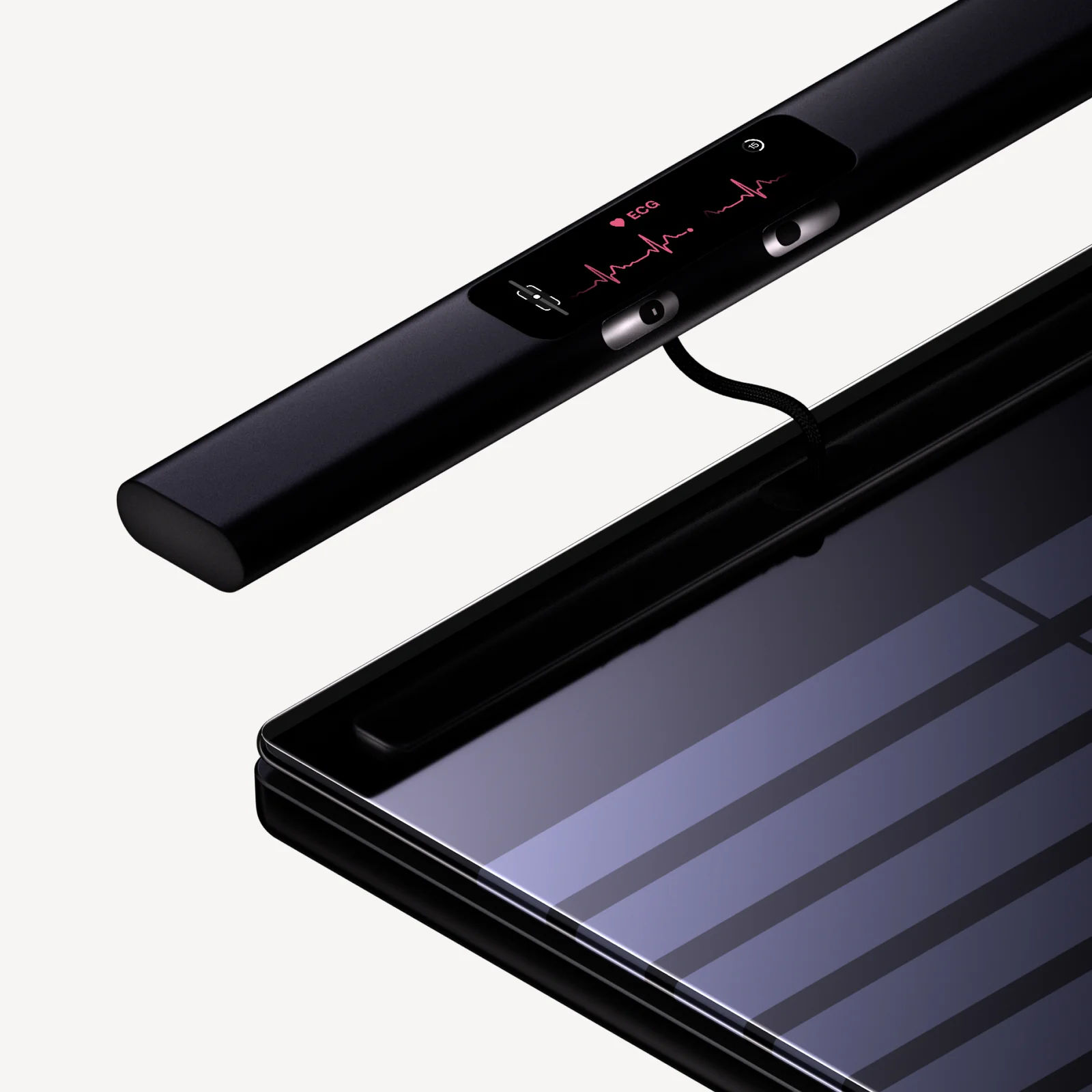
6-lead ECG. The handle electrodes record your heart's electrical rhythm and screen for atrial fibrillation (AFib). Good is normal sinus rhythm; a flagged irregular rhythm is the signal to see a doctor. It matters because AFib is common, often symptomless, and raises stroke risk roughly fivefold, so catching it early is genuinely high-value. (On the Body Scan 2, full ECG/arrhythmia depth pairs with Withings' ECG ecosystem; US heart features await FDA clearance.)
Blood oxygen (SpO2). Percentage of hemoglobin carrying oxygen, read by the PPG sensor in the grip. 95-100% is normal; below 94% is worth watching, and 90% or under is hypoxemia that needs assessment. Recurrent low readings can point to sleep apnea, lung, or heart problems, which is why it is a useful passive screen.
Vascular age. How old your arteries behave versus your calendar age, inferred from arterial stiffness signals. Good is equal to or younger than your real age. Concerning is 5-10+ years older, and 10-15 years older sits in a clearly elevated-risk band. It bundles several risk factors into one number that tracks heart-attack and stroke risk, and it moves with blood-pressure and lifestyle changes.
Pulse wave velocity (PWV). The speed the pulse travels along the aorta, in m/s; faster means stiffer arteries. Rough bands: 5-7 m/s is normal for younger adults, 7-9 for middle age, and it climbs to 9-12+ with age. Above roughly 10 m/s for your age band is concerning. Arterial stiffness is an early, independent predictor of cardiovascular events, often shifting before blood pressure does.
Cardiac output and stroke volume (ICG). New on the 2: impedance cardiography estimates how much blood the heart pumps per beat (stroke volume, ~60-100 mL) and per minute (cardiac output, ~4-8 L/min at rest). Below ~4 L/min at rest can mean under-perfusion; well above 8 at rest reflects a hyperdynamic state (fever, anemia, thyroid). Clinically, ICG trends help manage resistant hypertension and flag worsening heart failure, so it is a real cardiac-function window, not just a fitness stat.
Hypertension / blood-pressure risk. The Body Scan 2 issues hypertension risk notifications from its cardiovascular signals (it is not a cuff, so treat it as a screen that tells you to measure properly).
| Category | Reading (mmHg) |
|---|---|
| Normal | under 120/80 |
| Elevated | 120-129 / under 80 |
| Stage 1 hypertension | 130-139 / 80-89 |
| Stage 2 hypertension | 140+ / 90+ |
| Crisis (seek care) | 180+ / 120+ |
High blood pressure is the classic silent risk factor: sustained elevation quietly damages heart, brain, kidneys, and eyes, so an early flag is worth acting on.
Heart age (Withings+). A composite "cardiovascular age" built from your combined heart and vascular metrics, behind the subscription. Good is a heart age at or below your real age; higher is a prompt to address blood pressure, lipids, activity, and weight. Its job is motivational: one number that summarizes cardiovascular risk trajectory.
Metabolic
Glucose resilience / pre-diabetes signal (Withings+, coming soon). An estimate of how well your body handles glucose. The scale does not draw blood, so it infers a resilience trend rather than a lab value; the clinical anchors it maps toward are:
| Status | Fasting glucose | HbA1c |
|---|---|---|
| Normal | under 100 mg/dL (5.6 mmol/L) | under 5.7% |
| Prediabetes | 100-125 mg/dL (5.6-6.9) | 5.7-6.4% |
| Diabetes | 126+ mg/dL (7.0+) | 6.5%+ |
It matters because prediabetes is common, largely symptomless, and often reversible with diet, activity, sleep, and weight loss; an early nudge is the whole point. Confirm anything flagged with a real blood test.
Nerves and stress
Nerve health (sudomotor / electrodermal). Foot electrodes measure sweat-gland electrical conductance, a proxy for small-fiber and autonomic nerve function. On the sudomotor scale used clinically, foot conductance around 60 microsiemens or above is normal, 40-60 borderline, under 40 abnormal. Reduced conductance is an early sign of peripheral neuropathy, most often diabetic, frequently before you feel numbness or tingling. Early detection means you can act while nerve damage is still preventable.
Chronic stress. Derived from heart-rate and pulse-wave signals during the scan (higher heart-rate variability generally means better recovery and lower physiological stress; consistently low points to chronic stress load). Treat it as a coarse trend, not a diagnosis. It matters because sustained stress feeds blood pressure, poor sleep, and cardiometabolic risk, so a downward trend is a useful early warning.
Background & Context
Withings has made connected health hardware since 2008 (it invented the Wi-Fi scale) and has leaned hard into clinical-grade home monitoring. The original Body Scan launched at €399.95 as the first scale with a handle-based ECG and segmental composition. The Body Scan 2 is the deeper-diagnostics follow-up: it keeps the handle-and-glass electrode design but adds ICG (how efficiently the heart pumps) and BIS (cellular and metabolic health), plus hypertension and pre-diabetes flags, pushing it further into cardiometabolic screening.
Withings claims 99% correlation with DEXA for fat-mass measurement in internal testing, which if it holds up is the meaningful part: consumer bioimpedance scales are usually poor at absolute body-fat numbers and only useful for trends. The competitive picture is thin at this level. Nothing from Garmin (Index scales) or the cheap Wi-Fi crowd offers ECG plus segmental medical-grade analysis; the real alternative is the previous Body Scan or a bag of separate devices (a scale, an ECG patch, a blood-pressure cuff).
Pros & Cons
Pros
- Enormous metric breadth from one 90-second scan; genuinely a health dashboard.
- Handle electrodes enable 6-lead ECG and segmental analysis that plain scales cannot do.
- Strong claimed accuracy (99% DEXA correlation for fat mass).
- CE medical-device certification in the EU, not just a wellness gadget.
- Clean data flow into Apple Health / Google Health Connect; up to 8 users; ~15-month battery.
- Early warnings for AFib and high blood pressure that could actually matter.
Cons
- Expensive: €437.95, plus the best insights sit behind a subscription.
- Withings+ paywall: heart age, glucose resilience, and longevity scoring need Withings+ (first month free, then ~$99.50/year).
- Several headline features are "coming soon" (Bluetooth, glucose resilience, pregnancy/eyes-closed modes).
- US heart metrics await FDA clearance; regional feature parity varies.
- Not for everyone: not recommended with a pacemaker/implant, during pregnancy, or under 22 for hypertension alerts.
- Data-privacy consideration: this is a lot of sensitive health data living in a vendor cloud.
Who It's For
The buyer is a quantified-self or longevity-minded person who wants trend data on heart, body composition, and metabolic health at home and will actually act on it. It suits a health-conscious household (up to 8 users) and anyone with a family history of cardiovascular or metabolic risk who values early flags. It is overkill if you only want body weight and a rough body-fat trend; a €50 Wi-Fi scale covers that. It is also a poor fit if a recurring subscription for the best features annoys you, or if you would rather not centralise health data in a vendor cloud.
Buying Considerations
- Where to buy (EU): the Withings store direct, or Amazon.de and MediaMarkt for local warranty and returns. Two-year warranty included.
- Budget the subscription: factor ~$99.50/year for Withings+ if you want heart age, longevity scoring, and glucose resilience. The core weight and body-composition tracking work without it.
- Alternatives: the original Withings Body Scan (cheaper, no ICG/BIS), a Garmin Index scale (composition only, no ECG), or splitting functions across a basic smart scale plus a dedicated ECG/blood-pressure device.
- Check first: confirm which advanced metrics are live in your region at purchase, since several are staged rollouts, and that you are not in an excluded group (implant, pregnancy).
Data Privacy
This device generates one of the most sensitive datasets you can hold on yourself: ECG traces, cardiovascular risk, body composition, nerve function, soon glucose signals. All of it lives in Withings' cloud, so how they handle it matters as much as the specs.
How Withings handles it
Withings is a French company, and its data model is built around EU health-data law:
- Stored in France, kept in the EEA. Health data is hosted only on HDS-certified servers in France (Hébergeur de Données de Santé, the French health-data hosting standard) and, per the policy, "is not transferred outside the EEA." Non-health data can go to partners outside the EEA, health data does not.
- Certified. GDPR compliant, plus ISO 27001, ISO 27701 (privacy management), and HDS. Data is encrypted in transit and at rest; partner apps authenticate via OAuth 2.0.
- Not sold. The policy states personal data "will never be sold on any medium whatsoever without your explicit consent," and it is not shared with advertisers. Routine sharing is limited to service providers (hosting, delivery).
- Named medical partners. Cardio review services route data to specific partners: Heartbeat Health in the US, and DPV Analytics (a German firm whose cardiologists power Cardio Check-Up in France and Germany). This only happens for the service you opt into.
- Your rights. Full GDPR set: access, export/portability, rectification, objection, and deletion. You can delete your account yourself (with a 7-day reconsideration window), contact privacy@withings.com, and escalate to the French regulator CNIL. Inactive accounts are auto-deleted after 10 years plus a 90-day notice; billing records are held 10 years by law.
- No known health-data breach surfaced in the research.
The risks to weigh
- Cloud centralization. A rich, medical-grade profile in one vendor cloud is a high-value breach target and a single point of failure. Certifications lower the odds; they do not remove them.
- Vague secondary use. The policy is clear on hosting and sharing but thin on AI training and research. Processing leans on broad bases ("product improvement," "legitimate interest"), so exactly how de-identified data feeds algorithms is not spelled out.
- Subscription and vendor dependency. The best insights sit behind Withings+, so the data's usefulness is tied to an ongoing paid relationship and to Withings' corporate direction (it was sold to Nokia in 2016 and bought back in 2018; ownership can shift again, and data governance with it).
- Regional asymmetry. EU residents get the strongest protection (data in the EEA, HDS, CNIL recourse). US data touches a US partner and a different legal regime, and consumer wellness data is generally not HIPAA-protected the way clinical records are.
- Government requests. The policy allows disclosure to legal authorities when required but does not publish a transparency process for law-enforcement requests.
- Account security is on you. One login guards the whole profile. Without a strong, unique password and two-factor authentication, that is the weakest link, not Withings' servers.
Bottom line for me
For an EU user, this is about as good as consumer health-data hosting gets: French hosting, GDPR, HDS certification, CNIL recourse, and cardio review by a German company under EU jurisdiction. The residual risks are structural, not Withings-specific: centralizing very sensitive data in a for-profit cloud, loose language on secondary use, and dependence on a subscription and a company whose ownership has already changed once. Practical hygiene: strong password plus 2FA, only enable the services and sharing I actually use, review the Withings+ partner consents, and remember I can export and wipe the data if I ever want out.
Verdict / My Take
The Body Scan 2 is the most capable consumer scale on the market and the strongest sign yet that the bathroom scale is turning into a longevity screening tool. If the DEXA-level accuracy claim holds and the ECG/hypertension flags are reliable, it is a legitimately useful early-warning device, not a gimmick. The friction is the model: a €438 device that then asks ~$100/year for its smartest features, with a chunk of the spec sheet still "coming soon." For a data-driven person who will use the trends, it earns its place. For most people, a cheap Wi-Fi scale plus a separate ECG-capable watch delivers 80% of the value for a fraction of the cost.
Further Reading / Sources