Merz b. Schwanen does not sell one t-shirt in many colours. It sells a small family of the same idea, split first by where and how the cloth is knitted, then by weight, fit and era. Once you understand that split, the style codes stop looking like part numbers.
The brand sits on 2 pillars:
- The Originals, knitted in Germany on old machines. Loopwheelers and 1960s circular jersey machines, organic cotton, slow production, more structure, sizes that run small.
- The contemporary line, made with partners in Portugal. Same design language, more colours, more stock, usually side seams, a more modern everyday fit.
If you remember one thing: 215 is the icon, 2M15 is the practical sibling, 1950s is the lighter classic, TEE02 is the everyday modern tee.

How the brand itself sorts them
Merz does not organise its t-shirts by nostalgia. The official guide sorts them by fabric weight, and it says so plainly:
Welcome to our T-shirt guide! Explore our diverse range of T-shirts, thoughtfully categorized by fabric weight to help you find your ideal match. [...] The weights are based on the fabric's weight per square-yard and square-meter.
Three bands, with the brand's own descriptions:
| Band | Weight | Merz's words |
|---|---|---|
| Lightweight | 4.1 to 4.9 oz/sq.yd. (140 to 165 g/sqm) | "Easy-going & airy materials", "perfect for warm days or layering" |
| Mid-weight | 6.0 to 7.2 oz/sq.yd. (210 to 245 g/sqm) | "Sturdy & comfortable", 100% organic cotton |
| Heavyweight | 10.7 oz/sq.yd. (340 g/sqm) | "Sturdy & durable", 100% organic cotton |
On the heavyweight they are not modest:
At 10,7oz/sq.yd. (340g/sqm), this is likely the world's heaviest loopwheeled T-shirt, making it an absolute powerhouse!
And on the mid-weight, the pitch that covers the 215:
Sturdy feel, comfortable wear: weighing between 6,0oz/sq.yd. (210g/sqm) and 7,2oz/sq.yd. (245g/sqm), these durable styles offer both comfort and a cool look wherever you go.
The loopwheeled Originals
Knitted as a tube on vintage loopwheel machines, so there are no side seams. The cloth is dense and slightly springy, and it ages in a way cheap jersey does not. Underarm triangle gussets and baseball stitching at the hem and sleeves are the house details.
| Style | EUR | Weight / knit | Fit | What it is |
|---|---|---|---|---|
| 114 | 90 | Fine heritage jersey | Classic | 1920s crew with a turned-over collar. The museum piece |
| 1950s | 85 | 1-thread lightweight | Classic | The house staple. Soft, light, drapey. White runs a little sheer |
| 1940s | 90 | Same light 1-thread | Relaxed | 1950s cloth with a roomier body |
| 1940sP | 85 | Same light 1-thread | Relaxed + pocket | Pocket version of the 1940s |
| 215 | 105 | 2-thread midweight | Classic, tubular | The icon. Structured, opaque, paneled crew, no side seams |
| 215P | 105 | Same as 215 | Classic + pocket | Chest pocket version of the icon |
| 214 | 110 | Same 2-thread midweight | Relaxed | 215 cloth with roughly 6cm more chest room |
| 214PK | 115 | Piqué midweight | Relaxed | The one most lineup summaries miss. Piqué knit, more texture |
| 2S14 | 150 | 2-thread heavyweight | Relaxed | The tank. Slubby, workwear-thick, still seamless |
The distinction the brand itself draws is 215 against 1950s: same classic cut, different cloth. The 1950s is 1-thread and light. The 215 is 2-thread, heavier, rougher and more structured.
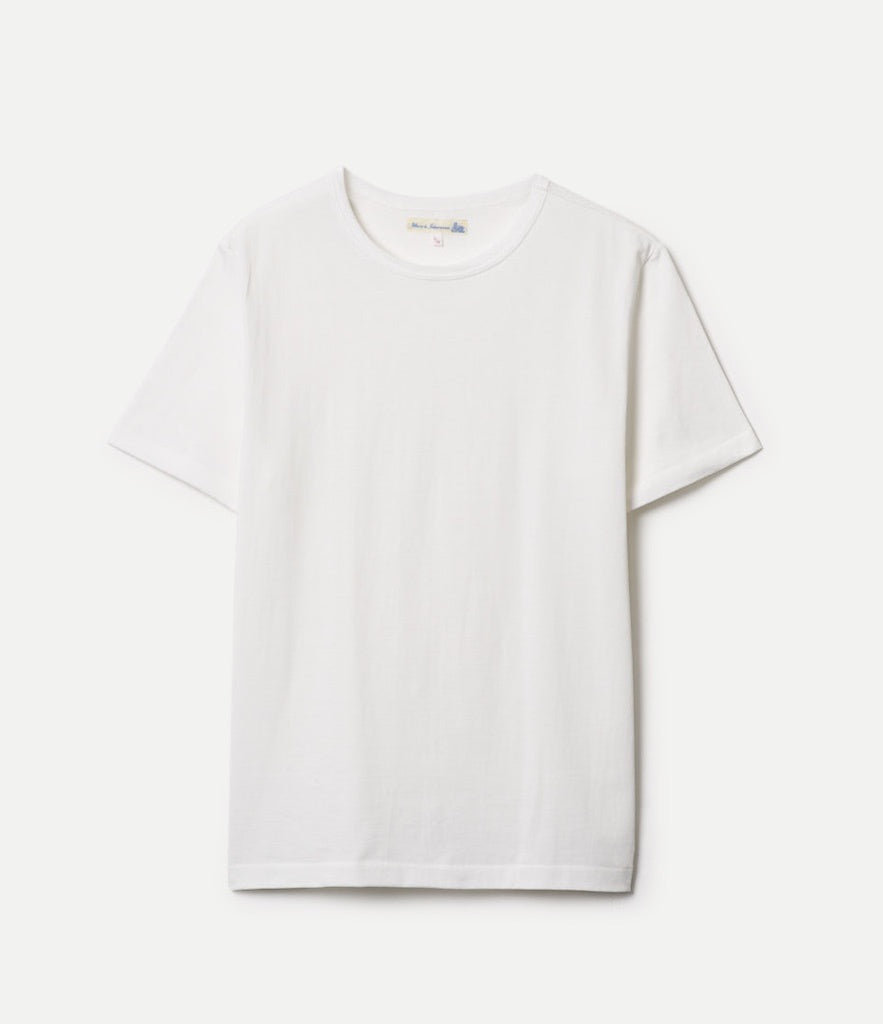
The 2M15 mid-century family
When demand for the 215 exploded after The Bear, Merz could not scale loopwheel production. Loopwheelers are slow and there are only so many of them. The answer was a second German family, knitted on original 1960s circular jersey machines.
These have side seams on purpose. The 215's tubular knit produces a straight, almost architectural body. The 2M15 is cut to follow a modern torso.
| Style | EUR | What it is |
|---|---|---|
| 2M15 | 90 | 6.8 oz / 230 g/sqm organic jersey, refined fit. The real everyday substitute for a 215 |
| 2M15C | 90 | Cropped. Sits on the waistband, works with high-rise or wide trousers |
| 2M15P | 90 | Pocket version in the same mid-century cloth |
The shorthand that stuck with me: 215 is Bauhaus, a seamless tube. 2M15 is mid-century, seamed, slightly lighter and easier to live with.
The Portugal line
The obtainable "just a very good t-shirt" styles. Still organic cotton, made with partners in Portugal rather than on the Albstadt loopwheelers.
| Style | EUR | What it is |
|---|---|---|
| TEE02 | 75 | Classic organic cotton jersey, about 6 oz / 210 g/sqm, side seams. The volume everyday tee |
| TEE02C | 75 | Cropped TEE02 |
| TEE03 | 75 to 85 | Authentic jersey, relaxed body, slightly higher and more athletic neck |
| SCT04 | 70 | Slub Pima cotton, relaxed, very soft, good in heat |
| HPT01 | 70 | Organic cotton and hemp, all plant-based |
| PIMATEE01VP | 60 | Vintage Pima cotton. The cheapest way into the brand |
| PIMATEE01V | 65 | Soft Pima V-neck |
| LINEN03 | 90 | Linen-cotton relaxed fit with a side slit |
| GHP01 | 120 | Sturdy boxy Giza cotton-hemp |
| CASHTEE01 | 120 | Premium cotton-cashmere |
| MERINOTEE01 | 145 | Refined knitted merino wool |
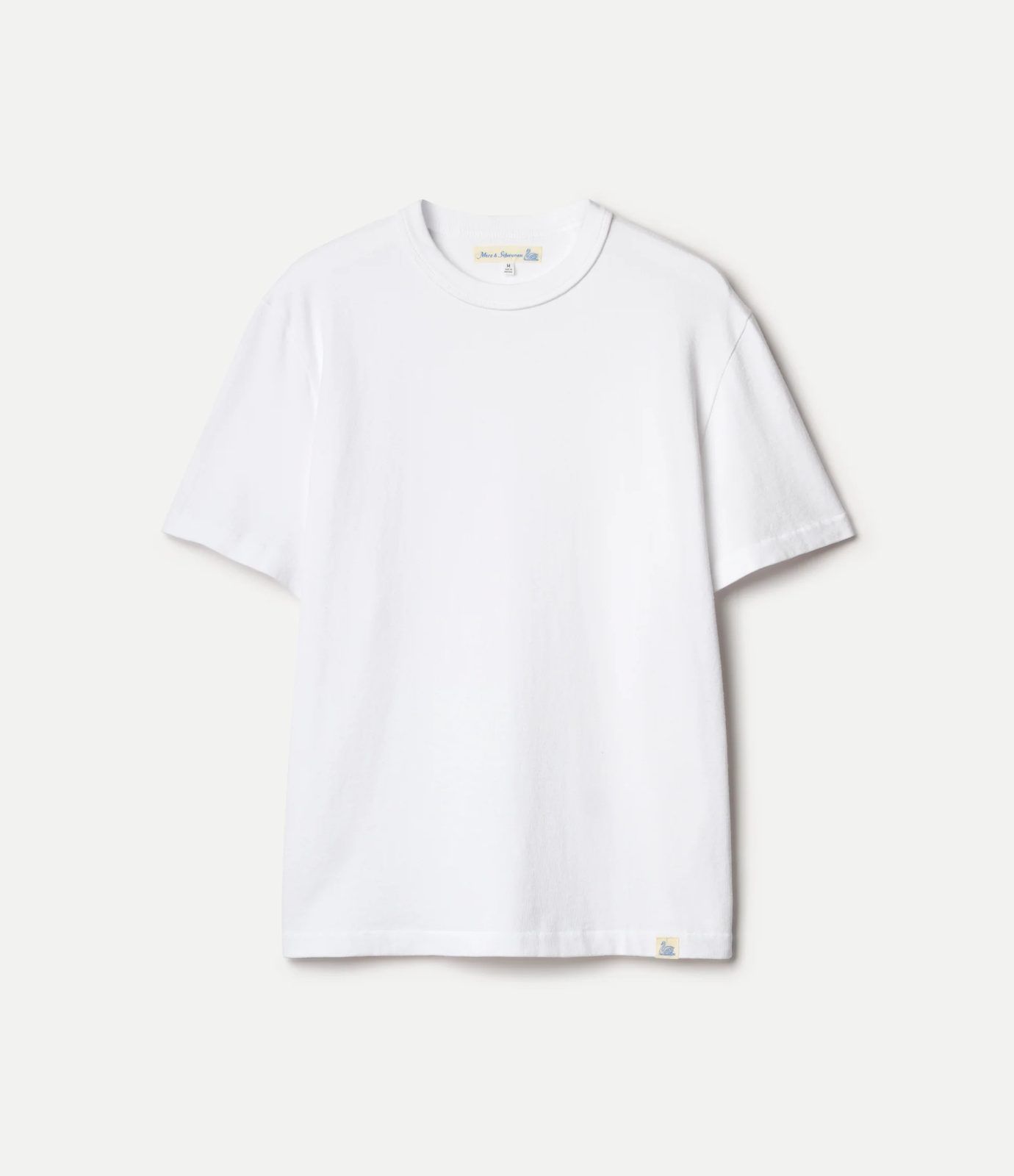
Fit and sizing
- The Originals run small. Size up, especially in the 215.
- Loopwheeled pieces are usually not fully pre-shrunk. Expect a little length loss after the first cold wash.
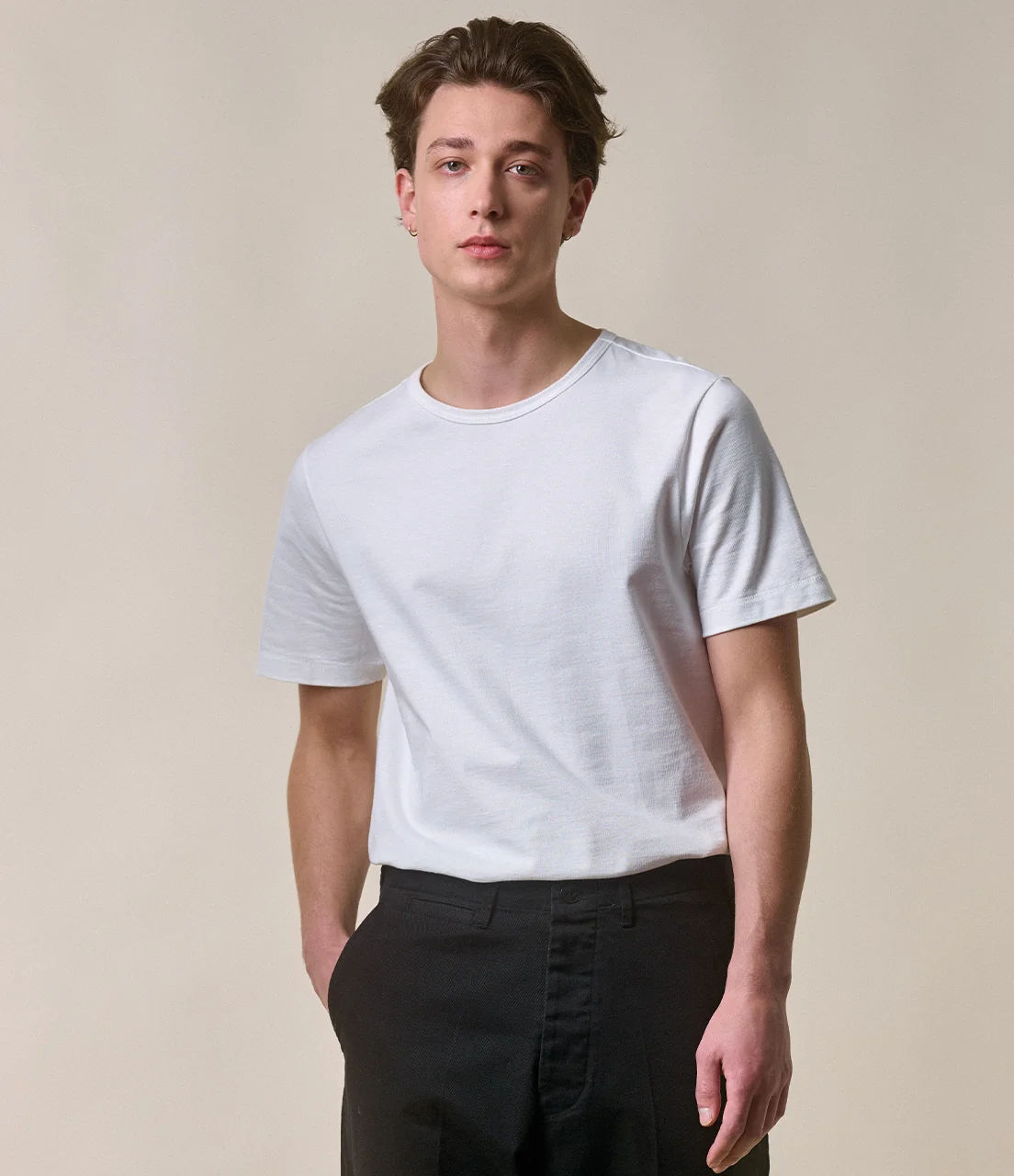
- The 215 hugs the chest and biceps. The 214 and TEE03 give air. The 2M15C and TEE02C are the short ones for high-waisted trousers.
- White 1950s can show through. White 215 generally does not.
- A 6 in a 215 is not automatically a 6 elsewhere. The Originals, the 2M15 family and the Portugal line are cut on different blocks. Check each size chart rather than assuming.
A buying map
| If you want | Buy |
|---|---|
| The famous one | 215, 105 EUR |
| That look without hunting restocks | 2M15, 90 EUR |
| Carmy length with modern trousers | 2M15C, 90 EUR |
| Summer and softness | 1950s at 85, or SCT04 at 70 |
| A daily driver that is easy to replace | TEE02, 75 EUR |
| A statement fabric | 2S14, 150 EUR |
| The cheapest way in | Vintage Pima, 60 EUR |
Where I am
I already own the 215 Loopwheeled Classic Fit Midweight in size 6/L, which is the anchor of the whole range. That settles the question of whether the cloth is worth it and leaves only the question of what to add around it.
The 3 that make sense next, in order:
- 1950s, 85 EUR. Same classic cut, 1-thread lightweight cloth. It is the summer answer to a tee I cannot wear in August, and the cut is already proven on my body.
- 2M15, 90 EUR. The everyday version. Side seams, slightly lighter, and in stock when the 215 is not. The one to buy if I want a second white tee I do not feel precious about.
- 2S14, 150 EUR. Only if the heavy loopwheeled cloth appeals as an object. 340 g/sqm is a lot of shirt, and it is a different garment rather than a thicker version of the same one.
What I would skip: the cashmere and merino tees, which are lovely and solve a problem I do not have.
On my shortlist
Both of the ones I am actually looking at are cropped, which is a trouser-rise decision more than a shirt decision. They only work if the waistband comes up to meet them, so they pair with high-rise or wide trousers and look wrong with anything that sits on the hips.
2M15C Cropped Mid-Century, 90 EUR
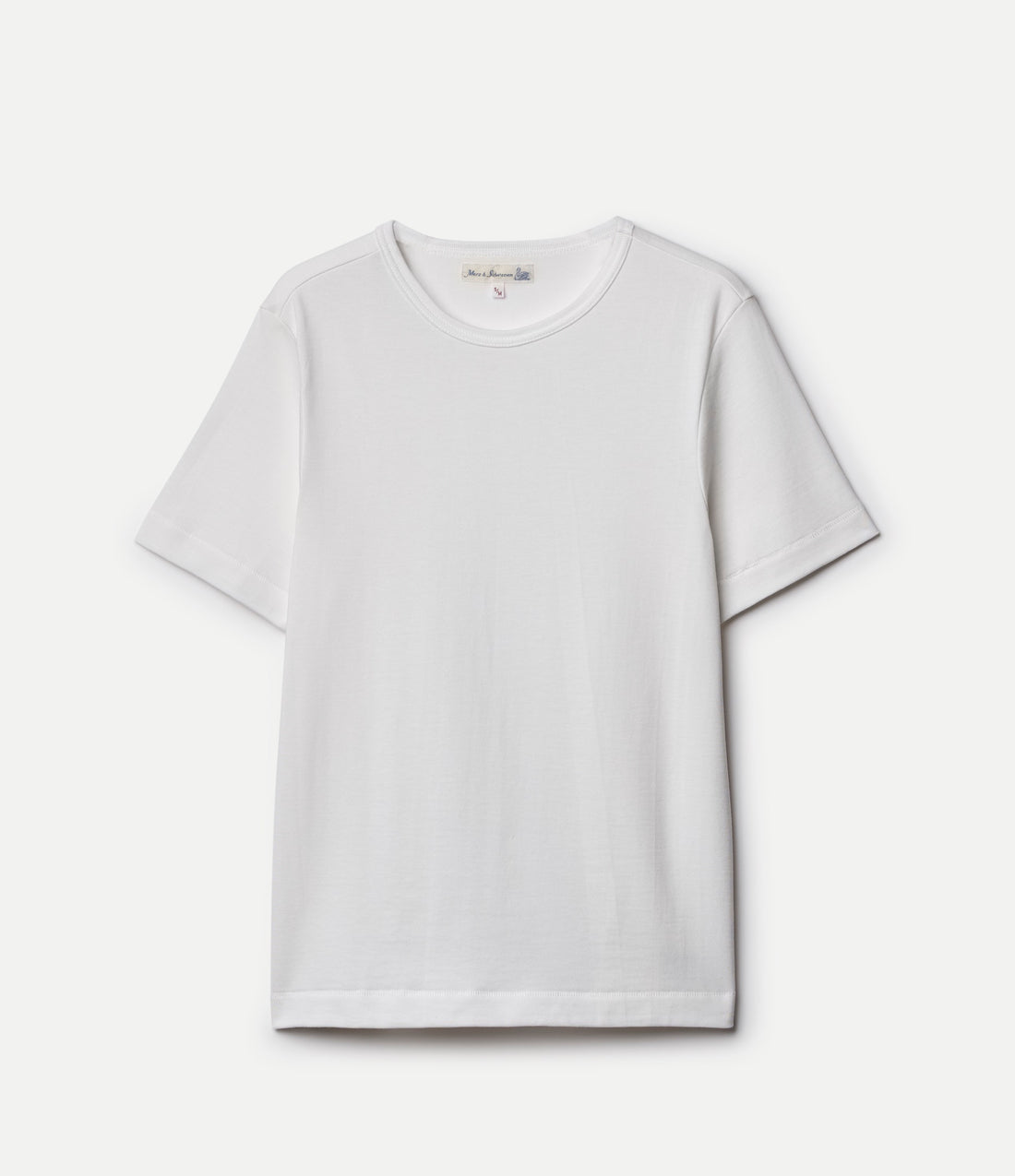
The cropped 2M15. Made in Germany on the 1960s mid-century jersey machine, 100% organic cotton at 230 g/sqm (6.8 oz), side seams, underarm inserts, baseball stitching. Merz's own framing:
In comparison to the 215, with its authentic straight fit due to the seamless tubular loopwheeling process, the 2M15 and 2M15C are provided with side seams to define a more organic shape that adapts better to modern bodies.
TEE02C Cropped Classic Cotton Jersey, 75 EUR
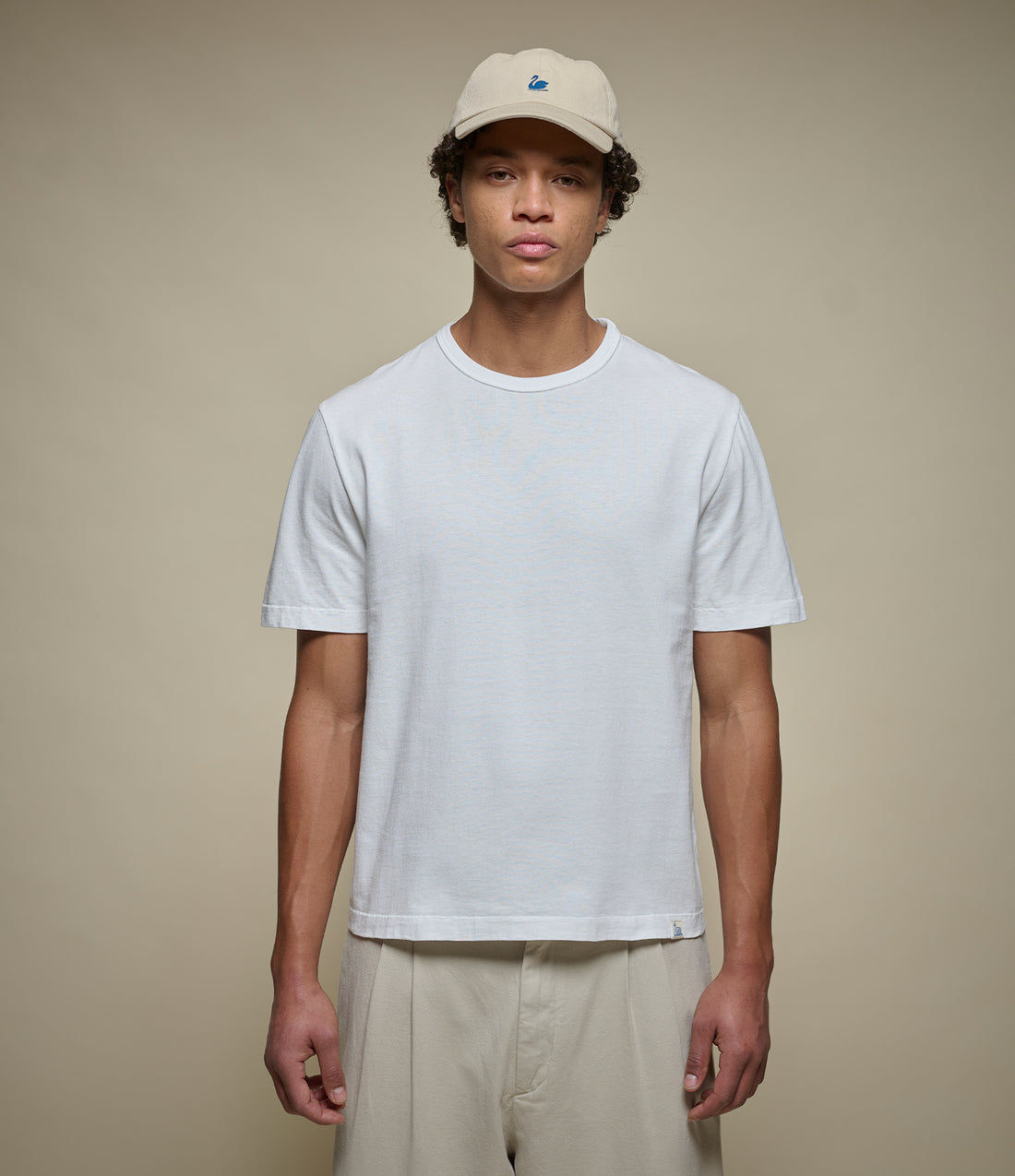
The Portugal-line cropped tee. Mid-weight 100% organic cotton jersey, paneled crew neck, ribbed collar, triangle inserts, baseball stitching. The detail that matters against the 2M15C: it is pre-shrunk, so what you try on is what you keep.
Side by side
| 2M15C | TEE02C | |
|---|---|---|
| Price | 90 EUR | 75 EUR |
| Made in | Germany, 1960s jersey machine | Portugal |
| Weight | 230 g/sqm (6.8 oz) | Mid-weight organic jersey |
| Pre-shrunk | Not stated | Yes |
| Construction | Side seams, underarm inserts, baseball stitching | Paneled crew, ribbed collar, triangle inserts, baseball stitching |
| 6/L in white | In stock | Sold out |
The stock problem
This is the thing to act on. I checked every colourway of both styles.
- 2M15C: 6/L is available in 5 of the 8 colourways, including the white one linked. The full run from 3/XS to 8/XXL is in stock.
- TEE02C: 6/L exists in exactly 1 of 6 colourways, the blue. The white page has only 3/XS left, and the 5/M variant on that link is sold out.
So the choice is mostly made for me. If I want the TEE02C in white at my size, it is not currently buyable. If I want a cropped Merz in 6/L today, it is the 2M15C.
Which one, and a size caveat
The 2M15C is the better buy at 15 EUR more. It is the German-made cloth on the mid-century machine, which is the half of the brand worth paying for, and it is the cropped sibling of the 2M15 I already listed as the everyday companion to my 215. The TEE02C is a good t-shirt, but at that point the price gap is small and the Portugal line is the one I would rather buy when it is the plain TEE02 at 75 EUR, not the cropped version.
One caveat on size. I wear 6/L in the 215, and the 215 is a tubular loopwheeled Original that runs small. The 2M15C is cut on a different block with side seams, and the TEE02C is a different line again and pre-shrunk. A 6 in one is not a 6 in the others, so check each size chart before ordering, or settle it in the Berlin store in 5 minutes.
Buying in Germany
Prices on merzbschwanen.com are already in EUR, so there is no conversion, no import VAT and no customs for a German order. That is unusual for a brand with this much heritage cachet, and it makes the 215 materially cheaper here than it is for the American buyers who made it famous.
There is a flagship store in Berlin Mitte, plus New York and Los Angeles. Worth a visit if you are in Berlin, because the sizing question and the 215-against-2M15 question both answer themselves in about 5 minutes with the garments in hand.
Further reading
- Men's T-Shirt Guide, the official weight-based sorting
- All men's t-shirts
- Made in Germany collection, the loopwheeled Originals
- Men's Still Good, the contemporary line