
The FreeStyle Libre 3 Plus is Abbott's latest continuous glucose monitor (CGM): a coin-sized sensor worn on the back of the upper arm that reads glucose from interstitial fluid and streams a value to your phone every minute, no scanning, for up to 15 days. It was built for people with diabetes, but it is also the tool most metabolic-health and longevity types reach for to see how their body actually responds to food, exercise, stress, and sleep.
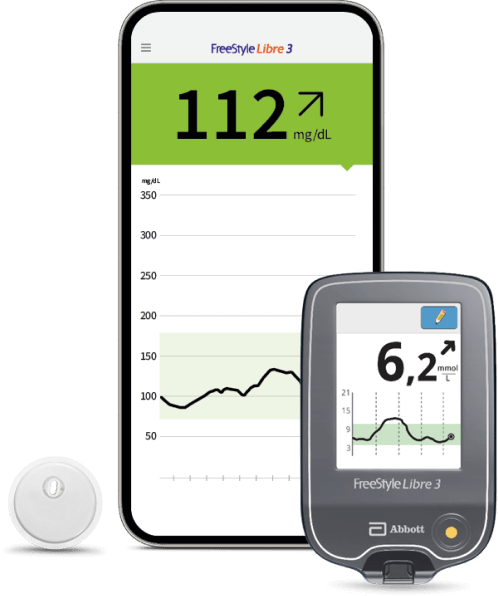

Overview
A real-time CGM in the smallest sensor on the market, described by Abbott as smaller than two stacked five-cent coins. It stands out for the combination of size, 15-day wear, and minute-by-minute streaming with alarms. In Germany it is a prescription device, reimbursed by statutory insurance for diagnosed diabetes; paid privately, sensors run roughly €60 to €100 each depending on pharmacy (about $170 to $200 in the US). The value: instead of the odd finger-prick snapshot, you get a continuous curve, which is the only way to see your real glucose patterns.
Detailed Specifications
| Maker | Abbott |
| Type | Real-time continuous glucose monitor (CGM) |
| Wear time | Up to 15 days (Libre 3: 14) |
| Reading frequency | Every minute, streamed automatically (no scanning) |
| Warm-up | 60 minutes after application |
| Accuracy (MARD) | 8.2% (Libre 3: 7.9%) |
| Sensor | Smallest and flattest on the market; thin flexible filament under the skin |
| Site | Back of the upper arm |
| Water resistance | 1 m for up to 30 minutes |
| Alarms | Real-time high/low glucose alerts |
| Age approval | 2+ (Libre 3: 4+), including pregnant women |
| Apps / sharing | FreeStyle Libre 3 app + reader; LibreView (clinician), LibreLinkUp (family) |
| Integration | mylife Loop AID today; insulin pumps and smart pens planned |
| Application | One-piece applicator; 4 of 5 users report painless placement |
Background & Context
Abbott launched the original FreeStyle Libre in 2014 as "flash" glucose monitoring: you scanned the sensor with a reader to get a value. Libre 2 added optional real-time alarms; Libre 3 (2022) dropped scanning entirely and shrank the sensor to the smallest on the market. The Libre 3 Plus (2024) is an incremental update: it stretches wear from 14 to 15 days and lowers the approved age to 2.
One quirk worth knowing: the Plus is marginally less accurate on paper (MARD 8.2% vs the Libre 3's 7.9%). MARD, Mean Absolute Relative Difference, measures how far the sensor drifts from a lab reference; lower is better, and anything under about 10% is considered strong for a CGM. So the Plus trades a hair of accuracy for a day more wear and broader approval. Both are excellent; the difference is academic for most users.
Its direct rival is the Dexcom G7 (10-day wear, similar accuracy). For non-diabetics specifically, Abbott sells a consumer version, Lingo, built on the same sensor platform but paired with a coaching app, and Ultrahuman sells a metabolic-tracking product on Libre hardware.
Pros & Cons
Pros
- Continuous, no scanning. A value every minute, straight to the phone, with alarms.
- Smallest, flattest sensor, comfortable and discreet under a shirt.
- 15-day wear, fewer changes and less cost per day than 10-day rivals.
- Painless application for most, one-piece applicator.
- Sharing built in: clinicians via LibreView, family via LibreLinkUp.
Cons
- Prescription-gated in Germany, and reimbursed only for diagnosed diabetes; non-diabetics pay out of pocket or use the consumer product.
- Slightly lower MARD than the plain Libre 3 (8.2% vs 7.9%).
- 60-minute warm-up and the usual CGM caveats: interstitial glucose lags blood by 5 to 10 minutes, so it trails during fast swings.
- Phone dependency: the best experience needs a compatible phone and the app running.
- Adhesive and skin: two weeks on-skin can irritate, and a snagged sensor is a wasted sensor.
Who It's For
The primary user is anyone managing diabetes (type 1, or type 2 on insulin), where continuous data and low-glucose alarms are genuinely important. The secondary user, and the relevant one for me, is the metabolic-health / longevity crowd: wear a sensor for two weeks as an experiment, learn which meals spike you, see what a walk after dinner does, then act on it. Used that way it is a learning tool, not a permanent wearable. For that purpose the cleaner route is the consumer product (Lingo in the EU/US) rather than an off-label prescription sensor.
Buying Considerations
- Germany: prescription and reimbursed by statutory insurance for diagnosed diabetes. Without a diagnosis, buy privately at a pharmacy (Apotheke) or the FreeStyle Libre online shop; expect roughly €60 to €100 per 15-day sensor.
- Non-diabetic and just curious: consider Lingo (Abbott's consumer glucose biosensor + app) or an Ultrahuman plan, both designed for lifestyle use without a prescription.
- Alternatives: Dexcom G7 (10-day, arguably the closest rival), or the plain Libre 3 if the extra accuracy matters more than the extra day.
- Tips: apply to the back of the upper arm, avoid a spot you sleep on or knock, and give it a day; early readings after warm-up can be jumpy.
Verdict / My Take
For someone managing diabetes this is close to the state of the art: tiny, accurate enough, 15 days, real-time, with alarms. For me the interest is different, a two-week metabolic experiment to see my own glucose response and stop guessing. Bought that way, the specific choice between Libre 3 and 3 Plus barely matters; both are excellent, and the honest move for a non-diabetic is the consumer route (Lingo) rather than an off-label prescription. The real value of a CGM is not the hardware, it is what you change after two weeks of watching your own curve.
Further Reading / Sources

- Product page and specs: freestylelibre.de
- Consumer glucose biosensor (non-diabetic use): Lingo by Abbott