

Git for Global Law puts each country's law into a git repository where every commit is 1 law taking effect, authored by that law. So git blame tells you which law wrote each line, and a checkout of any date shows the law as it stood that day. A parent repository then interleaves all the countries in order of entry into force, so 1 commit is the state of the world's law on 1 day.
I found it through a post by @roundtablespace on X on 30th October 2026. It's made by Lexifina, a legal-tech company. The idea is simple and obvious once you see it: law is text that changes by numbered amendments, which is exactly what git was built for.
Where it came from
It started on 28th October 2026 with Git for the US Code, by Alan Yahya at Lexifina: 9 titles of the US Code, rebuilt from 2017 by replaying every amending law on the older text and checking the result against the next official release. Of 365 changes, 361 reproduced the official text exactly. The post reached #1 on Hacker News with 450 points.
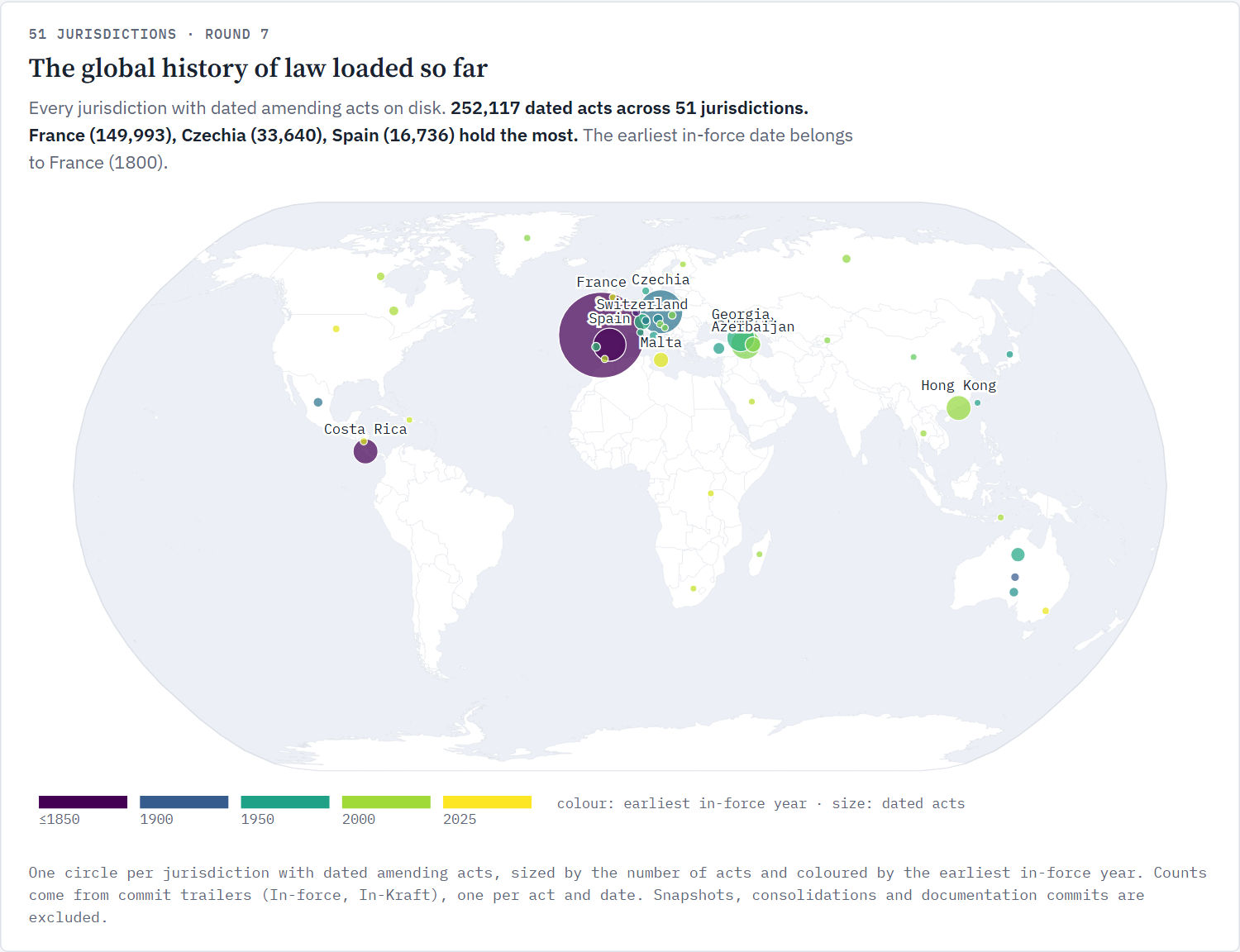
The global repository went up the same day. 2 days later, the manifest lists 107 corpora in 101 countries, and the repo has 400+ stars. The X post still says "Germany's constitution since 1949, Estonia and more": it's already far past that.
How it works
- 1 repository per country:
lexifina/<country>-law. Each commit there is 1 law taking effect. Its author is the law, and its trailers name the law and the in-force date. - 1 parent repository:
global-lawpins each country as a git submodule, arranged by jurisdiction (germany/bund/acts,estonia/national/acts, ...). - 1 world timeline: every commit in the parent moves exactly 1 country to its next law, in order of the in-force date.
- In force only: laws adopted but not yet in force wait on each country's
futurebranch.mainholds only what applies today. - Deterministic build:
tools/build.pyrebuilds the whole tree from the country repositories. When a country is corrected, the parent is rebuilt and force-pushed. - 193 UN members sit in
jurisdiction.json, plus territories and the EU. A country without law yet has a folder with itsSOURCES.mdand no submodule.
Git can't store dates before 1970, so pre-1970 changes (most of the Grundgesetz's early history) carry 1970 commit dates, 1 second apart. The In-force trailer is the real date, and the tools read it.
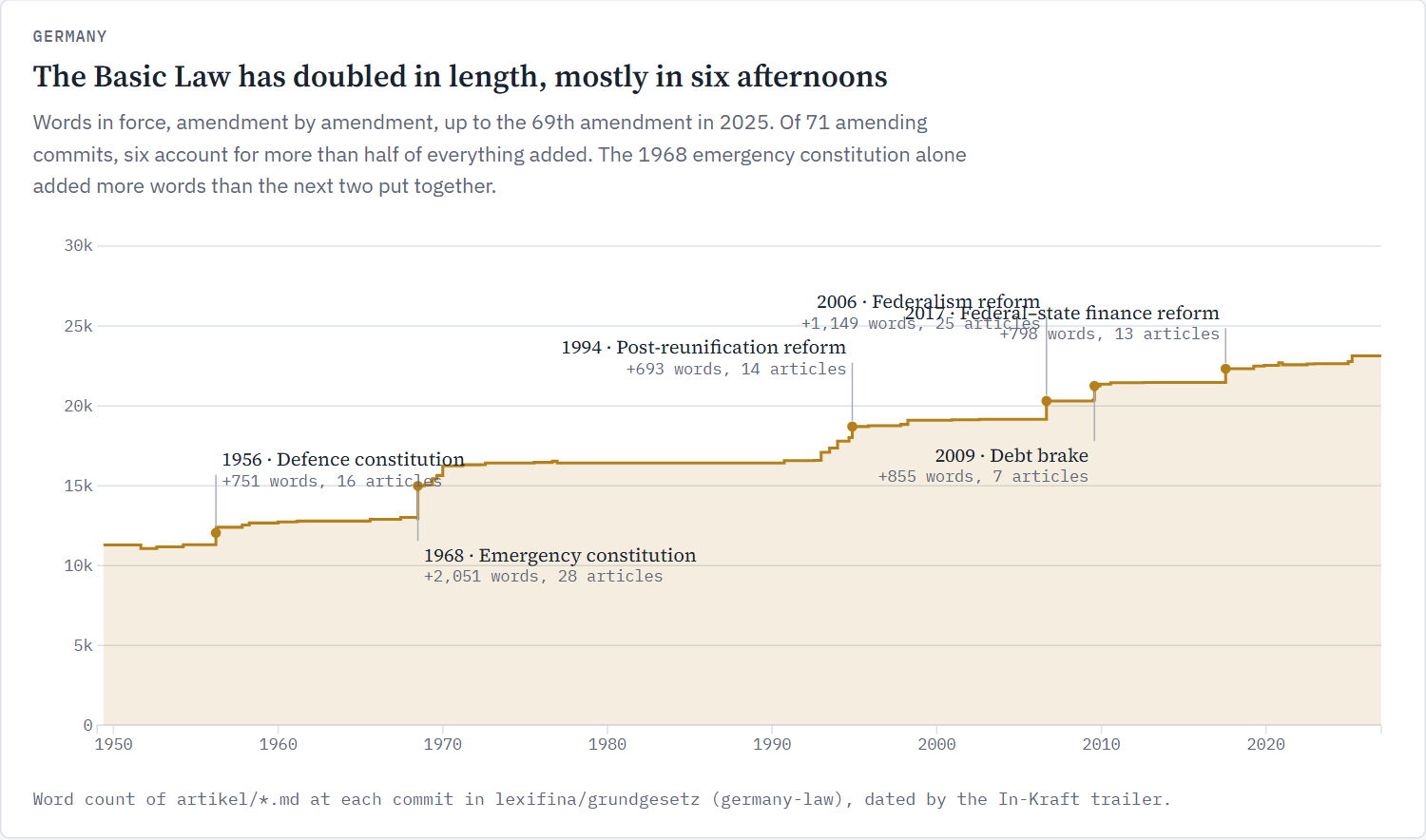
The chart above comes from the repository: 6 of the Grundgesetz's 71 amendments added more than half of its words.
Coverage
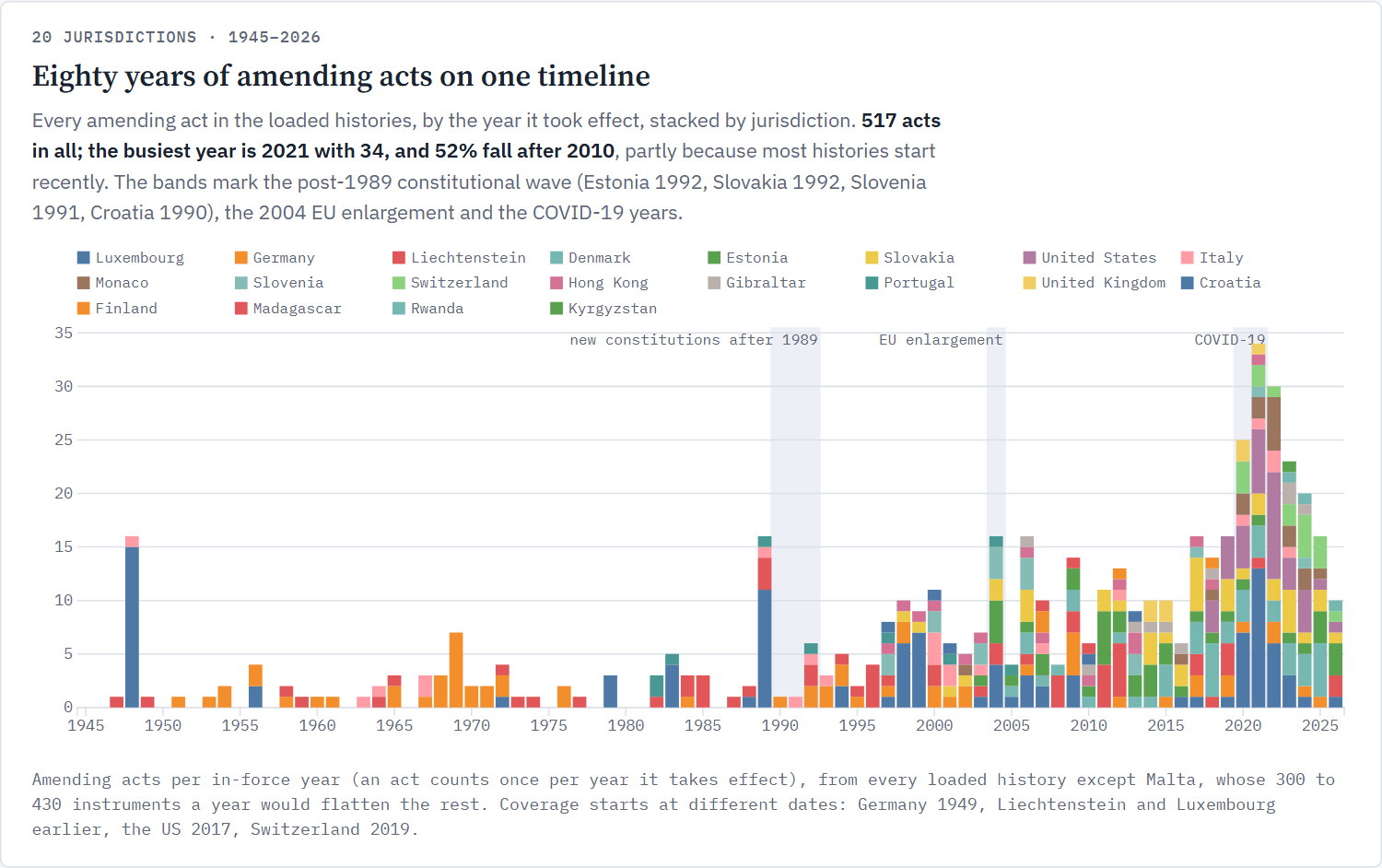
The corpora vary a lot. Some hold a whole statute book (Czechia, Spain, Switzerland, Georgia, Malta). Others hold a few acts or a sample: the US corpus is 9 titles of the US Code, the UK corpus only the special educational needs law. Germany has the Grundgesetz since 1949 and every other federal act since 2019.
The manifest says how each country's past is known:
| History | Meaning | Corpora |
|---|---|---|
in-force |
Dated official versions | 23 |
replayed |
Rebuilt by applying each amending act, with checked dates | 6 |
current-only |
Today's text only | 5 |
| Not set | Mostly new corpora, being filled | 73 |
Check coverage and record_to in manifest.json before you trust a date: a missing file can mean the provision wasn't in force yet, or that the record doesn't reach back that far.
Using it
Clone it with the submodules, then ask by date. Python 3 and git, nothing else:
git clone --recurse-submodules https://github.com/lexifina/global-law && cd global-law

python tools/law.py world 2022-05-01                    # every corpus on that day
python tools/law.py show 2022-05-01 united-states/federal/usc/title-11/1182.md
python tools/law.py words 2022-07-01 united-states/federal/usc/title-11/1182.md   # which law wrote each word
python tools/law.py diff 2022-05-01 2022-07-01 united-states/federal/usc/title-11/1182.md
python tools/law.py laws 1990-01-01 1990-12-31 germany  # every German law that took effect in 1990
Plain git works too: git log --first-parent is a world chronology of laws taking effect, and git grep --recurse-submodules <term> <commit> searches all the law in force at that moment, in every country.
From an AI model (MCP)
This is the part that interests me most. tools/mcp_server.py is a local, read-only MCP server with 18 tools: read a provision on a date, who wrote each word, compare dates, check citations in a brief, and which text applies to a case. It runs over stdio and makes no network calls.
claude mcp add global-law -- python tools/mcp_server.py
Then ask in plain words: "What did 11 U.S.C. §1182(1) say on 1 May 2022, and which law last changed it?"
It fixes a real weakness of LLMs. Lexifina's post cites studies where a model alone answered 24% of post-cutoff legal questions correctly, against 87% when it got the statutory text. Models also apply superseded rules. A dated, sourced record is the right input.
Limits
- Uneven coverage. 101 countries is the reach, not the depth. Many corpora are samples or current text only.
- Retroactive laws are noted in the commit messages but don't change the text shown on earlier dates.
git blameworks by line, so a partly changed paragraph is credited to the last law that touched it.law.py wordscredits each word instead.- Force-pushes. Corrections rebuild the history, so a fork needs
git submodule update --initand a forced tag fetch after each rebuild. - Not legal advice. Each change links to the official text; read that for anything that matters.
Why it matters
- For legal AI, it's a clean, dated, citable corpus under CC0. Free to use in a product, no credit needed. The law text keeps each country's own terms.
- For anyone reading law, it answers the question official portals make hard: what did this say on that date, and which act changed it.
- For builders, it's a great example of using git as a database of time.
Further reading
The original Lexifina post on the US Code:

The Hacker News discussion:

The X post where I found it:
