
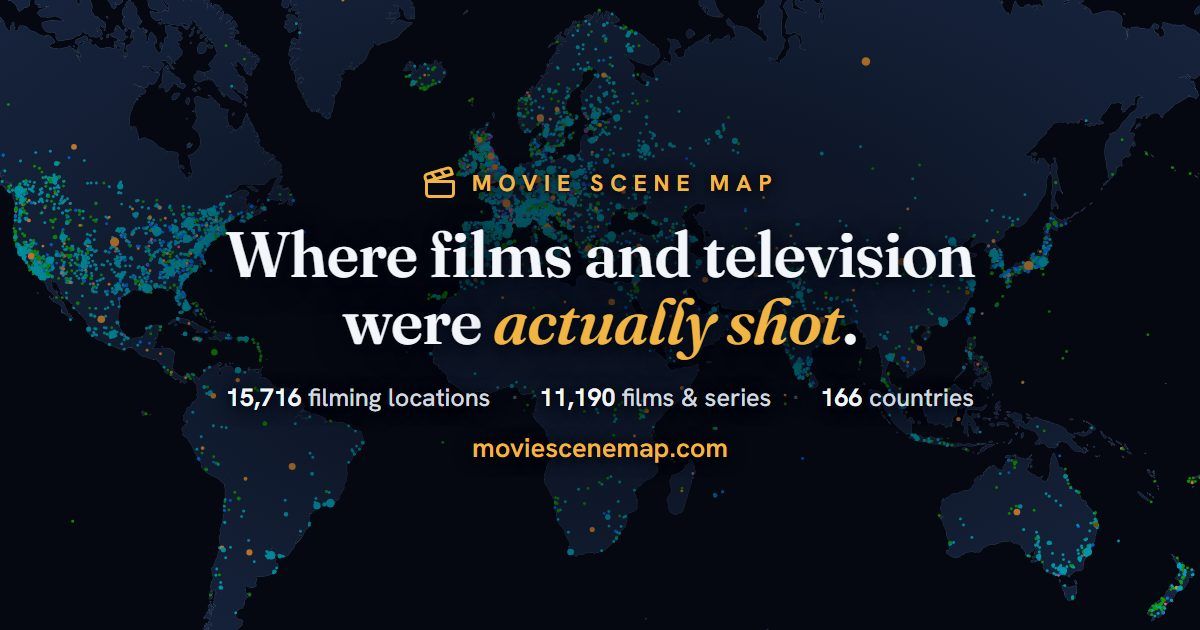
Movie Scene Map answers one question: where was this actually filmed? Search a title and get the studios, castles, streets and landscapes it was shot in. Click a place and get what was made there. It covers 15,716 locations in 166 countries, and it is free with no signup, no ads and no accounts.
That description undersells it. What makes this worth a note is not the map, it is the sourcing discipline underneath it, and the fact that the whole dataset ships as CC0 with an MCP endpoint attached.

What is in it
| Kind | Count | Placed by |
|---|---|---|
| Films and series with a page | 9,295 | Where a camera stood |
| Video games | 2,153 | Where the story is set |
| Anime | 407 | Where the story is set |
| Manga | 365 | Where the story is set |
| Locations | 15,716 across 166 countries | Coordinates from Wikidata |
The United States holds 5,178 locations, the United Kingdom 2,068 and France 947. California alone has 1,751 productions filmed in it.
A production earns its own page only when it has 2 or more recorded locations, or enough Wikipedia coverage that people ask. Roughly 3,000 single-location titles stay on the map without a page, which is the right call: 3,000 stubs would be worse than none.
The evidence rules
This is the part worth reading. The site holds 3 kinds of evidence and refuses to mix them.
1. Wikidata statements. The backbone is the filming location (P915) property on Wikidata, joined to each place's coordinates, its Wikipedia article and its photograph on Wikimedia Commons. Nothing comes from fan wikis or listicles. Every page carries a "Source data" link to the record it was built from.
2. Wikipedia prose, labelled as such. Since August 2026 the atlas also reads the Filming section of each production's English Wikipedia article, because the prose often knows more than the statements do. A film's article can name 15 towns where Wikidata records none. Those places appear on the map, every one labelled "per Wikipedia", kept in separate lists, separate columns and separate counts. 22,070 links across 5,555 productions rest on this, including 1,684 productions for which Wikidata records no filming location at all.
3. The place's own article, weakest of the 3. Durham Cathedral's page says what was shot in it; the film's page often does not. 3,091 pairings across 2,275 places come from reading the location's article rather than the production's, and 1,934 productions get their first precisely located place this way. It is treated as the weakest evidence: it puts no pin on the map and appears in no download or MCP record. It lives only on the 2 pages it concerns, with the sentence quoted whole and linked.
Separately, 17,739 pairings carry one verbatim sentence from the production's English Wikipedia article, in quotation marks with a link. That is how a page tells you the glacier by Finse was the planet Hoth. About 4 out of 5 pairings have no sentence, and those stay quiet rather than paraphrasing.
Games, anime and manga are a different claim
A video game is filmed nowhere, and neither is an anime or a manga. Those pages use narrative location (P840), where the story is set, and they live under /game/, /anime/ and /manga/ for exactly that reason.
The interesting problem: Wikidata writes narrative location at story scale. Across every game on the site it records 724 settings to a country and zero to a district or a county. So the atlas reads Wikipedia's setting categories instead, "Video games set in Tokyo" and 547 others in English and Japanese, giving 2,408 places across 1,390 titles. A category resolving to a whole country is dropped, because a country is what this stream exists to get past.
Manga is the sharpest case. Wikidata records a narrative location for 27 manga in the world. Japanese Wikipedia files hundreds of them under the ward or the city they happen in.
The open data and the MCP endpoint
Everything is downloadable, rebuilt on every deploy, CC0 because the facts are Wikidata's.
| File | What it holds |
|---|---|
filming-locations.geojson |
One Point per place, with country, kind, fame rank and production count |
filming-locations.csv |
The same places as a flat table, for spreadsheets and pandas |
productions.csv |
One row per title: year, kind, places, the source of each claim |
atlas-compact.json |
The site's wire format, all 3 files in one document. What the MCP server reads |
The quoted Wikipedia sentences are deliberately not in the downloads. They are CC BY-SA 4.0, and bundling share-alike text into a CC0 offer would make that offer false. That is a level of care most projects skip.
There is a read-only Model Context Protocol server over the same data. Streamable HTTP, stateless, no authentication, 8 tools: where a production was filmed, what was filmed at a place, what was filmed near a coordinate, searches over both sides, the ranking, the country list and the statistics.
{
  "mcpServers": {
    "filmmap": {
      "type": "http",
      "url": "https://moviescenemap.com/mcp"
    }
  }
}
The 2 rules above are built into the endpoint rather than left to the reader: every record it returns carries the "filmed at" or "set in" distinction, because an assistant only knows if it is told.
What it refuses to do
- No dot in the middle of a country. 829 productions are recorded only at country or state level, Casablanca, Gladiator and Psycho among them. Those pages say what is known in words and leave the map alone.
- A place is not a scene. P915 records that a production filmed somewhere and stops. Which scene was shot where is not in the data, so it is not in the files, and the site says it must not be inferred from them.
- No scraping, no generation. If a page says a production was shot somewhere, an editor wrote that down.
- No fixed schedule. The site rebuilds from a fresh Wikidata query. Corrections go upstream to Wikidata and flow in on the next rebuild, benefiting every tool built on the same record, not just this one.
Why it is worth studying
Set the films aside for a second. This is a single-person static site over an open dataset, with a strict source hierarchy, an honest licence split, a public API and an MCP endpoint. That is the same shape as indexAll - indexes of brands, apps, and tools and worth reading as a method rather than a subject: state where every fact came from, refuse to place what you cannot place, and ship the data you built on.
The maker publishes as "Flightmussy" and runs 4 sibling atlases on the same method: World Train Map, The Castle Map, Sunshine Map and World Beach Map. It made the front page of Hacker News, was covered by GIGAZINE and BILD, and the Wikidata Weekly Summary named it Tool of the Week. None of it was pitched or paid for.
The practical move: add the MCP endpoint, then any trip planning question about where something was shot gets a sourced answer instead of a hallucinated one. The CSV drops into SQLite in one line if you want it locally.
Further reading
- Movie Scene Map, the map itself
- About, the sourcing rules in full and worth reading
- Open data and the MCP endpoint
- The most filmed cities and regions on earth
- 150 famous scenes, ranked by how many Wikipedia languages cover the production