
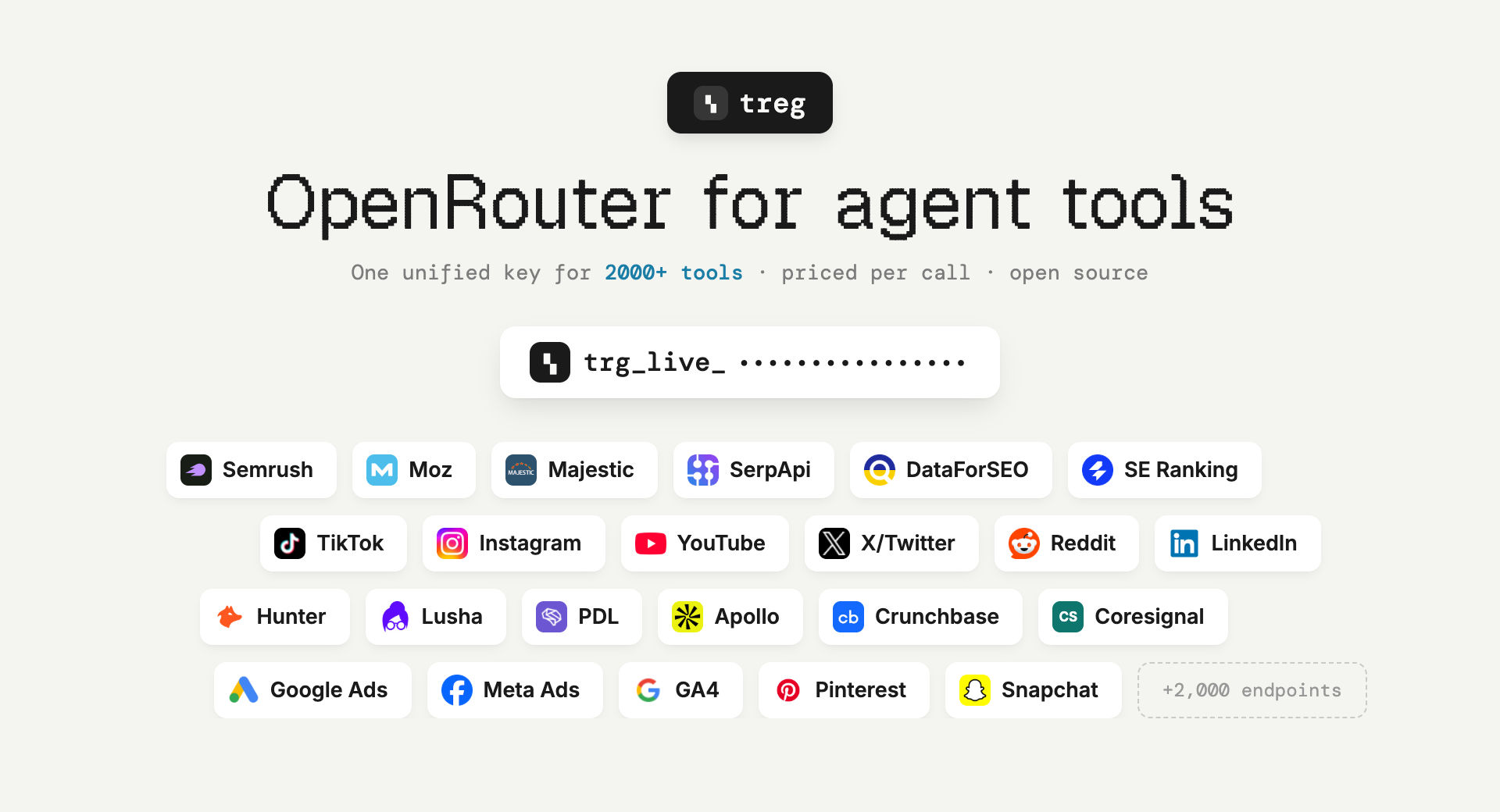
treg is a proxy that sits between your agent and roughly 2,900 third-party API endpoints across 60 providers. You hold one token. treg holds the accounts. Every call is metered against a prepaid balance at the provider's own rate, with no markup and no subscription. The pitch is "OpenRouter, but for agent tools instead of models", and that is an accurate description of the mechanism.
The reason it matters for prospecting work: the people-data providers each want $34 to $149 a month for a seat you use in bursts. treg charges $0.0089 for a verified work email and nothing for a miss.

For business people
The problem treg solves is subscription sprawl. To enrich a list of prospects properly you need an email finder, a verifier, a phone provider, a company database and a funding source. Bought separately that is Apollo at $59, Hunter at $34, Lusha at $49, Crunchbase at $99 and People Data Labs at $98 per month, roughly $340 a month for tools you touch a few days out of thirty.
treg carries those accounts and resells the calls at cost. You top up a balance, your agent calls what it needs, and a lookup that finds nothing is free. A hundred leads in their own demo run cost $1.76.
The second half is the part that matters for a team. You register your own API keys once, server-side, and every teammate's agent can call them without ever holding the credential. Your own key always beats treg's, and calls on your own key are never metered. So the Apollo seat I already pay for stops being a per-person thing and starts being a shared capability.
| What you get | Rate |
|---|---|
| Verified work email (Tomba) | $0.0089 per find |
| Email verification (Hunter) | $0.003 per check |
| Match plus work email (Apollo) | $0.026 per contact |
| Person enrichment (People Data Labs) | $0.028 |
| Company enrichment (Crustdata) | $0.010 per company |
| People at a company (LeadMagic) | $0.025 |
| Lookalike companies | from $0.049 |
| Job postings (Coresignal) | $0.020 |
New teams start with $1.00 of free credit, which is enough to test the whole flow.
For technical people
One endpoint does everything: POST or GET to /call/, authenticated with an X-Treg-Token header. Two request shapes.
By catalog id, where treg picks the credential:
curl "https://treg.to/call/hunter.people.email.find?domain=reddit.com&full_name=Alexis%20Ohanian" \
  -H "X-Treg-Token: $TREG_TOKEN"
By upstream URL, where you prefix the real request you would have made:
curl "https://treg.to/call/https://api.stripe.com/v1/charges" \
  -H "X-Treg-Token: $TREG_TOKEN"
The method, path, query string and body pass through unchanged, and the response is the upstream's verbatim. treg relays, it does not model the API, so it survives upstream schema changes. Your X-Treg-Token is stripped before the upstream sees it.
The credential ladder
Every catalogued call resolves in this order:
- your team registered its own tool for that provider, so that key is used
- your team stored a secret for that provider, injected through a virtual tool
- neither, so treg's own key is used and the call is billed
Only step 3 costs money. An endpoint treg has no published price for is refused rather than served free.
Setup
curl -fsSL https://treg.to/install.sh | sh   # installs the CLI, points it at the registry
treg login                                   # GitHub by default, --email for a code
treg catalog search "find a work email"      # search by the job, not the vendor
treg catalog get hunter.people.email.find    # params, price, example response
treg call hunter.people.email.find --query domain=reddit.com
treg balance                                 # what that cost
As a Claude Code plugin, which is the path I would take:
/plugin marketplace add superdesigndev/treg
/plugin install treg@treg
It installs with no token, and the skill walks the agent through sign-in and treg mcp install on first run. There is also a Claude.ai connector surface at https://treg.to/mcp/v2/, which exposes only curated catalog endpoints and separates reads from writes so Claude gets accurate safety signals.
To share your own keys, point it at a project:
treg scan     # read-only preview of the keys, skills and CLIs it would register
treg upload   # register them, encrypted server-side, idempotent
treg upload reads the .env, matches keys against about 80 known providers, and also picks up skill subdirectories and installed CLIs.
Gotchas worth knowing
- No concurrency limit. Fire calls in parallel with
asyncio.gather. The only limits are the provider's own, relayed verbatim. - Saturation returns 503 with
{"treg_saturated": true}and aRetry-Afterheader. Nothing was billed. A bare 5xx with no JSONdetailis never treg's own answer. - Out of balance returns 402 carrying
balance_micro,estimated_cost_microand atopup_url, so an agent can act on it without parsing prose. - Retries are safe with an
Idempotency-Key. 5xx responses, timeouts and network errors are never billed. - WAF false positives. If a body carries SQL or HTML and Cloudflare or Render 403s it before treg sees it, base64-encode the body and add
X-Treg-Body-Encoding: base64. The CLI does this automatically. treg.<capability>routed endpoints are the one case where treg picks the provider for you. Everywhere elsecatalog searchshows the options side by side with prices and you choose. It does not silently fail over between providers.
There are three Markdown-readable indexes, each served as plain text by appending .md: use-cases compares every provider that does one job on price and measured success rate, workflows chains jobs with the receipt from a real run, and tools/<provider> lists one provider's endpoints. Start an agent at treg.to/llms.txt.
The benchmark
treg cites the People Search Bench by LessieAI, 119 real tasks, measured as percentage answered correctly by the same agent with and without treg.
| Category | Claude Code alone | With treg | Lessie | Exa |
|---|---|---|---|---|
| Recruiting | 50.5 | 80.0 | 68.2 | 64.7 |
| B2B prospecting | 43.0 | 78.2 | 60.6 | 55.2 |
| Deterministic | 57.0 | 76.3 | 70.4 | 61.2 |
| Influencer | 43.2 | 62.9 | 62.3 | 41.6 |
Read it with the usual caution. It is a vendor-selected benchmark, published by one of the competitors it scores, and the gain measured is mostly "an agent with paid data beats an agent with only web search". That is true and unsurprising. The benchmark repo is public, so the tasks can be checked.

Where it fits for me
My enrichment currently runs through separate wrappers in ~/ai/_shared/, one per provider, each with its own key in the .env. treg would collapse that into one endpoint and one token, and would let me try Tomba, LeadMagic or Crustdata without opening an account first. That alone is worth the test. See Apollo.io API and Nubela / NinjaPear for what it would sit alongside.
The Apollo case is the strongest one: registering my existing key makes those calls free of the balance instead of duplicating a subscription I already pay for.
Caveats
- LinkedIn endpoints are in the catalog. Icypeas "email from LinkedIn" at $0.019, plus LinkedIn profile data with no official API behind it. Those calls run on treg's infrastructure, not mine, so my own account and IP are never involved. That is a real distinction from scraping it myself, and it is still worth deciding deliberately rather than by accident.
- GDPR. Scraped personal data on EU individuals used for cold outreach is the exposed part of this stack, not the tooling. Selling from Germany into the EU, the lawful-basis question sits with me, not with the provider.
- Provider terms. Several of these vendors do not obviously permit resale of their calls. If a provider objects, an endpoint can disappear from the catalog without warning.
- Single choke point. One token reaches every provider and every uploaded key. Credentials are held server-side by a young project. That is the trade for not holding them yourself.
- Prepaid, so plan for a 402. Automatic top-ups exist. An agent mid-run that hits an empty balance stops.
Further reading
- treg.to, the dashboard and sign-in
- Tool catalog, every endpoint with its per-call price
- treg.to/llms.txt, the machine-readable setup brief
- People Search Bench, the benchmark repo
- Product Hunt launch