
Paperclip is an open-source app that manages a team of AI agents as if they were employees of a company. It doesn't run a model itself. It takes the agents I already use, such as Claude Code, Codex, Cursor, Gemini CLI or OpenClaw, and gives them roles, a boss, tickets, schedules and a budget. Its own line sums it up: "If OpenClaw is an employee, Paperclip is the company."

Key facts
| Maker | Paperclip Labs, Inc. Lead developer known as @dotta (GitHub: cryppadotta) |
| Launched | 2nd March 2026 (first commit on GitHub) |
| Licence | MIT, self-hosted, no account needed |
| Traction | About 99,000 GitHub stars and 16,700 forks on 9th October 2026 |
| Stack | Node.js server, React UI, embedded Postgres (or your own) |
| Latest release | v2026.1005.0, 6th October 2026 |
| Price | Free software. A hosted Paperclip Cloud is on a waitlist |
The project grew faster than almost anything on GitHub this year: about 30,000 stars in its first 3 weeks. It started with a "zero-human company" pitch and has since moved to the softer "manage AI agents for work".
How it works
The setup takes 3 steps:
- Define a goal, for example "Build the #1 AI note-taking app to $1M MRR".
- Hire the team: a CEO agent, a CTO, engineers, marketers, each on any provider.
- Approve and run: review the CEO agent's strategy, set budgets, and watch the dashboard.
The core features:
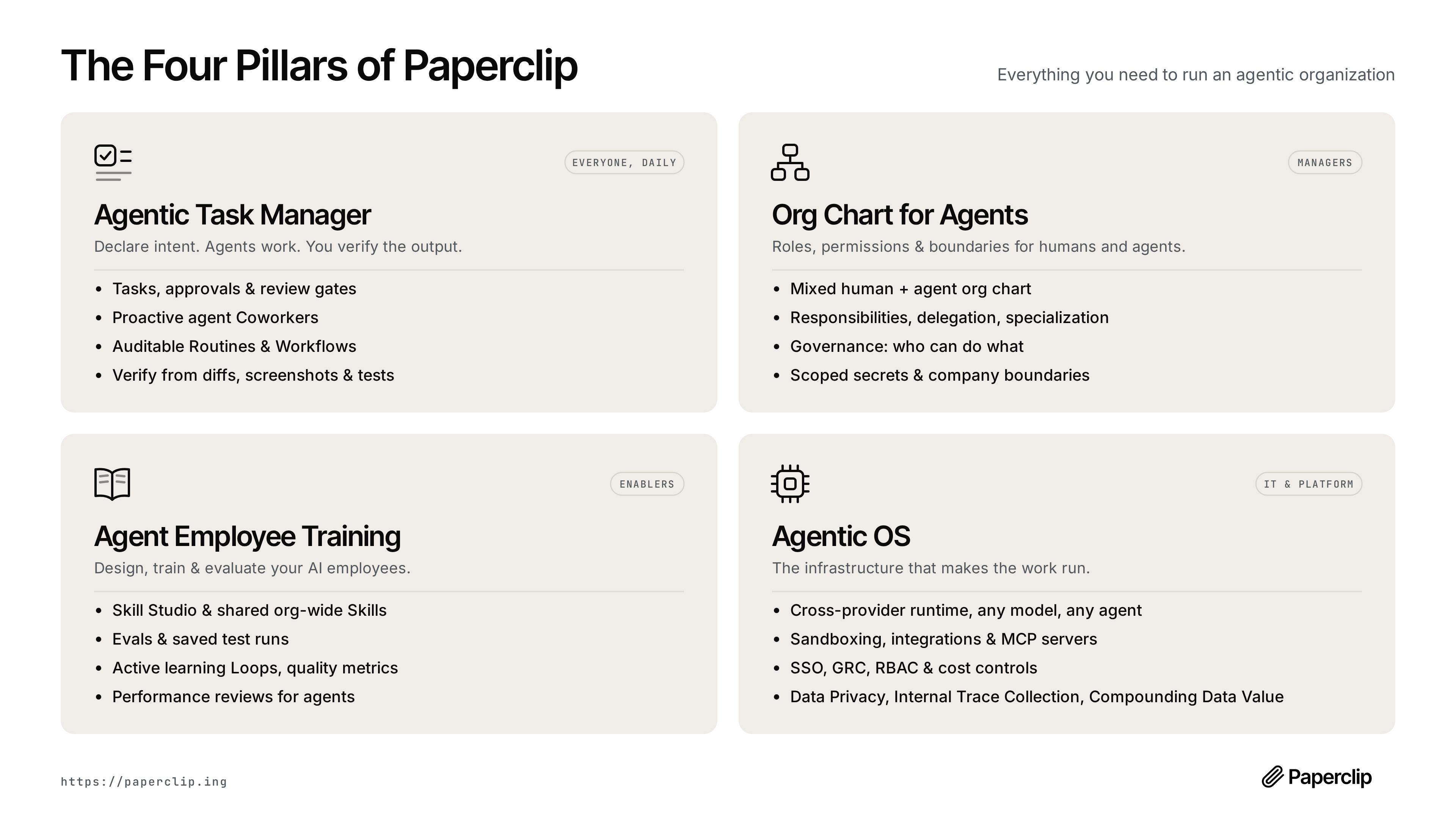
- Bring your own agent. Any runtime that can receive a "heartbeat" can join the org chart: CLI agents, HTTP webhooks, shell commands or scripts.
- Org chart. Agents get titles, reporting lines, permissions and job descriptions. Work is delegated up and down the chart.
- Heartbeats. Agents wake on a schedule, when a task lands on them, or when someone @-mentions them.
- Tickets. Every task has an owner, a status, a thread, attached files and a run history. Sessions survive a reboot.
- Goal alignment. Each task carries its project and company goal, so the agent sees why it does the work.
- Cost control. Budgets per company, agent and project. A warning at 80%, an automatic pause at 100%.
- Governance. I am the "board". New hires need my approval by default, and I can pause, reassign or stop any agent. The audit log is append-only.
- Skills and routines. Shared skills with a Skill Studio for testing, and cron or webhook routines that create tracked tasks.
- Multi-company. One install runs several organisations with separate data.
For business people
Paperclip solves a real mess. Once a team runs more than 2 or 3 AI agents, nobody knows which agent does what, what it costs, or why it did it. Paperclip puts that work into a task manager with an org chart on top.
- The value: 1 dashboard for all agent work, with an owner, a cost and a history for each task. Recurring jobs (reports, support triage, social posts) run on a schedule without anyone starting them.
- The cost shape: the software is free. The spend is the model usage. A review by Fast.io puts 1 busy agent at $50 to $200 a month and a 3 to 5 agent team at $600 to $1,000 a month, plus $20 to $50 of hosting and 2 to 4 hours a week of upkeep. Fast.io sells a competing product, so treat its numbers as a rough guide.
- The risk: governance catches structure, not quality. The same review found broken web layouts and invented statistics in agent output. Every deliverable still needs a human check.
- When to choose it: a team that already runs several agents and needs visibility, budgets and an audit trail. Not for someone who wants 1 coding assistant or a managed service with no operations work.
For technical people
Paperclip is a control plane, not an agent framework. It doesn't tell you how to build an agent. It schedules, tracks and governs agents that exist.
# Node.js 24.11 or newer
npx paperclipai@latest onboard --yes

# Throwaway instance with a CEO agent already set up
ANTHROPIC_API_KEY=... npx paperclipai test-drive
- Runtime: 1 Node.js process with an embedded Postgres and local or S3-compatible file storage. Remote and cloud deployments work too.
- Adapters: Claude Code, Codex, Cursor, Gemini CLI, OpenCode, Pi, Hermes, Grok Build, Kimi Code and OpenClaw out of the box. Custom processes, HTTP endpoints and adapter packages add more. See the adapter overview.
- Heartbeat execution: a database-backed wake-up queue that merges duplicate wake-ups, checks the budget, resolves the workspace, injects secrets and skills, then calls the adapter.
- Atomic task checkout: 1 assignee and an execution lock per task, so 2 agents never work the same ticket.
- Workspaces: optional isolated git worktrees per run, plus dev servers and preview URLs.
- Identity: trusted-local or authenticated mode, agent API keys, short-lived run JWTs, per-company access checks.
- Connections: GitHub, Notion, Railway or any MCP server, with each gateway action set to Allowed, Ask first or Off.
- Portability: export and import a whole company (agents, skills, routines) with secrets stripped.
⚠️ Budget stops use recorded spend. Usage reports arrive late and in-flight runs finish, so a hard stop can overshoot.
Pros and cons
Pros
- Free, MIT-licensed, runs on my own machine with no account.
- Works with the agents I already pay for, so no lock-in to 1 model.
- Budgets, approvals and an audit log are built in, not bolted on.
- Very active project: releases every few days and a large contributor base.
Cons
- Self-hosted only for now. If the server stops, the agents stop.
- The "company" metaphor (CEO agent, board, hiring) is heavy for small, single-purpose jobs.
- Output quality depends on the agents. Paperclip coordinates bad work as well as good work.
- Young and fast-moving: the pitch, the features and the docs change month to month.
My take
Paperclip formalises what many people already do by hand: several Claude Code sessions, a task list, and a lot of tab-switching. The useful parts for me are the tickets, the per-agent budgets and the routines. The "zero-human company" story is marketing. I'd use it as an operations layer for agents that already do good work, with a human reviewing every output, not as a way to run a business on autopilot.
Further reading

- Paperclip AI review 2026: features, real costs and verdict (Fast.io, a competitor)