Kimi K3.1 Pro is the new flagship model from Moonshot AI, the Beijing company behind the Kimi assistant. Released on 23rd October 2026, it is a 2.8-trillion-parameter open-weight model with a 1-million-token context. On Moonshot's own benchmarks it sits next to Claude Opus 5.5 and GPT-6 Astra on coding and agent work, and ahead of them on some finance and research tests. The weights are due by 4th November 2026, so anyone can download and run it.

Overview
- What it is: a mixture-of-experts (MoE) model with 2.8T total and 104B active parameters, multimodal, with a 1M-token context. It is K3 with much more reinforcement-learning post-training, across 100s of domains.
- 2 versions: K3.1 Pro, and K3.1 Pro Highspeed, 2 to 3 times faster.
- Where: live on Kimi.ai and the Kimi apps, Kimi Work (desktop), Kimi Code and the Kimi API. Also on OpenRouter.
- Price (API): $2 per million input tokens, $10 per million output, $0.20 for cached input, confirmed on OpenRouter on 24th October 2026. Highspeed is reported at twice that.
- Open weights: full weights by 4th November 2026. The licence wasn't announced with the release.
What's new
- Coding: from quick fixes in real codebases to full projects, including games in Unity, Unreal Engine and Godot, and more polished front ends and Three.js scenes.
- Long tasks: in 1 internal test it built a walking simulator for a 296-bone, 402-muscle human model over 167 missions. When reward tuning stalled, it probed the physics, found and fixed 36 errors in the shoulder-muscle maths, and retrained.
- 3D and CAD: writes and runs scripts for Blender and CAD tools without connectors. 92.7% on BenchCAD with tools, behind Opus 5.5 (96.2%) and GPT-6 Astra (95.9%). A new 3D Make feature on kimi.ai exports models for 3D printing.
- Finance: best score on OfficeQA Pro v2 (64.4), and large internal gains: financial modelling +7.2 points, financial research +11.6, business operation about 4.2 times K3.
- Fewer made-up facts: on Moonshot's hardest internal factuality test, the claim-level hallucination rate fell from 23.4% to 8.3%. Moonshot says this is a stress test, not the everyday error rate.
The benchmarks
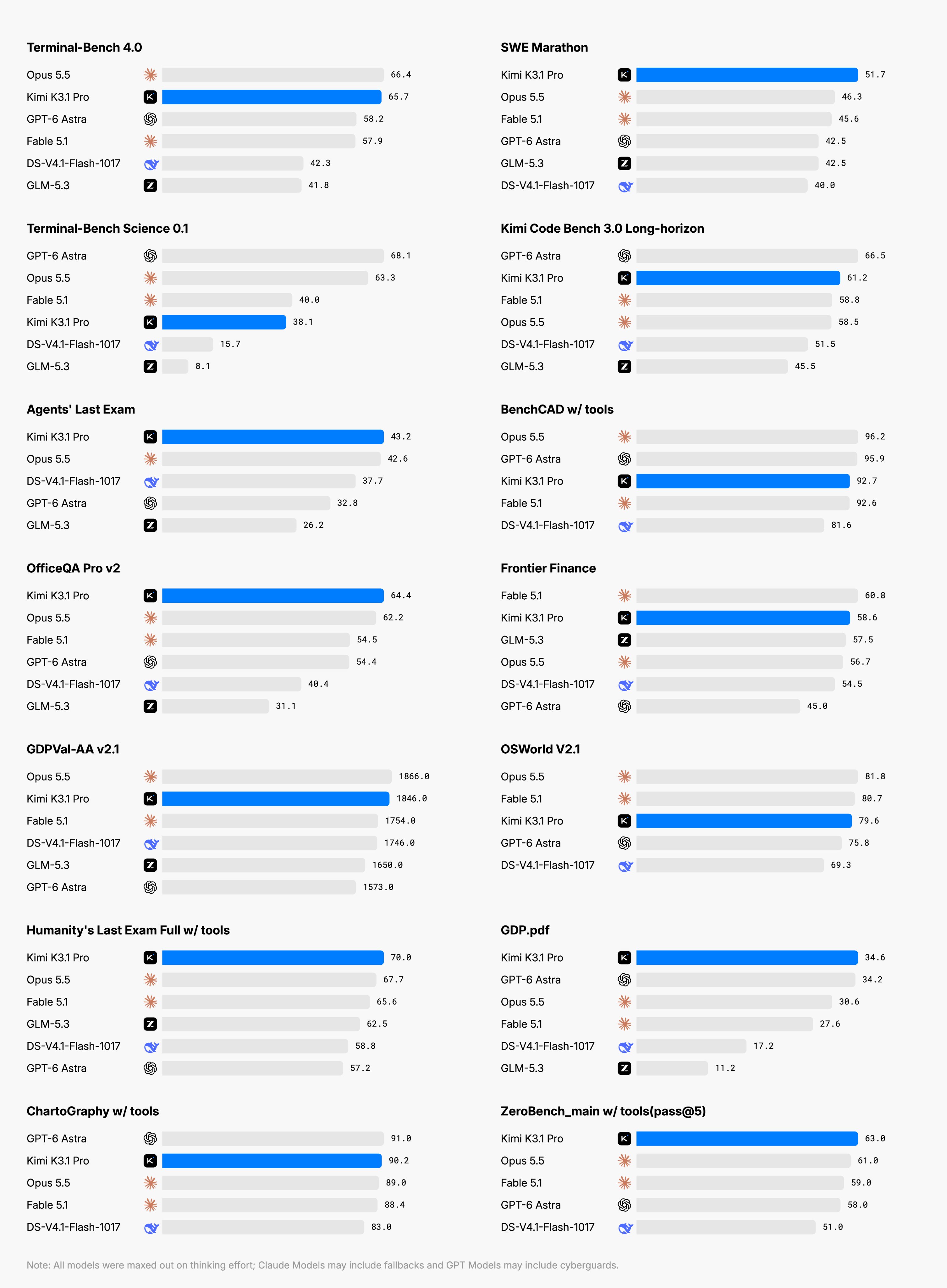
Selected results from Moonshot's chart, all models at maximum reasoning effort:
| Benchmark | Kimi K3.1 Pro | Claude Opus 5.5 | GPT-6 Astra | What it tests |
|---|---|---|---|---|
| Terminal-Bench 4.0 | 65.7 | 66.4 | 58.2 | Coding agents in a terminal |
| SWE Marathon | 51.7 | 46.3 | 42.5 | Long software-engineering tasks |
| Terminal-Bench Science | 38.1 | 63.3 | 68.1 | Scientific computing tasks |
| OSWorld V2.1 | 79.6 | 81.8 | 75.8 | Using a computer like a person |
| GDPVal-AA v2.1 | 1846 | 1866 | 1573 | Real knowledge-work deliverables |
| Humanity's Last Exam | 70.0 | 67.7 | 57.2 | Expert questions, with tools |
| OfficeQA Pro v2 | 64.4 | 62.2 | 54.4 | Analysis of real financial documents |
| BenchCAD | 92.7 | 96.2 | 95.9 | 3D reconstruction through CAD code |
The pattern: level with the best closed models on everyday coding and agent work, ahead on long tasks and some research tests, clearly behind on scientific computing.
For business people
- Near-frontier quality at a lower price. $2/$10 per million tokens, and cheaper than K3's $3/$15. For high-volume work (document analysis, research, drafting, coding agents), the cost per task can drop a lot against the top closed models.
- Open weights mean choice. By November it can run on your own servers or with any hosting provider, so data never has to go to Moonshot. That matters for regulated industries and for the EU.
- Where the data goes today. The hosted API and apps are run by Moonshot AI, a Chinese company. Moonshot offers Zero Data Retention to API customers, but many European and US companies will only use it self-hosted or through a Western provider. Check with legal before sending customer data.
- Good fits: financial modelling and research, long document analysis (1M tokens holds several 100 pages), coding agents, 3D and product design.
- Risks: the benchmarks are Moonshot's own, some internal. Test on your own tasks before you switch. The licence terms for commercial use aren't published yet.
For technical people
- Architecture: MoE, 2.8T total, 104B active per token, multimodal, 1M context. Post-trained from K3 with large-scale joint RL across 100s of domains, on a rebuilt RL stack (long-context inference, sandboxes, rollout scheduling, environment QA).
- API: models
kimi-k3.1-proandkimi-k3.1-pro-highspeedon platform.kimi.ai, also on OpenRouter (moonshotai/kimi-k3.1-pro, 1,048,576-token context). - Benchmark caveats: Kimi's coding scores were run with the Claude Code harness, at reasoning effort
max, temperature 1.0, top-p 0.95. Competitor numbers come from their own reports or leaderboards. Moonshot notes that Claude models may include fallbacks and GPT models cyber safeguards. - In Kimi Code: select it with
/model. - Self-hosting: 104B active parameters keeps inference cost per token moderate, but the full 2.8T weights need a multi-GPU server to load. Quantised versions and third-party hosts usually follow an open-weight release.
The cyber-safety choice
Moonshot published an unusual section on how it limited the model's hacking ability before releasing the weights.
- It found that cyber-related content in the training data and RL tasks steadily raised the model's ability to find and exploit vulnerabilities.
- For the open-weight release, it removed cyber-related data from both mid-training and RL, while keeping general coding tasks.
- On its internal exploit benchmark, xdev-bench-hard, the version without these measures solved 90.5% of tasks (pass@3). The released model solves 81.0%.
- Its stated rule: don't release open weights that push the absolute frontier of cyber capability, and keep it behind frontier closed models that have been public for at least 3 months. It argues that open models still help defenders audit their own code, legacy systems included.
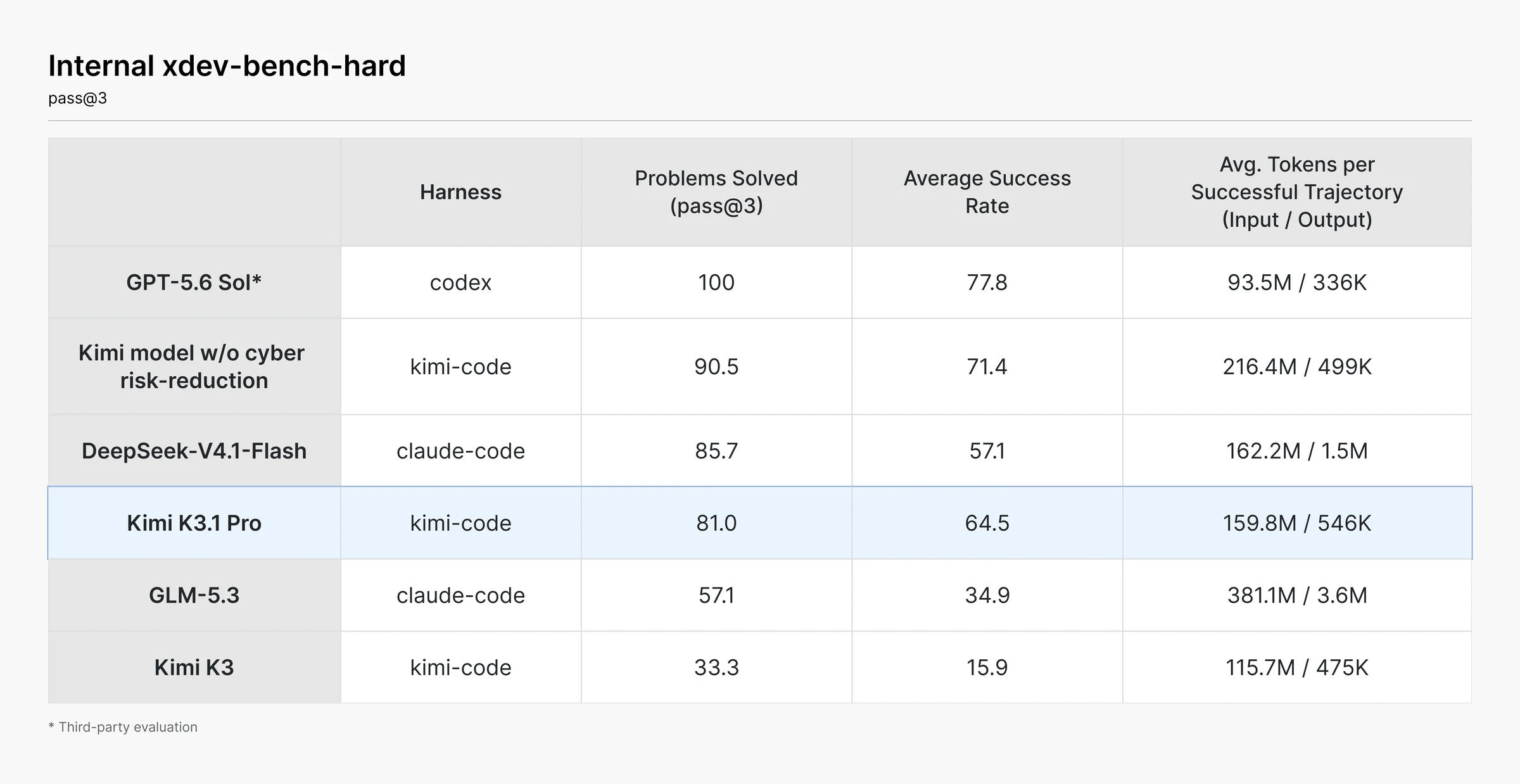
81% is still a capable exploit developer, and it improved over K3. The removal lowers the ceiling. It doesn't make the model harmless.
Verdict
Kimi K3.1 Pro is the strongest open-weight model so far, by Moonshot's numbers: close to Claude Opus 5.5 on the coding and agent work that matters most day to day, ahead on long tasks, and much cheaper per token. The open weights are the real news: by November, near-frontier quality can run on infrastructure you control. Until independent tests confirm the numbers and the licence is out, treat it as a strong candidate to test, not a drop-in replacement. For the Opus 5.5 side of the comparison, see Claude Opus Best Practices.
Further Reading