

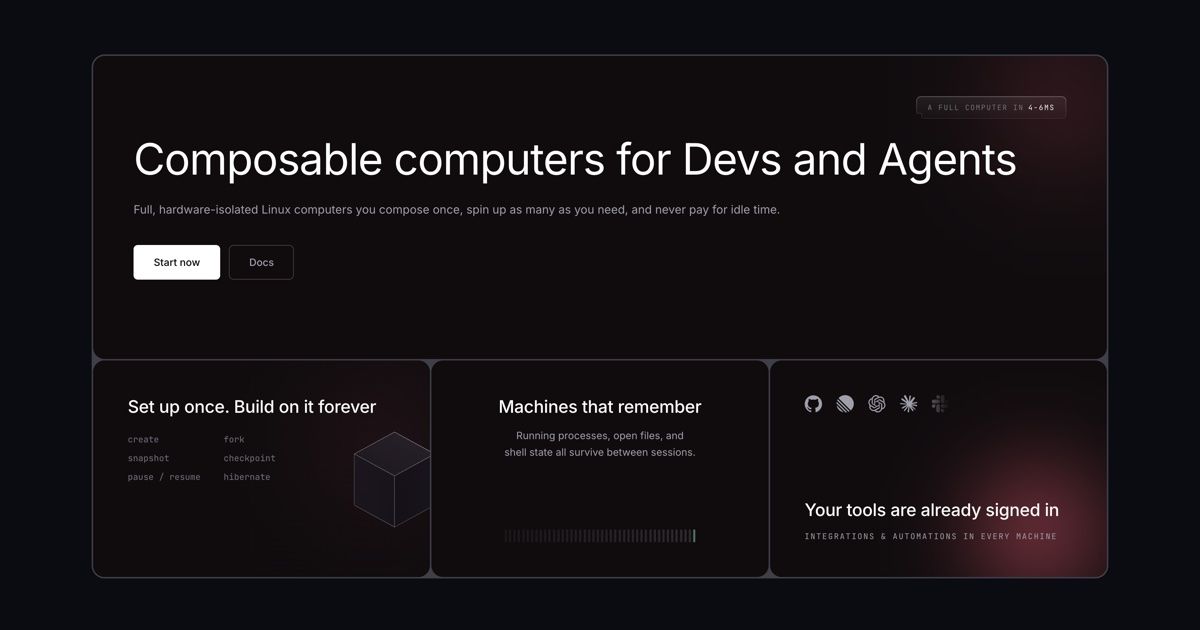
boxd rents you Linux computers in the cloud that start in a few milliseconds, keep their state between sessions, and cost almost nothing while they sleep. Each one is a real virtual machine with its own kernel, not a container.
The pitch is "composable computers": set up 1 machine the way you want it, then copy it as often as you need. A coding agent gets its own machine per task, a pull request gets its own preview machine, and you pay only while they run.
| Company | boxd, the Netherlands, founded in 2026 |
| Founders | Michiel Voortman, Laurentiu Ciobanu and Hidde Kehrer |
| Funding | $2M pre-seed in September 2026, led by BlueYard Capital, with Antler and others |
| Machine | 2 vCPU, 8 GiB RAM, 100 GB disk, Ubuntu 24.04 with root, systemd and Docker |
| Price | About €0.22 an hour while running, €30 of free credits to start |
| Access | CLI, SSH, Python and TypeScript SDKs, gRPC API, browser desktop |
What it does
- Instant start. A machine boots in under 10 ms, the site says. A suspended one wakes in under 1 ms, a hibernated one in about 85 ms.
- Persistence. Processes, open files and shell state survive when you disconnect. That's the main difference from throwaway sandboxes.
- Fork. Copy a running machine, memory and disk included, in under 200 ms. The copy uses almost no extra disk until it changes.
- Snapshots and checkpoints. Save a named state and start fresh machines from it, or roll 1 machine back in place. 10 checkpoints per machine.
- Sleep when idle. A machine with no network traffic for 4 hours hibernates to disk, where it costs disk storage only.
- On the internet by default. Every machine gets its own HTTPS domain,
name.boxd.sh, plus custom domains, port forwards and Tailscale. - Agents preinstalled. Claude Code, Codex and OpenCode come ready on every machine.
- Integrations and automations. Connect GitHub, Linear, Slack and others once, then run TypeScript scripts on schedules or events while the machine sleeps between runs.
For business people
The problem: AI coding agents need somewhere to run code. Your laptop is risky, because an agent can delete files or leak secrets. A classic cloud server is slow to start and costs money all night. Container sandboxes start fast but forget everything when they stop.
What boxd offers: a full computer per agent or per task, isolated at the hardware level, fast enough to create on demand, and cheap to keep around because idle machines hibernate.
Where it fits:
- Agent workspaces that stay alive for weeks and pick up where they left off.
- Parallel agents: fork 1 prepared machine 10 times and let 10 agents try 10 approaches.
- Preview environments: 1 machine per pull request, live at its own URL.
- Products with 1 machine per user, created through the SDK.
- Untrusted code, behind a VM boundary with egress control that decides what the machine can reach.
Costs: billing is per resource and per hour. The default machine costs about €0.22 an hour while it works, and near nothing in standby or hibernation. An account holds up to 50 machines, or 2 until you add a card.
The limits:
- A very young company. Founded in 2026, pre-seed stage, with no public customer numbers. The site lists engineers at Meta, Google and Tesla as users, which isn't the same as company contracts.
- 1 machine size by default. Bigger or smaller machines are on request.
- The speed figures are the maker's own.
For technical people
- Isolation: KVM microVMs on boxd's own virtualisation engine. The device model covers only CPU, RAM, storage and networking, with no emulated audio, webcam or USB. The founders say this shrinks the attack surface.
- Lifecycle: running, standby (frozen in host RAM) and hibernated (memory written to disk). Auto-suspend is off by default, and auto-hibernate starts after 4 hours without traffic.
- Disks: copy-on-write, so a fork shares its parent's blocks until it writes.
- APIs: Python SDK (sync and async), TypeScript SDK for Node, Bun and Deno, and a raw gRPC API with the
.protopublished. - Agent tooling: a
boxd-cliskill for your coding agent, and documented setups for Claude Managed Agents and the OpenAI Agents API, where the vendor runs the agent loop and every tool call runs in your boxd machine. - Self-hosting: available, with
boxd-ctlto set quotas.
From the quickstart:
curl -fsSL https://boxd.sh/downloads/install.sh | sh
boxd auth login
boxd new myapp
ssh myapp.boxd

boxd machine fork myapp myapp-test                    # live copy
boxd snapshots save myapp my-workspace                # reusable state
boxd machine new fresh --from-snapshot my-workspace
boxd machine checkpoint save myapp before-changes     # roll back later
The same in Python:
from boxd import Boxd

boxd = Boxd()  # reads BOXD_API_KEY
boxd.machines.exec(machine.id, "sudo systemctl start nginx")
boxd.snapshots.create(machine.id, "my-workspace")
boxd.machines.create("fresh", from_snapshot="my-workspace")
How it compares
| Service | Approach |
|---|---|
| E2B | Sandboxes for AI agents, built for short-lived code runs |
| Daytona | Sandboxes and dev environments for AI-generated code |
| boxd | Persistent full VMs, live fork, hibernation, per-machine domains |
Value
My agents run on my own Mac Studio today. That's fast and free, but every agent shares 1 machine, 1 disk and my secrets. boxd is the kind of service that would give each long job its own computer: fork a prepared NicAI machine, let Claude Code work on it overnight, and let it hibernate when it's done.
The European base matters to me too: a Dutch company billing in euros. At €0.22 an hour, a nightly 2-hour agent run costs less than €15 a month. The €30 credit is enough to test that before committing.
Further Reading